Storing Cannabis Seeds Correctly
Storing Cannabis Seeds Correctly: Best Methods for Long-Term Viability
Updated: February 2026 | How to Store Cannabis Seeds: Avoid Humidity & Condensation | Cannapot
Author: Cannapot Grow Team | Reading time: approximately eighteen minutes
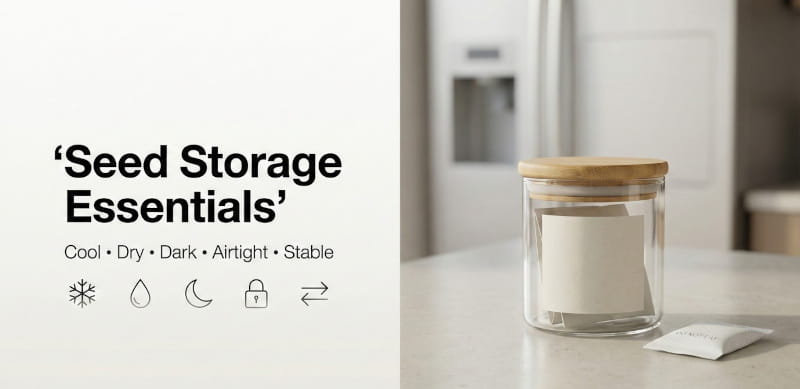
The Most Important Things At A Glance
✓ Cannabis seeds stay viable longest when they are stored cool, dry, dark, airtight and under stable conditions.
✓ Humidity and temperature fluctuations damage seeds far faster than age alone and are the main causes of storage failure.
✓ An airtight jar with silica gel inside a refrigerator is one of the safest and simplest long-term storage methods.
✓ Cold containers should never be opened immediately, because condensation can damage seeds and increase mold risk.
The short version: Keep seeds cool, dark, dry, airtight, and stable. Most “bad storage” problems come from humidity and temperature swings, not age by itself.
-
Best everyday setup: airtight jar + small desiccant + refrigerator (stable zone, not the door).
-
Biggest mistake: opening a cold container while it is still cold (condensation risk).
-
Simple rule: less heat + less moisture = longer viability.
Table of Contents
-
Why seed storage matters
-
The five enemies of stored seeds
-
Practical storage targets (temperature and humidity)
-
Best storage setups by time horizon
-
Step-by-step: the refrigerator method
-
Step-by-step: the freezer method (long-term)
-
Labeling and organization that prevents mistakes
-
Common mistakes (and how to avoid them)
-
How to tell if stored seeds are still viable
-
Cannapot storage standard (how we store seeds)
-
Related Cannapot reads and seed categories
-
FAQ
Why seed storage matters
Cannabis seeds are living biological material in a dormant state. They are built to survive a “pause” between seasons, but they are not indestructible. Over time, stored seeds slowly lose vigor. When storage conditions are poor, that loss speeds up and can show up as slower germination, uneven sprouting, or seeds that never crack at all.
The goal of proper storage is simple: slow down aging. You do that by controlling the environment around the seed so it does not absorb moisture, does not heat up, and does not experience repeated swings that stress the seed over and over.
The five enemies of stored seeds
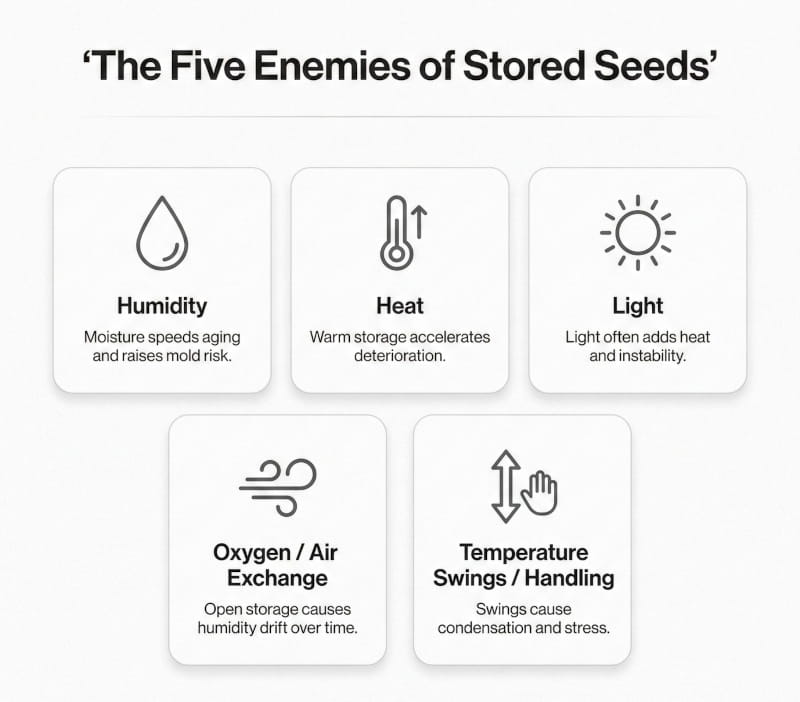
If you remember only one section, remember this list. Almost every storage failure is one or more of these:
1. Moisture and humidity
Humidity is the biggest problem in normal homes. Seeds naturally exchange moisture with the air. If the surrounding air is humid, seeds slowly rehydrate, which increases the risk of deterioration and mold. If humidity fluctuates a lot, the seed repeatedly absorbs and releases moisture, which is also stressful.
2. Heat
Heat speeds up the chemical reactions that cause seeds to age. Even a warm cupboard above a fridge can be worse than people think. Warm plus humid is the fastest path to losing viability.
3. Light
Light is less destructive than heat and humidity, but it still matters. Light often comes with warmth, and it encourages inconsistent microclimates in containers. Dark storage is the safer default.
4. Oxygen exposure
Seeds stored in fully open packaging are exposed to oxygen and to changing humidity. Airtight containers reduce both issues at once. For long-term storage, airtight is not optional.
5. Temperature swings and handling
Stability matters as much as “cold.” A refrigerator door that is opened all day is not as stable as a drawer or the back of a shelf. Repeated temperature changes also raise condensation risk when you open the container.
Practical storage targets (temperature and humidity)
A simple guideline you can actually use
Seed storage professionals often summarize good storage with rules like “cool and dry” and the well-known “Hundred Rule” (storage temperature in °F + relative humidity in % should stay under 100). You do not need to calculate anything perfectly, but the logic is useful:
-
Lower temperature helps.
-
Lower humidity helps.
-
Stable conditions help.
Temperature: what “cool” means in a home setup
-
Room storage (short-term): a cool interior cupboard is acceptable if it is truly stable and dry.
-
Refrigerator (medium to long-term): a typical refrigerator zone sits around 4–8°C, which is ideal for many collectors because it is cold enough to slow aging without freezing.
-
Freezer (very long-term): can work if seeds are very dry and sealed airtight. The freezer method is less forgiving if moisture is trapped inside the container.
Humidity: what “dry” means without special equipment
In practice, most people control humidity by storing seeds airtight and adding a small desiccant (such as silica gel) to prevent moisture buildup. You do not need to chase perfect numbers. The goal is simply: avoid moisture exposure and avoid moisture swings.
Practical target: “Dry enough that the container never feels damp, and stable enough that seeds are not repeatedly warming and cooling.”
Best storage setups by time horizon
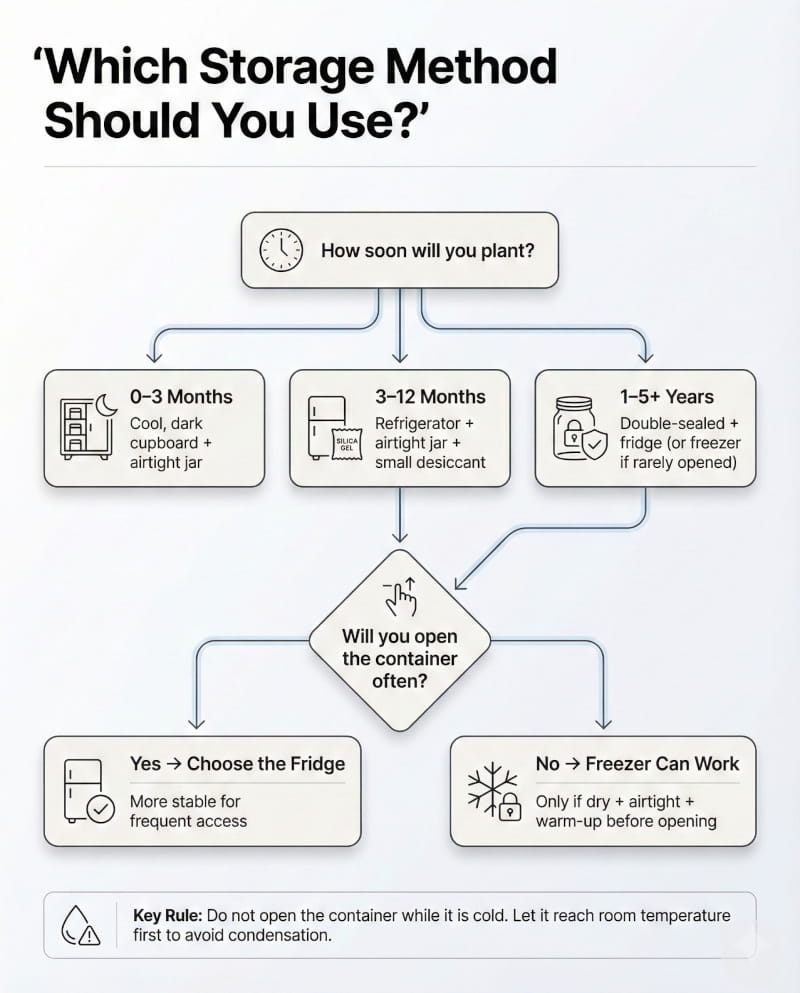
|
How long you want to store |
Best setup |
Why it works |
|
Up to ~3 months |
Original pack inside an opaque airtight jar in a cool, dark cupboard |
Simple, low handling, avoids light and most humidity |
|
3–12 months |
Airtight jar + small desiccant + refrigerator (stable shelf or drawer) |
Cool and stable slows aging; desiccant buffers humidity |
|
1–5+ years |
Double-sealed (bag + jar) with desiccant; fridge or freezer depending on stability |
Maximum protection from oxygen and moisture swings |
What container should you use?
-
Best: a small glass jar with a tight lid (low odor transfer, stable seal).
-
Also good: a quality mylar bag inside a jar (double barrier).
-
Avoid: thin plastic baggies and anything that does not fully seal.
Do you need desiccant?
For refrigerator or long-term storage, yes. A small silica gel pack is a simple way to keep the microclimate inside the container dry. If you use silica gel, keep it separate from direct seed contact (for example, in its own pouch or taped to the inside of the lid).
Step-by-step: the refrigerator method
This is the most reliable “set it and forget it” method for many collectors.
What you need
-
Airtight glass jar (small to medium)
-
Your seed packs (leave seeds in their breeder packaging if possible)
-
One or two small silica gel packs (food-safe if possible)
-
Optional: humidity indicator card (useful, not required)
-
A label (strain, breeder, date)
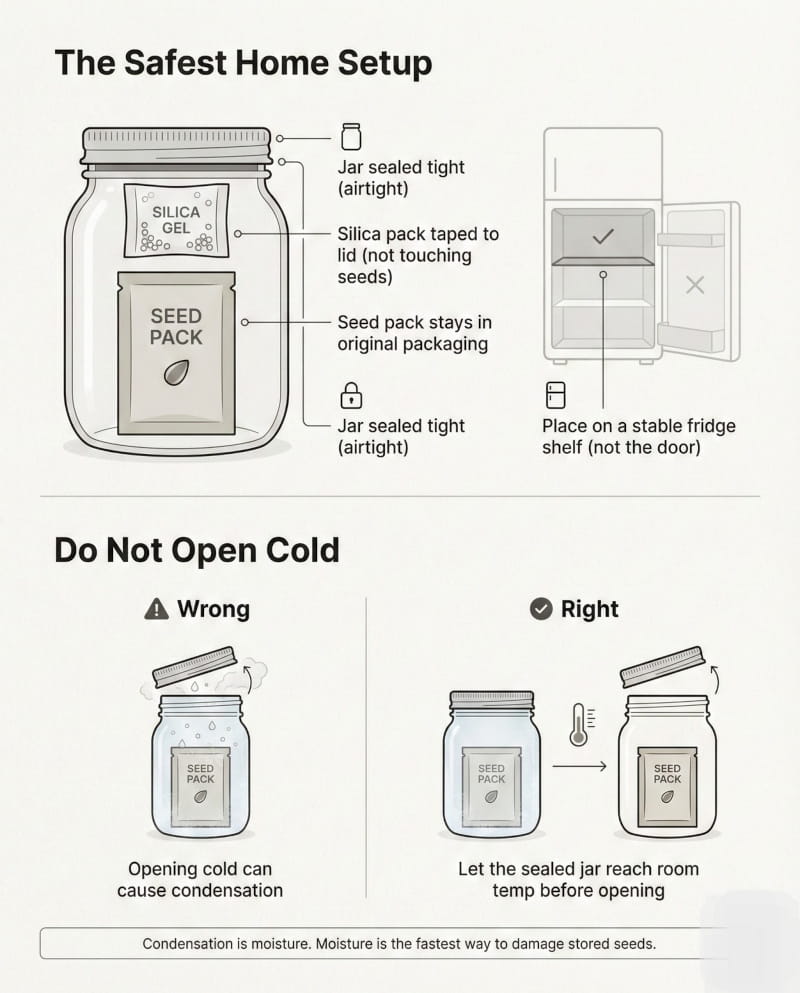
Steps
-
Keep seeds in their original pack (breeder pack, vial, or labeled sleeve) to preserve identity.
-
Add a silica gel pack to the jar. Do not place seeds loose against silica gel.
-
Seal the jar airtight. Tighten fully.
-
Place the jar in a stable refrigerator zone (a drawer or a back shelf is usually more stable than the door).
-
Avoid frequent opening. Repeated openings create temperature and humidity swings.
-
When you need seeds: take the jar out and let it sit closed at room temperature for at least 30–60 minutes.
-
Open only after warm-up. This helps prevent condensation forming on cold seeds.
-
Remove what you need, reseal, and return the jar to the fridge.
Condensation warning: Condensation is not “a small issue.” Moisture on seeds can reduce viability and increase mold risk. Warming the sealed container before opening is one of the highest-impact habits you can adopt.
Step-by-step: the freezer method (long-term)
Freezer storage can be effective for very long timelines, but only if you do it correctly. The freezer is less forgiving than the refrigerator if moisture is present.
When freezer storage makes sense
-
You are storing seeds for multiple years.
-
You can keep them sealed most of the time with minimal handling.
-
You can ensure a dry, airtight environment inside the container.
Steps
-
Dry and seal correctly: keep seeds in original packaging, then place that pack inside a sealed mylar bag or secondary pouch.
-
Add desiccant in the outer layer (not loose with seeds).
-
Double-seal: put the sealed bag inside an airtight jar.
-
Freeze once, handle rarely. Avoid moving in and out of the freezer regularly.
-
Warm up before opening: when you need seeds, remove the sealed jar and let it reach room temperature before opening (often a few hours is safer than minutes).
Important: If you know you will open the container often, refrigerator storage is usually the smarter choice because it reduces extreme temperature transitions and repeated condensation risk.
Labeling and organization that prevents mistakes
Storage is not only biology. It is also logistics. Many “lost seeds” happen because packs are not labeled or dates are forgotten.
A labeling template that works
-
Strain name: (exact spelling)
-
Breeder or seed bank: (brand)
-
Seed type: feminized / autoflower / regular / CBD-oriented
-
Purchase date: month + year
-
Storage method: cupboard / fridge / freezer
If you keep multiple jars, consider one jar per “lane” (for example, one for feminized photoperiod seeds and one for autoflowers). Fewer mixes reduces errors when you pull seeds quickly.
Common mistakes (and how to avoid them)
Mistake 1: storing seeds in a warm place “because it is dark”
A dark drawer near heat sources (routers, appliances, heaters) can still be a bad environment. Cool matters. Stable matters.
Mistake 2: using the refrigerator door
The door warms up and cools down the most. A back shelf or drawer is usually more stable.
Mistake 3: opening a cold container
This is how condensation happens. Always warm the sealed container before opening.
Mistake 4: loose seeds with no identity
Even if you think you will remember, you will not remember. Keep seeds in labeled packs or clearly labeled vials.
Mistake 5: chasing “perfect hacks” instead of stability
The strongest storage strategy is boring: airtight, cool, dry, dark, stable. Fancy hacks matter far less than consistency.
How to tell if stored seeds are still viable
No visual check is perfect, but there are signals that often correlate with viability:
What healthy seeds often look like
-
Firm shell that does not crush easily
-
Even coloring (tan to darker patterns are normal)
-
No obvious cracks, mold, or “spongy” feel
Common myths
-
The float test: floating does not automatically mean a seed is dead. Some viable seeds float at first due to trapped air.
-
“Old means useless”: age matters, but storage conditions matter more. A well-stored seed can outperform a newer seed that was stored poorly.
If you are testing older seeds, consider starting with a small sample rather than committing your entire pack at once.
Cannapot storage standard (how we store seeds)
Seed freshness is mostly storage discipline. In the Cannapot shop, seeds are stored in professional refrigeration units at around 4°C and protected from light and humidity to help maintain vitality and freshness. We apply the same logic we recommend to collectors: keep seeds cool, dark, dry, and airtight.
Related Canna Wiki articles