Hybrid Cannabis Strains: Genetics & Differences
What are hybrid cannabis strains and how is their genetics created?
Updated: August 2026 | What are hybrid cannabis strains, how are such crosses created, and what do terms such as Indica-dominant, Sativa-dominant or ratios such as 70/30 and 50/50 actually say about their genetics?
Author: Cannapot Grow Team | Reading time: approximately 24 minutes
The Most Important Points at a Glance
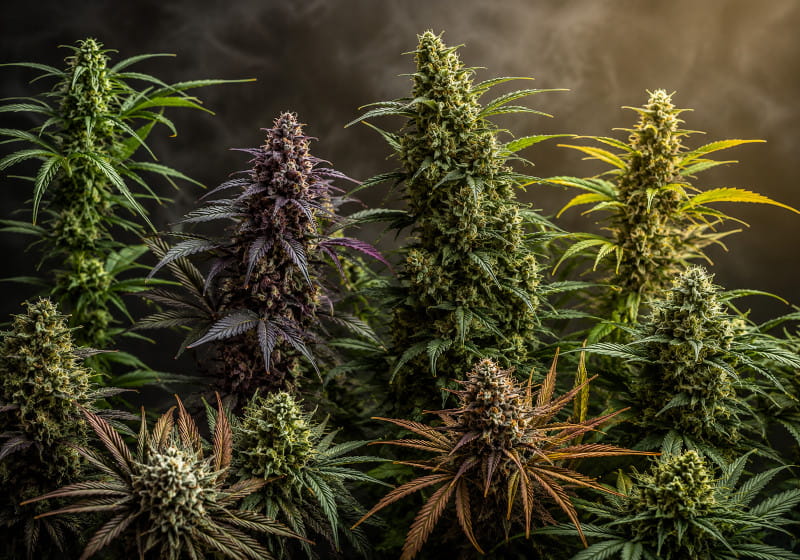
✓ Hybrid cannabis strains are created by crossing different cannabis lines. Which traits the offspring display depends on the parents used, their genetic composition, and further selection.
✓ Terms such as Indica-dominant, Sativa-dominant or 50/50 are mainly used as a rough classification of hybrid genetics. However, they can describe the actual genetic composition and characteristics of a plant only to a limited extent.
✓ Ratios such as 70 % Indica and 30 % Sativa are not a mathematical division of plant traits. Growth, aroma or effects therefore do not automatically occur in the stated ratio.
✓ Even plants from the same cross can develop different traits. Factors such as genotype, phenotype, the genetic stability of the parental lines, and the respective breeding generation all play a role.
✓ The term “hybrid” alone does not reliably indicate effects, flowering time, plant height or potency. A strain’s specific lineage and its cannabinoid and terpene profile are more informative.
Anyone browsing strain descriptions today will encounter the term “hybrid” almost everywhere. Some genetics are described as Indica-dominant, others as Sativa-dominant, and still others as balanced 50/50 hybrids. Then there are ratios such as 60/40 or 70/30. At first glance, this seems very precise – genetically, however, the matter is considerably more complex.
Hybrid cannabis is created by crossing different genetic lines. Breeders combine selected parent plants to bring certain traits together in a new way – such as plant structure, flowering time, aroma, cannabinoid profile, resin production, resistance or yield. However, which characteristics actually appear in the offspring cannot be determined from an Indica/Sativa ratio alone.
This Canna Wiki guide therefore goes beyond the simplified formula “Indica + Sativa = hybrid.” You will learn how cannabis hybrids are created, what role parental lines, genotype and phenotype play, how F1 and F2 differ, how ratios such as 70/30 or 50/50 should be interpreted, and why the traditional terms Indica and Sativa are viewed more critically today.
What does hybrid mean in cannabis?
A hybrid cannabis strain is a breeding line whose lineage is based on the crossing of different cannabis lines. Two relatively clearly defined parental lines can be combined with each other. In modern strains, however, existing hybrids are often crossed again, so the family tree may contain multiple generations and different genetic lines.
The term “hybrid” therefore primarily describes breeding origin and, by itself, does not provide a reliable indication of potency or effects. Hybrids can grow compact or tall, flower early or late, and develop very different cannabinoid and terpene profiles. Their aromas can likewise range from earthy and spicy to fruity, floral, creamy or gassy notes.
Anyone who wants to learn the basics of seeds, germination, inheritance and the different types of cannabis seeds will find a dedicated basics section on these topics. An overview of the cannabis seeds available in the shop can be found in the corresponding category. This article deliberately focuses on the genetic fundamentals and classification of hybrid cannabis strains.
How are cannabis hybrids created?
Cannabis hybrids are created when breeders cross genetically different lines and deliberately select plants from the offspring for further breeding. The aim is not simply to combine two strain names, but to bring together certain characteristics of the parents in a new line and select for them over further generations.
Crossing different cannabis lines
In a classic sexual cross, one parent plant provides the pollen while the other produces seeds after pollination. Cannabis is predominantly dioecious by nature, meaning male and female plants occur separately. Anyone who wants to explore the biological basics in more detail can find them in the guide on identifying male and female cannabis plants. For traditional breeding and preservation work, regular seeds also play an important role because they can produce both male and female plants.
Parent plants and selection
The selected parents determine which genetic variants can be passed on to the next generation. Breeders therefore do not rely solely on familiar names such as “Kush,” “Haze” or “Cookies,” but on specific plant traits – for example growth habit, ripening time, aroma, resin production, cannabinoid profile or vitality. Careful selection of suitable parents is therefore a fundamental basis of the actual cross.
Genotype and phenotype
The genotype refers, in simplified terms, to a plant’s genetic makeup. The phenotype describes its actually expressed and observable traits. These result from the interaction between genetic predisposition and environmental conditions. This is why even closely related plants can differ in height, branching, aroma, flowering time or other characteristics.
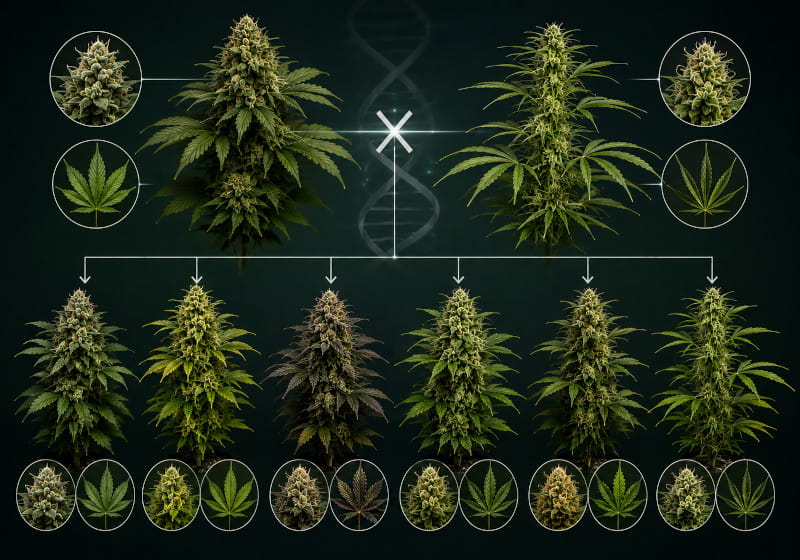
Siblings from the same hybrid cross can therefore differ considerably from one another. During sexual reproduction, genetic variants from both parents are recombined in the offspring. How uniform a generation turns out depends, among other things, on the genetic composition and stability of the parental lines and on the traits being considered. How such differences within a population are systematically compared and promising plants selected as keepers is explained in detail in our Canna Wiki guide to cannabis pheno hunting. Through targeted selection over further generations, breeders can increasingly stabilize certain characteristics.
What do F1, F2 and further generations mean in cannabis?
F1 and F2 refer to successive generations of a cross – they are not quality grades. The letters and numbers help describe the position of a generation within a breeding project and therefore make its lineage easier to trace.
|
Designation |
Simplified explanation |
Important for classification |
|
P |
Parent or starting generation |
The genetic composition of the parents influences the subsequent generations. |
|
F1 |
First filial generation from the cross of two parental lines |
How uniform the offspring are depends largely on the genetic composition of the parents. |
|
F2 |
Second filial generation produced from F1 individuals |
Genetic segregation can make differences between the offspring more apparent. |
|
F3, F4 etc. |
Further successive filial generations |
Through targeted selection and further mating, certain traits can be increasingly stabilized. |
|
BX |
Backcross |
Offspring are crossed back to a parental line or a genetically close line in order to preserve or reinforce specific traits. |
The designation F1 is not always used in exactly the same way for cannabis strains. In principle, F1 stands for the first generation resulting from the cross of two parental lines. How similar the plants in this generation are depends greatly on the parents used. If the parental lines have already been stabilized over a longer period, the offspring can also be more uniform. With genetically more diverse parents, however, considerably greater differences may occur.
A detailed explanation of the various terms can be found in the separate article on F1, F2, BX, S1 and IBL in cannabis. For hybrid cannabis strains, a simple distinction is sufficient here: F1 refers to the first generation of a cross, F2 to the following generation. In subsequent generations, breeders can deliberately select plants and stabilize certain characteristics step by step.
Why are cannabis strains crossed with each other?
Cannabis breeders cross different lines to combine desired traits. These may include growth, flowering time, aroma, cannabinoid profile, resin production, yield or resistance. Which traits ultimately become established becomes apparent in the offspring and through further selection over several generations.
-
Plant structure: more compact or more strongly branched growth, altered internodes and more controllable stretch.
-
Flowering time: earlier or more uniform maturity can be an important selection goal.
-
Aroma and terpenes: Parents are combined to pass on specific aromas and flavors or to create new profiles.
-
Cannabinoid profile: Breeding can be directed toward THC, CBD or other cannabinoid ratios. One example is deliberately selected CBD-rich genetics.
-
Resistance: Certain lines may carry traits that are advantageous under defined environmental conditions.
-
Yield and flower structure: These traits can also be selected for, but they are complex and influenced by multiple genetic and external factors.
-
New trait combinations: The real appeal of hybridization often lies in combining traits that occur separately in the parents.
Autoflowering is also a trait that has been introduced into numerous modern cannabis strains through targeted crossing. Early Lowryder genetics played an important role in the spread of automatically flowering strains. Anyone specifically looking for such genetics can find them under Autoflower seeds. In hybrid cannabis strains, however, autoflowering is only one of many traits that can be combined through breeding.
What types of hybrid cannabis are there?
Hybrid cannabis strains are often classified according to whether their genetics are more strongly influenced by Indica or Sativa lines. Many strains are therefore described as Indica-dominant, Sativa-dominant or 50/50. These labels provide practical guidance but cannot fully describe the actual characteristics of a plant.
Indica-dominant hybrids
Hybrids are described as Indica-dominant when the Indica share predominates in the stated lineage. Traits such as more compact growth, stronger branching or broader leaves are often associated with this classification. How strongly these characteristics appear, however, depends on the specific genetics and individual phenotype. You can learn more about origins and typical traits in the guide to Indica cannabis.
Sativa-dominant hybrids
In Sativa-dominant hybrids, the Sativa share accordingly predominates in the stated lineage. This is often associated with taller growth, longer internodes or greater stretch during flowering. These characteristics can also vary depending on the strain and phenotype. Further background can be found in the article on Sativa cannabis.
Balanced or 50/50 hybrids
50/50 hybrids are strains whose lineage is stated as equal parts Indica and Sativa. However, this does not mean that every individual characteristic must also be expressed in an exact 50-to-50 ratio. Growth, flowering time, aroma and other traits are influenced by numerous genetic factors.
|
Classification |
Usual meaning |
Typical classification |
|
Indica-dominant |
Predominant Indica share in the stated lineage |
Often more compact growth and broader leaves |
|
Sativa-dominant |
Predominant Sativa share in the stated lineage |
Often taller growth and greater stretch |
|
50/50 hybrid |
Indica and Sativa shares are stated in equal proportions |
Characteristics may show traits from both sides |
What do 70/30, 60/40 or 50/50 mean in hybrid cannabis strains?
Ratios such as 70 % Indica / 30 % Sativa or 50/50 are mainly used to provide a rough classification of a hybrid cannabis strain’s lineage. However, they do not mean that all genes or characteristics of a plant are distributed in exactly this ratio.
This is particularly clear with modern hybrids. Many of their parents are themselves already crosses of different cannabis lines. When such strains are crossed with one another over several generations, an increasingly complex family tree develops. A simple ratio such as 70/30 can therefore represent this entire genetic history only in simplified form.
Genetic studies also show that modern strains cannot always be clearly separated from one another using the labels Indica and Sativa. A 2021 study published in Nature Plants examined more than 100 cannabis samples and found no clear genetic separation between the groups labeled Indica and Sativa. Differences were observed, among other things, in certain terpenes. This underlines why ratios such as 70/30 or 60/40 should be understood more as guidance than as exact genetic measurements.
Hybrid vs. Indica vs. Sativa – what are the differences?
Indica, Sativa and hybrid are often used as three different groups of cannabis strains. This classification can be useful as an initial guide. In practice, however, the boundaries are fluid because many modern strains originated from crosses between different lines.
|
Designation |
What it usually means |
Typical classification |
|
Indica |
Cannabis lines traditionally associated with the Indica side |
Often more compact growth and broader leaves |
|
Sativa |
Cannabis lines traditionally associated with the Sativa side |
Often taller growth, narrower leaves and greater stretch |
|
Hybrid |
Cross of different cannabis lines |
Can combine characteristics of different parental lines |
A large study of nearly 90,000 cannabis samples from the United States also shows that this classification is not always clear-cut. It found that the labels Indica, hybrid and Sativa only partially reflect the actual differences in cannabinoid and terpene profiles. Anyone wishing to assess a particular strain more precisely should therefore consider its lineage and cannabinoid and terpene profile in addition to its classification as Indica, Sativa or hybrid.
What characteristics can hybrid plants have?
Hybrid cannabis plants can have very different characteristics because these depend on the particular parental lines used. Depending on the cross, plant height, branching, flowering time, aroma, flower structure, resin production or cannabinoid profile can differ considerably. This diversity is one of the reasons hybrids play such a major role in modern cannabis breeding.
-
Growth: from compact and bushy to tall with strong stretch.
-
Branching: some lines develop strong lateral branches, while others grow more strongly apically.
-
Flowering time: can be short, medium or long and cannot be inferred from “hybrid” alone.
-
Flower structure: compact to airier flowers are possible depending on the genetic background.
-
Aroma: Terpene profiles can range from earthy, resinous and spicy to fruity, floral, citrusy, creamy or gassy.
-
Cannabinoids: Hybrids can be selected for THC-dominant, CBD-rich or other chemical profiles.
Whether a hybrid cannabis strain is suitable for certain climatic conditions depends on its specific genetics. For outdoor cultivation, characteristics such as flowering or ripening time, resistance and preferred climatic conditions are therefore especially important. You can find a suitable selection at Cannapot under outdoor cannabis seeds.
Do hybrid cannabis strains have a specific effect?
No. The term “hybrid” alone does not indicate what effect a cannabis strain has. The familiar classification “Indica is relaxing” and “Sativa is stimulating” is also too simplistic to reliably describe the effects of a particular strain.
The cannabinoid and terpene profile, their respective concentrations, the amount consumed and individual sensitivity play a much greater role. In addition, plants of the same strain can also differ in their composition. The actual effects therefore cannot be inferred from the terms hybrid, Indica or Sativa alone.
Scientific studies also show that the Indica/Sativa classification only partially reflects the genetic and chemical differences among modern strains. Anyone wishing to assess a hybrid cannabis strain more precisely should therefore pay particular attention to its specific genetics and information on cannabinoids and terpenes.
Are modern cannabis strains predominantly hybrids?
Many modern cannabis strains are hybrids or already contain several hybrid lines in their family tree. Over decades, breeders have combined genetics from different regions and strain families. Today, for example, Afghani, Kush, Haze or Skunk lines can be found in the lineages of numerous well-known strains.
As a result of this long breeding history, many lines have been crossed with one another repeatedly. Modern cannabis strains can therefore often no longer be clearly assigned to a single original group. Genetic studies also confirm that many present-day strains have highly intermixed ancestries.
At the beginning of this development were, among other things, regional cannabis populations and traditional strains that were later used as starting material for new crosses. You can learn more about these more original genetics in our articles on cannabis landraces and heirloom cannabis.
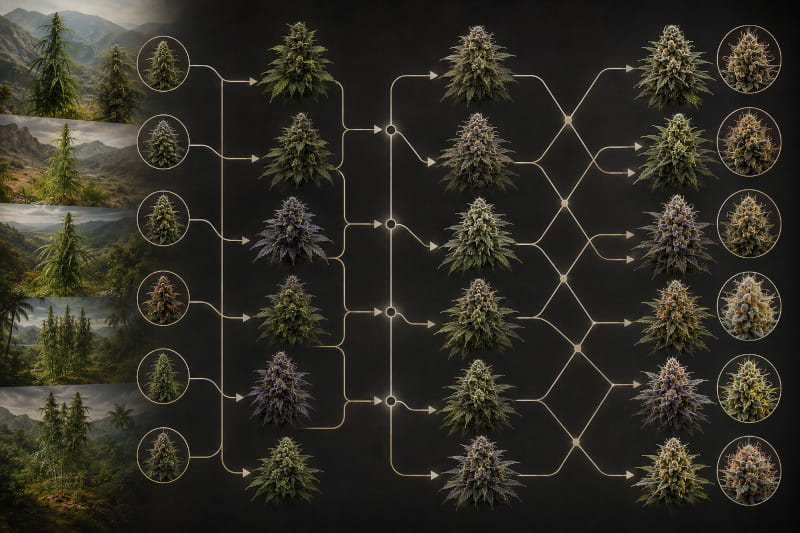
In simple terms: new strains were created from regional and traditional cannabis lines through targeted crosses. These were later combined with other genetics and themselves became parents of new crosses. Step by step, this is how the complex family trees of many modern hybrid cannabis strains developed.
What is a polyhybrid in cannabis?
A polyhybrid is created when parental lines that are already hybrids are crossed with each other again. This brings together genetics whose family trees already consist of several earlier crosses.
A simple example: A × B produces Hybrid 1 and C × D produces Hybrid 2. If Hybrid 1 and Hybrid 2 are then crossed with each other, the new polyhybrid combines genetics from all four original starting lines. In modern cannabis strains, such family trees can become considerably more complex over many generations.
This allows characteristics of different lines to be recombined again and again. At the same time, the offspring may differ more strongly from one another if the parents used already pass on many different traits. Especially with such polyhybrids, a simple ratio such as 60 % Indica / 40 % Sativa can only roughly represent the full genetic background of a strain.
Well-known hybrid cannabis strains as examples
Well-known hybrid cannabis strains range from classic genetics such as Skunk #1 and Black Widow to modern hybrids such as Jealousy and Frozen Gelato. The following examples show their different genetic origins, known parental lines and their importance in the development of modern cannabis hybrids.
Skunk #1
Skunk #1 is one of the most influential classic cannabis hybrids. Its genetics became the basis for numerous later crosses and can still be found in the family trees of many strains today. Skunk #1 is therefore a good example of how an early hybrid could develop into an important breeding line over time.
Black Widow
Black Widow is also one of the great hybrid classics and became internationally known in the 1990s. It too was later incorporated into numerous further crosses. There are differing accounts of its exact original lineage, which is why its historical family tree can no longer be reconstructed unambiguously in every detail.
Blue Dream
Blue Dream is usually described as a Sativa-dominant hybrid. The strain clearly illustrates what this designation means: Sativa-dominant is not the same as a pure Sativa, but describes the predominant orientation within hybrid genetics.
OG Kush
OG Kush is one of the most influential genetics in modern US cannabis breeding. It has been used as a parental line for numerous later strains and appears directly or indirectly in many family trees. Through further crosses, an entire range of new strain families emerged from a well-known hybrid.
Girl Scout Cookies / GSC
Girl Scout Cookies, now often abbreviated to GSC, itself became the starting point for numerous modern crosses. Cookies genetics can now be found in many strain families and has repeatedly been combined with other well-known lines. GSC therefore exemplifies the development from a successful hybrid into a widely used parental line.
Platinum Valley
Platinum Valley was created by crossing SFV OG and Platinum. Both parents already have an extensive genetic history of their own, making Platinum Valley a good example of modern hybrid breeding. The strain shows how established cannabis lines are combined to create new hybrids with an increasingly branched family tree.
Bruce Banner #3
Bruce Banner #3 was created from OG Kush and Strawberry Diesel. This brings together two well-known genetic lines whose characteristics were combined in a new cross. The strain is also a good example of how different phenotypes can emerge from a cross and certain plants can then be selected for further breeding.
Jealousy
Jealousy was created from Sherbert Bx1 and Gelato 41. Since both parents already have an extensive breeding history of their own, Jealousy is a typical example of modern polyhybrid genetics. Here, original cannabis lines are not crossed directly; instead, hybrids developed over several generations are combined.
Green Gelato
Green Gelato was created by crossing Sunset Sherbet and Thin Mint Girl Scout Cookies. Since both parents themselves already resulted from earlier crosses, Green Gelato is a clear example of modern hybrid breeding. The strain shows how established cannabis lines are recombined to create hybrids with an increasingly branched genetic lineage.
Toad Venom
Toad Venom also represents the newer generation of modern cannabis hybrids. Strains like these show how far today’s breeding has moved away from the simple idea of “Indica × Sativa.” A single strain name can now conceal a family tree containing numerous lines that had already been crossed previously.
Frozen Gelato
Frozen Gelato by In House Genetics was created by crossing Gelato 45 and PlatinumZ. Both parents already have extensive family trees made up of different hybrid lines. Frozen Gelato is therefore a good example of how modern breeders recombine established hybrids to develop new genetics.
Sour Diesel
Sour Diesel is one of the best-known US cannabis strains and is usually classified as a Sativa-dominant hybrid. However, there are differing accounts of its exact origin and lineage. This is not unusual for older strains, as their breeding history was not always documented as extensively as that of many modern crosses.
Why are parental lines so important in hybrid cannabis?
The parental lines provide important clues about which genetic characteristics are present in a hybrid cannabis strain. They show which strains or breeding families a cross originated from and which traits can be passed on to the offspring. The term “hybrid” alone reveals very little about this.
It is also worth looking at the breeding history. Is it the first generation of a cross, a backcross, a line developed over several generations or a polyhybrid? Two strains can, for example, both be described as 70/30 Indica-dominant and still differ considerably in growth, flowering time, aroma, and cannabinoid and terpene profile.
For a more precise classification, several pieces of information should therefore be considered together: parental lines, generation, typical phenotypes, flowering time, growth, cannabinoids and terpenes. The more precisely a breeder documents the origin and characteristics of a strain, the easier it is to understand what lies behind its hybrid genetics.
Common misconceptions about hybrid cannabis
-
“50/50 means the effects are split exactly 50/50.”
No. 50/50 merely describes the usual classification of the lineage. It does not imply correspondingly divided effects. -
“Indica-dominant automatically means relaxing.”
No. No specific effect can be reliably inferred from the term Indica-dominant. Cannabinoids, terpenes, the amount consumed and individual sensitivity are among the factors that play a role. -
“Sativa-dominant automatically means stimulating.”
No. Even with Sativa-dominant hybrids, the effects cannot be predicted from the label alone. Sativa-dominant primarily describes the classification of the lineage. -
“Hybrid automatically means especially potent.”
No. The term hybrid does not indicate how high the THC, CBD or other cannabinoid content of a strain is. The specific genetics are what matter. -
“All seeds of a hybrid strain produce identical plants.”
No. Plants from the same cross can also develop different traits. How similar or different the offspring are depends, among other things, on the parental lines used and the respective breeding generation. -
“F1 automatically means completely uniform plants.”
No. F1 initially refers to the first generation from the cross of two parental lines. How uniform these plants are depends largely on the parents used and their genetic composition.
FAQs about hybrid cannabis strains
Q: What is a hybrid cannabis strain?
A: A hybrid cannabis strain is created by crossing different cannabis lines. In modern hybrids, even the parents may already have resulted from several earlier crosses, creating very extensive family trees.
Q: What does hybrid mean in cannabis?
A: Hybrid means that different genetic lines have been combined. However, the term alone does not indicate how a strain grows, how long it flowers or what cannabinoid and terpene profile it has.
Q: How are cannabis hybrids created?
A: Cannabis hybrids are created by crossing selected parental lines. Breeders can then select plants with certain characteristics from the offspring and further develop them through additional crosses and generations.
Q: What does Indica-dominant hybrid mean?
A: In an Indica-dominant hybrid, the Indica share predominates in the stated lineage. Certain growth characteristics are often associated with this, but the actual traits depend on the specific genetics and individual phenotype.
Q: What does Sativa-dominant hybrid mean?
A: In a Sativa-dominant hybrid, the Sativa share predominates in the stated lineage. However, this does not mean that it is a pure Sativa or that a specific effect can be inferred from it.
Q: What is a 50/50 hybrid?
A: In a 50/50 hybrid, the Indica and Sativa shares are stated in equal proportions. This does not mean that growth, aroma or effects must also be expressed in an exact 50-to-50 ratio.
Q: What does 70 % Indica and 30 % Sativa mean?
A: The ratio is used to roughly describe the lineage or orientation of a hybrid cannabis strain. It does not mean that all characteristics of a plant are expressed as exactly 70 % Indica and 30 % Sativa.
Q: Do hybrid cannabis strains have a specific effect?
A: No. No specific effect can be inferred from the term hybrid alone. The cannabinoid and terpene profile, the amount consumed and individual sensitivity are among the factors that play a role.
Q: Are hybrids stronger than Indica or Sativa?
A: Not automatically. How high a strain’s THC or CBD content is, for example, depends on its specific genetics and not on whether it is described as a hybrid.
Q: What is the difference between hybrid, Indica and Sativa?
A: A hybrid is a cross of different cannabis lines. Indica and Sativa, by contrast, are traditionally used to classify different cannabis lines and their typical traits. Because many modern strains have been crossed over generations, the boundaries are often fluid today.
Q: Are most modern cannabis strains hybrids?
A: Many modern cannabis strains are hybrids or contain several hybrid lines in their family tree. Decades of breeding have repeatedly combined numerous well-known genetics.
Q: What is an F1 cannabis hybrid?
A: F1 refers to the first generation from the cross of two parental lines. How similar the individual plants of this generation are depends greatly on the parental lines used and their genetic composition.
Q: What is a polyhybrid?
A: A polyhybrid is created when parental lines that are already hybrids are crossed with each other again. This can create family trees in which numerous different cannabis lines come together.
Q: Can seeds of the same hybrid strain produce different plants?
A: Yes. Plants from the same cross can show different traits. How strongly they differ depends, among other things, on the parental lines, the respective generation and the breeding work carried out so far.
Conclusion: Hybrid cannabis is more diverse than an Indica/Sativa percentage
Hybrid cannabis strains are created by crossing different cannabis lines and can combine characteristics of different parents. Because existing hybrids are also repeatedly crossed further, many modern cannabis strains today have extensive family trees made up of several breeding lines.
Terms such as Indica-dominant, Sativa-dominant, 70/30 or 50/50 provide practical guidance but do not tell the whole story of a strain. For example, they do not precisely predict how a plant grows, what aroma it develops or what its effects will be.
Anyone wishing to understand hybrid genetics more precisely should therefore look primarily at the parental lines and other strain information. Generation, typical phenotypes, flowering time, growth, and cannabinoid and terpene profile together provide a much more accurate picture than a single Indica/Sativa percentage.
Sources and further reading
- Watts S, McElroy M, Migicovsky Z et al. (2021): Cannabis labelling is associated with genetic variation in terpene synthase genes. Nature Plants 7, 1330–1334. DOI: 10.1038/s41477-021-01003-y.
- Sawler J, Stout JM, Gardner KM et al. (2015): The Genetic Structure of Marijuana and Hemp. PLOS ONE 10(8): e0133292. DOI: 10.1371/journal.pone.0133292.
- Smith CJ et al. (2022): The phytochemical diversity of commercial Cannabis in the United States. PLOS ONE 17: e0267498.
- Jin D et al. (2021): Classification of cannabis strains in the Canadian market with discriminant analysis of principal components using genome-wide single nucleotide polymorphisms. PLOS ONE 16: e0253387.
- Weeding out variability: a proof-of-concept for producing uniform F1 hybrid Cannabis sativa L. using single-seed descent. Horticulture Research 13(5), 2026, uhag038. DOI: 10.1093/hr/uhag038.
- Benkirane C et al. (2026): Unraveling the genetic diversity of Cannabis sativa L.: Phenotypic and molecular assessment, drivers of variation, and implications. Industrial Crops and Products 240, 122575. DOI: 10.1016/j.indcrop.2025.122575.