Flushing Cannabis: When, Why & How
Flushing Cannabis: Timing, Duration and the Right Approach
Updated: September 2026 | Flushing cannabis: an easy-to-understand guide to pre-harvest flushing, “water only”, soil, coco, hydro, and mineral and organic fertilization.
Author: Cannapot Grow Team | Reading time: approximately fifteen minutes
The most important points at a glance
✓ During so-called pre-harvest flushing, the supply of mineral nutrients is stopped during the final phase before harvest and only water is given instead. This is not the same as deliberately flushing the growing medium because of an excessively high salt concentration.
✓ Water does not simply “pull” fertilizer out of the flowers. By omitting the nutrient solution, further nutrient input is reduced; depending on the medium and irrigation method, soluble salts in the root zone can be diluted or leached out.
✓ There is no fixed rule such as “cannabis must always be flushed for 7 or 14 days.” What matters are the growing medium, fertilization system, previous nutrient supply and the actual harvest window.
✓ Soil, coco and hydroponic systems respond differently to flushing. Especially in organically fertilized soil, nutrients already present in the substrate and biologically bound nutrients cannot simply be removed with a few waterings.
✓ Current research provides no clear evidence that pre-harvest flushing generally improves flavor, smoke quality or the level of terpenes. Studies mostly show small or no consistent effects on yield, cannabinoids and terpene profiles.
What Does Flushing Cannabis Mean?
When flushing cannabis – often simply called “flushing” – it is important to distinguish between flushing before harvest and deliberately washing excess fertilizer salts out of the root medium. Both practices are often referred to by the same term in everyday growing, but they serve different purposes.
During so-called pre-harvest flushing, the previous mineral nutrient supply is stopped or significantly reduced toward the end of flowering. Flushing because of an excessively high salt concentration, on the other hand, is intended to correct conditions in the root zone during an ongoing grow. The cause, timing and procedure are therefore not identical.
What Is Pre-Harvest Flushing?
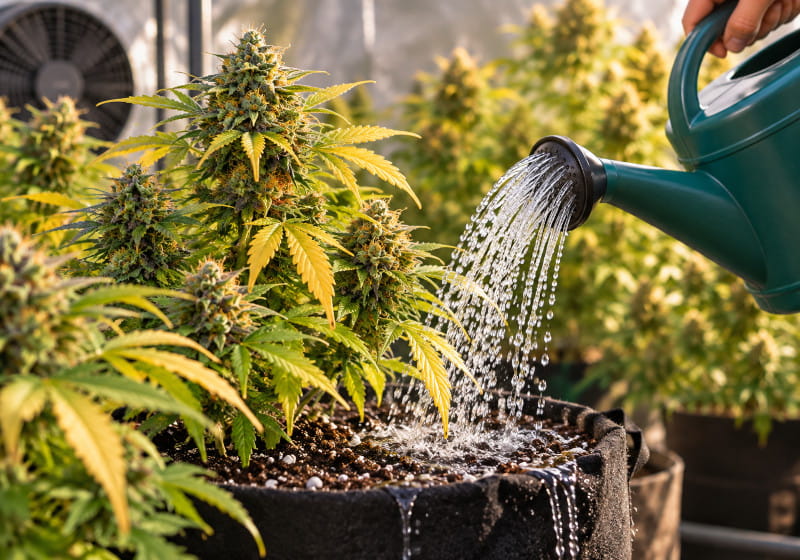
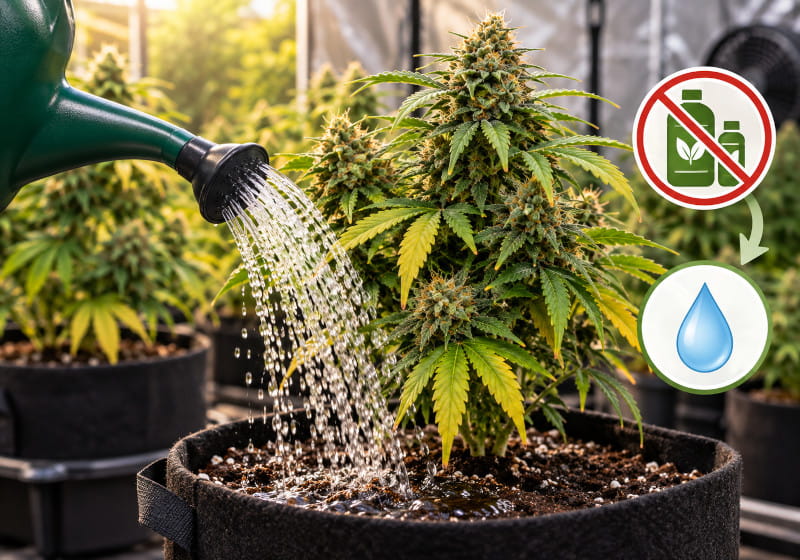
Pre-harvest flushing means stopping mineral fertilization during the final phase before harvest so that the plant is subsequently watered only with water. This is why it is often simplified as “water only before harvest.”
The plant does not automatically need to be flushed with particularly large amounts of water. If only the nutrient supply is stopped, irrigation should still match the plant’s water requirements and the growing medium being used. A normal switch from nutrient solution to water is therefore different from actively washing out the substrate.
Is Flushing for Overfertilization the Same Thing?
No. Flushing before harvest and flushing a substrate because of an excessively high concentration of soluble fertilizer salts are two different measures. Especially in substrates supplied with mineral nutrients, salts can accumulate in the root zone. If the concentration is in fact too high, it may make sense, depending on the medium and the cause, to adjust further nutrient input and reduce excess soluble salts in the root medium.
Brown leaf tips, very dark green foliage or other changes do not automatically prove overfertilization, however. An unsuitable pH, incorrect watering, root-zone problems or actual nutrient deficiencies can cause similar symptoms. We explain how to assess such problems in more detail in our guide to nutrient deficiencies in cannabis and in our guide to fertilizing cannabis correctly.
Important: The commonly used phrase “flush fertilizer out of the plant” is technically inaccurate. When only water is given, further nutrient input is initially stopped or reduced. Depending on the cultivation system, soluble salts in the root medium can be diluted or leached out. Nutrients already taken up by the plant, however, are not simply removed from leaves or flowers by irrigation water. Certain mobile nutrients can be relocated between different tissues within the plant – but this is a physiological process and not direct “flushing out.”
Why Is Cannabis Flushed Before Harvest?
When flushing before harvest, further mineral nutrient input is reduced or stopped during the final phase of the grow. The main objective is to avoid unnecessary fertilizer applications during this short final phase. Depending on the growing medium and irrigation method, the concentration of soluble nutrient salts in the root zone may also decrease.
Flushing has traditionally been associated with other expectations as well. It is often claimed, for example, that it improves flavor, aroma, smoke quality or ash color. However, there is currently no clear scientific evidence for such general quality claims. A change in nutrient supply before harvest does not automatically mean that the quality of the harvested flowers will also improve.
One plausible advantage, by contrast, may be saving fertilizer toward the end of cultivation. If additional nutrient applications at this stage no longer provide a relevant benefit to the plant or yield, they can be omitted. This reduces both fertilizer use and potential nutrient discharge through runoff or wastewater. However, the point at which this is reached cannot be determined by a fixed number of days for every grow.
Do You Always Have to Flush Cannabis Before Harvest?
No. Current research does not support a universally applicable requirement to flush cannabis before harvest. Whether and how flushing may be useful depends primarily on the growing medium, previous nutrient supply and the fertilization system being used. A plant supplied with mineral nutrients in coco or hydro, for example, starts from a different situation than a plant in organically fertilized soil or living soil.
Research to date does not show a consistent improvement in quality simply because nutrients are no longer supplied before harvest. At the same time, studies indicate that a limited period of flushing can be possible under certain conditions without significantly reducing yield or chemical quality. For this reason, neither “cannabis must always be flushed” nor “flushing is fundamentally pointless” is a technically convincing statement.
Flushing with Mineral Nutrients
With mineral fertilization, further nutrient input can be controlled relatively directly. If the previous fertilizer is no longer added to the nutrient solution, correspondingly fewer or none of those fertilizer nutrients are newly supplied during subsequent irrigation. Depending on the medium, watering method and runoff, the concentration of soluble salts in the root zone may also decrease.
This does not, however, result in a fixed flush duration for every plant grown with mineral nutrients. Growers using a coordinated fertilizer system can use the manufacturer’s intended final phase as a guide. The actual developmental stage of the plant, the medium used and the expected harvest window remain decisive.
Flushing with Organic Nutrients and Living Soil
In organically fertilized soil, nutrient supply cannot be stopped as immediately as with a mineral nutrient solution. Organic source materials are gradually converted into plant-available forms through biological processes in the soil. Organic fertilizers or slow-release fertilizers already present in the substrate therefore do not disappear simply because only water is given during the final phase.
Running large amounts of water through biologically active soil in order to “flush out” all nutrients is therefore not equivalent to flushing coco or a hydroponic system. In addition, unnecessarily heavy watering can impair the water-to-air balance in the root zone. In organic systems, it is therefore especially important to plan nutrient supply appropriately throughout the entire grow instead of trying to correct excessive feeding immediately before harvest by aggressive flushing.
When Should You Flush Cannabis?
If cannabis is going to be flushed before harvest, it should only begin during the final phase of flowering, once the actual harvest window can be reasonably estimated. A blanket rule such as “always exactly two weeks before harvest” is of little use because the actual maturity date can differ from the original flowering-time information.
Manufacturer flowering-time information provides useful guidance but is not an exact countdown. Even plants of the same strain can mature at different rates. If nutrient input is stopped too early, the period of restricted nutrient supply may be unnecessarily prolonged. If flushing only starts immediately before harvest, however, there is hardly any time left for a planned flush.
What matters, therefore, is not only the number of flowering weeks that have passed, but the actual maturity of the plant. Trichomes, pistils and other signs of maturity help to estimate the harvest window more accurately. We explain how to assess these indicators in detail under harvesting cannabis – the right time.
For placing the entire grow in a timeline, our Cannabis Grow Calendar for Indoor & Outdoor is also useful. It shows how a possible flushing phase fits into late flowering and the subsequent harvest window.
How Long Should You Flush Cannabis Before Harvest?
There is no fixed flushing duration that applies to every cannabis plant. In cultivation practice and fertilizer schedules, periods ranging from a few days to around two weeks are often mentioned. However, these are guidelines rather than a scientifically confirmed standard duration.
How long a flush may be useful depends mainly on the growing medium, the type of fertilization, previous nutrient supply and the remaining time until harvest. Nutrient availability and salt concentration in the root zone change differently in soil than in coco or hydroponic systems. Flush duration should therefore always be considered in the context of the specific cultivation system.
It is also important not to artificially extend the flush simply to reach a predetermined number of days. If harvest is delayed, what was originally a short period can become an unnecessarily long period of nutrient deprivation. The actual harvest window should therefore continue to be monitored during the flushing phase.
| Growing system | What determines flush duration? | Typical mistake |
|---|---|---|
| Mineral-fertilized soil | Pre-fertilization of the substrate, previous nutrient applications, plant condition, harvest window and fertilizer schedule | automatically starting a 7- or 14-day countdown |
| Coco | Composition of the nutrient solution, EC development, runoff and remaining time until harvest | treating coco like pre-fertilized soil |
| Hydro / Rockwool | Composition of the nutrient solution, pH, EC, system management and actual harvest window | reducing nutrient input too early or for too long without monitoring |
| Organic soil / Living Soil | Organic nutrient sources already present and their continued biological conversion in the soil | trying to “flush out” organically bound nutrients with large amounts of water |
Starting nutrient deprivation too early or extending it unnecessarily can promote deficiency symptoms and stronger leaf aging. Yellowing leaves toward the end of flowering may be part of natural senescence, but they are not proof that a flush is “working” particularly well. The goal should therefore not be to provoke visible deficiency symptoms as quickly as possible.
How to Flush Cannabis Properly: What Does “Water Only” Mean?
With pre-harvest flushing, “water only” initially means that the previous mineral nutrient solution is no longer given. The plant is then still watered according to its water requirements and the growing medium being used. Flushing therefore does not automatically mean running the largest possible amount of water through the pot at every watering.
There is an important distinction here: watering without fertilizer and actively leaching the substrate are not the same thing. The first approach primarily stops further nutrient input. The second is intended to deliberately remove soluble salts from the root medium or reduce their concentration. Watering too frequently or using too much water can keep the root zone unnecessarily wet for a long time, particularly in soil. We explain how to correctly assess watering time, substrate moisture and pot weight in detail under watering cannabis correctly.
What Water Is Used for Flushing?
Even during flushing, the water used should suit the growing medium and the previous irrigation strategy. Water quality does not suddenly become irrelevant simply because the normal base fertilizer is no longer added. Especially in coco and hydroponic systems, the starting EC, pH and mineral content of the water can still be relevant.
The term “plain water” also does not mean that the water must be free of dissolved minerals. Depending on the region, tap water can contain varying amounts of calcium, magnesium and other minerals. Reverse-osmosis or distilled water, by contrast, has very low starting conductivity. Which water is suitable therefore depends on the entire cultivation system, not simply on the fact that flushing is taking place.
Do You Need to Use Especially Large Amounts of Water When Flushing?
No. During normal pre-harvest flushing, cannabis does not automatically need to be watered with particularly large amounts of water. If the aim is merely to stop further fertilizer application, the plant should continue to be watered according to its needs – just without the previous mineral nutrient solution.
Running larger amounts of water through the substrate serves a different purpose: it is intended to deliberately dilute or leach soluble salts from the root medium. Whether this is useful depends on the medium and the specific starting situation. Soil, for example, has different buffering properties and structure than coco or rockwool. A method used in a drain-to-waste coco system should therefore not be transferred unchanged to organically fertilized soil.
Flushing Cannabis in Soil, Coco and Hydro
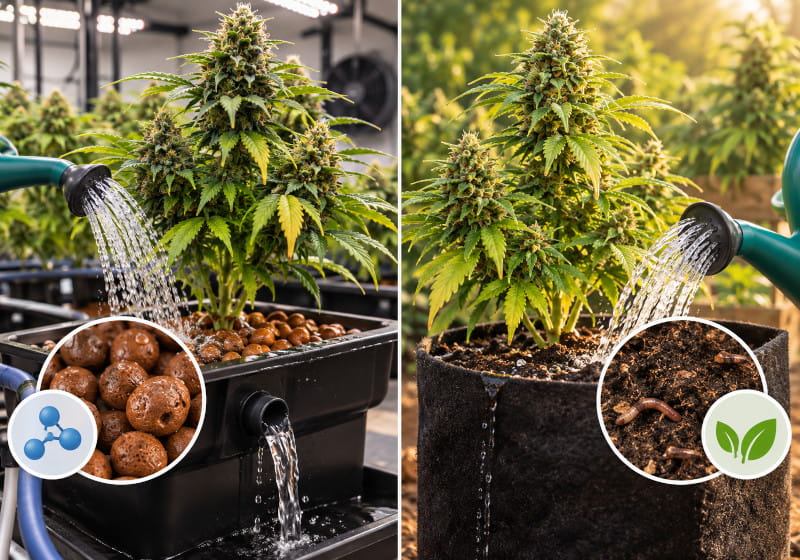
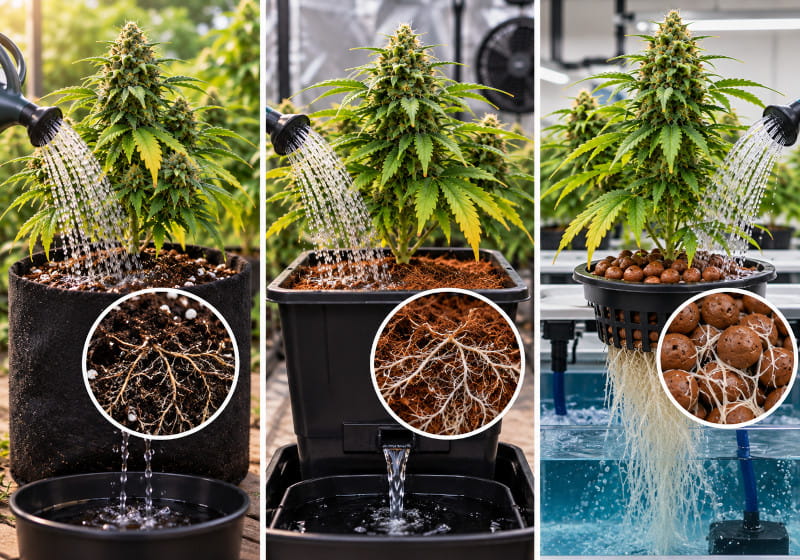
How flushing affects nutrient supply depends to a large extent on the growing medium being used. Soil can store and buffer nutrients, while coco is more dependent on the nutrient solution supplied. In hydroponic systems, the composition of the nutrient solution can be changed especially directly. A flush therefore does not automatically have the same effect in soil, coco and hydro.
| Medium | What changes during flushing? | What should you pay particular attention to? |
|---|---|---|
| Soil | Further liquid fertilization can be stopped; nutrients already present in the substrate may remain available. | Consider pre-fertilization, organic components, previous feeding and the risk of overwatering. |
| Coco | Changes in the nutrient solution affect conditions in the root zone relatively quickly. | Keep an eye on starting EC, runoff EC, water quality and irrigation strategy. |
| Hydro / Rockwool | Nutrient supply can be changed directly through the composition of the nutrient solution. | Monitor pH, EC, water quality and the operation of the specific system. |
How Do You Flush Cannabis in Soil?
When flushing cannabis in soil, the key factors are how the substrate is composed and what type of fertilizer was previously used. With mineral liquid fertilizer, further feeding can be stopped toward the end of flowering while the plant continues to receive water according to its needs. Nutrients may nevertheless remain available in the substrate – depending on pre-fertilization, previous fertilizer applications and the composition of the soil.
In organically fertilized soil, nutrient supply can be stopped even less abruptly. Organic material can continue to be mineralized through biological processes and thereby become available to the plant. Running large amounts of water through the pot to “flush out” all nutrients from organic soil is therefore neither equivalent to omitting a mineral liquid fertilizer nor automatically useful.
How Do You Flush Cannabis in Coco?
With cannabis grown in coco, changes in the supplied nutrient solution affect conditions in the root zone relatively quickly. Coco normally does not contain the same nutrient reserve as pre-fertilized soil and is deliberately supplied through the nutrient solution during cultivation. If the composition of that solution changes, the plant’s ongoing nutrient supply therefore also changes relatively directly.
Coco is not completely inert, however: the material has a cation exchange capacity and can bind and exchange certain cations in particular. During flushing, starting EC, water quality, irrigation and runoff should therefore be considered together. A conspicuously high runoff EC may indicate an elevated concentration of soluble salts in the root zone – but this is a different starting situation from a routine flush immediately before harvest.
How Do You Flush Cannabis in Hydro or Rockwool?
In hydroponic systems, nutrient supply can be controlled particularly directly through the nutrient solution. When its composition is changed, conditions at the roots change much more immediately than in buffered soil. Rockwool likewise contains very little nutrient reserve of its own, and the plant’s supply comes largely from the solution provided.
For this very reason, pH, EC and water quality should also be monitored during a flush. A longer period of nutrient deprivation in these systems cannot simply be assessed according to the same rules as a plant in soil. Our comparison Soil, coco or rockwool – the best medium for cannabis explains the basic differences between these substrates.
What Role Do Manufacturer Fertilizer Schedules Play?
Manufacturer fertilizer schedules are an important guide because they are designed around the respective nutrient system and its intended use. Depending on the manufacturer, feeding is reduced toward the end of flowering, stopped completely or changed to a different nutrient composition. Some schedules specify water only for the final phase before harvest.
Such a schedule, however, is a recommendation for a specific product and cultivation system and not a universal rule for every cannabis plant. The substrate, previous fertilization, plant development and actual harvest window must also be taken into account. A schedule intended for soil should likewise not be transferred unchanged to coco or a hydroponic system.
Growers using a complete fertilizer system can therefore use its schedule as a starting point and adapt the final phase to the actual development of the plants. We explain how fertilizer schedules, dosage, pH and EC should generally be interpreted in our detailed guide How to fertilize cannabis correctly.
Practical rule: If a manufacturer specifies only water or reduced nutrient input for the final phase, this is first and foremost a recommendation for that fertilizer system. It does not mean that every cannabis plant requires the same flush regardless of medium and fertilization.
What Does Research Say About Pre-Harvest Flushing?
Scientific data on pre-harvest flushing are still limited, but several of the most common claims have now been investigated. The results available so far provide no clear evidence that flushing generally improves flavor, smoke quality, cannabinoid content, terpene profile or yield. At the same time, studies indicate that a limited period of nutrient deprivation before harvest may be possible under certain conditions without substantially reducing yield or chemical quality.
Study with Five Cannabis Cultivars
A 2024 study by Saloner, Sade and Bernstein published in Industrial Crops and Products examined five medical cannabis cultivars. During the final phase, the plants either continued to receive mineral nutrients or received water only. Overall, flushing had only limited effects on plant development, biomass, physiological functions and cannabinoid and terpenoid profiles. Differences between cultivars were observed for some of the characteristics examined, however.
The authors nevertheless support flushing as a possible cultivation practice because, under the conditions studied, no deterioration in yield or chemical quality was observed, while nutrient use and associated environmental impacts could be reduced. This does not mean, however, that flushing automatically improves flavor or smoke quality.
Utah State University Study
A master’s thesis published at Utah State University in 2024 also investigated nutrient withdrawal before harvest. Pre-harvest flushing did not increase total cannabinoid yield or the quality parameters examined. While nitrogen concentration in the leaves decreased and deficiency symptoms became visible, nitrogen concentration in the flower tissue did not decrease correspondingly.
This result contradicts the simplified idea that watering with water specifically “flushes” nutrients out of the flowers. Changes in nutrient supply, possible relocation of mobile nutrients within the plant, and leaching soluble salts from the root medium are different processes.
Practical Trial with 0, 7, 10 and 14 Days of Flushing
Additional practical data come from a trial by Rx Green Technologies. A cannabis strain grown in coco was compared across flushing periods of 0, 7, 10 and 14 days. No significant differences were found in flower weight, THC content or terpene content. The blind test of flavor, smoke smoothness and ash color likewise showed no significant advantage for longer flushing periods.
This trial should, however, be weighted differently from an independent peer-reviewed study: it was conducted by a company using one strain and a specific nutrient and cultivation system. The results are therefore interesting supplementary practical data, but they do not allow universal conclusions for all strains and growing systems.
| Common claim | What does current research show? |
|---|---|
| “Flushing removes fertilizer from the flowers.” | This has not been established as a general rule. Further nutrient input can be reduced, and soluble salts in the root medium can be affected. This is not the same as directly “flushing out” nutrients already absorbed by the flowers. |
| “Flushing improves flavor.” | There is currently no robust evidence that pre-harvest flushing generally improves flavor. |
| “Quality suffers without flushing.” | The studies available so far do not support this blanket claim. |
| “A limited flush can save fertilizer.” | Yes. If further nutrient applications can be omitted during the final phase without relevant disadvantages, fertilizer use is reduced. |
| “Every cannabis strain responds the same way.” | No. Research shows that some responses to nutrient withdrawal can be cultivar-specific. |
Overall, the data available so far support neither a general requirement to flush nor the blanket rejection of the method. A limited period of nutrient deprivation before harvest may be a sensible strategy depending on the cultivation system and can reduce nutrient inputs. Many traditional claims that flushing generally produces cleaner, better-tasting or higher-quality flowers, however, are not sufficiently supported. The growing medium, fertilizer system, plant condition and actual harvest window remain decisive.
What Mistakes Should You Avoid When Flushing Cannabis?
The most common mistakes when flushing cannabis result from rigid schedules, excessive amounts of water or failing to distinguish between different cultivation systems. A flush should neither be started automatically according to a calendar nor treated as the solution to every problem in the root zone. The decisive factors are the medium, fertilization, plant condition and the actual harvest window.
| Common mistake | Why is it problematic? | Better approach |
|---|---|---|
| Automatically flushing for 7 or 14 days | Maturity, medium and nutrient supply can differ significantly. | Consider the harvest window, plant condition and cultivation system together. |
| Confusing “water only” with aggressive flushing | Unnecessarily large amounts of water can keep soil wet for a long time in particular and put stress on the root zone. | Distinguish between watering without fertilizer and deliberately leaching the substrate. |
| Treating soil, coco and hydro the same way | Nutrient storage, buffering and controllability differ depending on the medium. | Adapt the approach to the medium and fertilizer system. |
| Seeing yellow leaves as proof of a successful flush | Yellowing can indicate natural senescence or nutrient stress, but it does not prove a quality improvement. | Monitor plant development and do not intentionally provoke visible deficiency symptoms. |
| Equating overfertilization with pre-harvest flushing | The two measures have different starting situations and objectives. | First determine whether there is salt buildup or overfeeding, or simply the final phase before harvest. |
| Starting the flush too early | If harvest is delayed, nutrient deprivation can continue unnecessarily long. | Begin only once the actual harvest window can be estimated with sufficient confidence. |
| Following a fertilizer schedule blindly | Manufacturer schedules cannot precisely predict the individual maturity date and specific growing situation. | Use manufacturer information as a guide and compare it with plant development and the harvest window. |
Frequently Asked Questions About Flushing Cannabis
How Long Before Harvest Should You Flush Cannabis?
There is no fixed flushing duration for cannabis. In practice, periods from a few days to around two weeks are often mentioned, but these are only guidelines. The decisive factors are the growing medium, fertilizer system, previous nutrient supply and the actual harvest window.
Do You Always Have to Flush Cannabis Before Harvest?
No. Current research does not establish a general requirement for pre-harvest flushing. A limited period of nutrient deprivation can be useful depending on the cultivation system, but the same approach cannot be applied indiscriminately to mineral-fertilized soil, coco, hydro and organic soil.
Does Flushing Remove Nutrients from the Cannabis Plant?
Not in the sense that irrigation water directly washes fertilizer out of leaves or flowers. Omitting fertilizer initially reduces further nutrient input. Depending on the cultivation system, soluble salts in the root medium can be diluted or leached out. Nutrients already absorbed, however, cannot simply be flushed out of plant tissue with irrigation water.
Should You Water Cannabis with Water Only During Flushing?
With classic pre-harvest flushing, the previous mineral nutrient solution is stopped and the plant is then watered without the normal fertilizer. However, this does not automatically mean that particularly large amounts of water must be used. Water quality and irrigation should continue to suit the respective cultivation system.
Can You Flush Cannabis for Too Long?
Yes. An unnecessarily long period of nutrient deprivation can promote deficiency symptoms and stress the plant. A flush should therefore not be started too early solely on the basis of a theoretical harvest date. If maturity is delayed, the period without the previous nutrient supply is otherwise extended as well.
Is Flushing Necessary with Organic Fertilizer?
A classic flushing strategy from mineral-fed systems cannot be transferred directly to organically fertilized soil or living soil. Organic nutrient sources can continue to be biologically converted in the soil. They do not simply disappear when only water is given during the final phase.
Can You Flush Cannabis When It Has Been Overfertilized?
If the concentration of soluble fertilizer salts in the root medium is actually too high, controlled leaching may be useful depending on the medium. However, this is a corrective measure and not the same as pre-harvest flushing. It should first be established whether there is actually overfeeding or salt buildup.
Does Flushing Improve the Flavor of Cannabis?
A general improvement in flavor through flushing has not yet been convincingly demonstrated scientifically. Studies to date show no clear advantage of longer flushing periods for flavor or chemical quality. Aroma and flavor are also influenced by many other factors, including genetics, maturity, drying and storage.
Sources and Further Information
- Saloner, A., Sade, Y. & Bernstein, N. (2024): To flush or not to flush: Does flushing the growing media affect cannabinoid and terpenoid production in cannabis? Industrial Crops and Products 220, 119157.
- Hershkowitz, J. A. (2024): Nutrient Management of Cannabis in Controlled Environments. Utah State University.
- Rx Green Technologies: Cannabis Flushing Study – Impact of different flushing times on quality and taste in Cannabis sativa L.