Leaf Miners on Cannabis: Damage & Control
Understanding Leaf Mines on Cannabis Leaves
Updated: October 2026 | Leafminer flies and leaf miners on cannabis: species, feeding tunnels, diagnosis, biological control and prevention.
Author: Cannapot Grow Team | Reading time: approximately eighteen minutes
The Most Important Points at a Glance
✓ Leafminer flies are small insects belonging to the family Agromyzidae. Their larvae develop inside leaves, where they feed on plant tissue. The broader term leaf miners also includes insects from other families and orders.
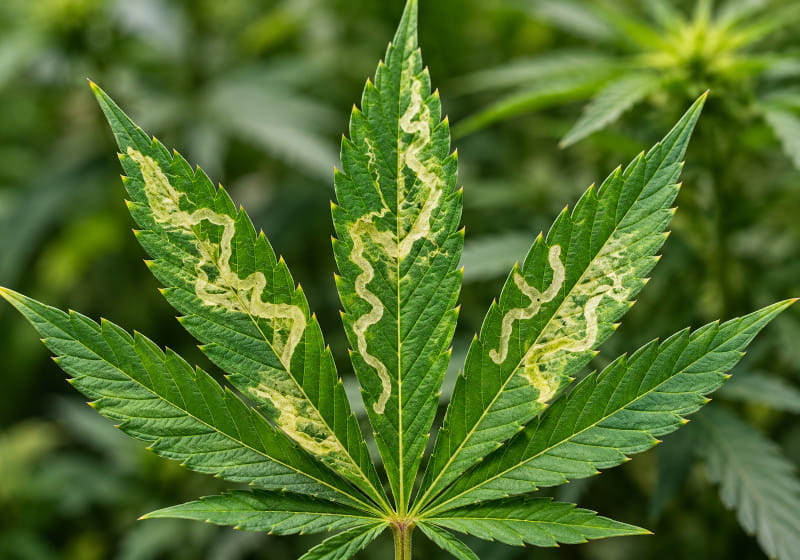
✓ Typical signs include pale, often winding or serpentine tunnels within the leaf tissue. These mines may gradually widen as the larvae develop. However, not every pale line on a cannabis leaf indicates leafminer activity.
✓ Liriomyza cannabis is a scientifically documented leafminer fly species associated with Cannabis sativa. Other Liriomyza species are significant pests of various agricultural and horticultural crops, but their biology and economic importance cannot automatically be extrapolated to cannabis.
✓ Leaf mines often remain visible long after the larvae have left the leaf. The clearest signs of an active infestation are living larvae inside the leaf tissue and the appearance of new or expanding mines.
✓ Yellow sticky traps are useful for monitoring adult leafminer flies but cannot confirm an active larval infestation on their own. Parasitoid wasps may help control certain leafminer species, although their effectiveness depends on the target species and growing conditions.
Pale, curved lines suddenly appear on a cannabis leaf. Some run as narrow tracks through the leaf, while others form broader, irregular tunnels. They may conceal larvae feeding inside the leaf tissue. This feeding habit is known as leaf mining. Among the best-known culprits are leafminer flies, whose larvae leave characteristic feeding tunnels. Unlike surface feeding damage, this injury occurs between the outer layers of the leaf.
The pale colour of these marks is not the only important factor when assessing them. More important is whether a tunnel actually runs inside the leaf, whether a larva is visible within it and whether new mines are developing. Older, abandoned feeding tunnels may also persist for a long time. This Canna Wiki guide therefore focuses on the characteristics, biology and damage patterns of leafminer flies on cannabis. Other causes of leaf discoloration and plant damage are covered in our category Cannabis Plant Problems & Diseases.
What Are Leafminer Flies and Leaf Miners?
Leafminer flies are small two-winged insects belonging to the family Agromyzidae. The larvae of many species develop inside leaves and feed on plant tissue. By contrast, the term leaf miner does not refer to a particular insect family but generally describes insects whose larvae create feeding tunnels or broad mines within leaves.
In addition to leafminer flies, larvae of certain moths and butterflies and other insect groups can cause this type of damage. A pale mine alone is therefore insufficient to identify its cause conclusively as a particular fly species. The shape of the mine, the host plant and characteristics of the larvae or adult insects can provide important clues. In some cases, expert examination is also necessary.
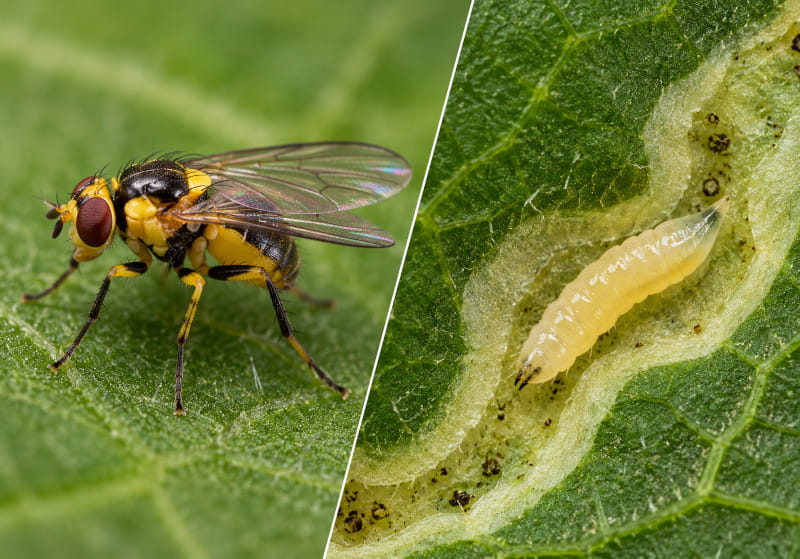
Agromyzidae larvae are legless and generally pale in colour. Adult flies of the genus Liriomyza are usually only a few millimetres long. Several economically important species have distinctive yellow-and-black markings. However, appearance varies within the family, so neither body colour nor size alone allows reliable species identification.
Which Leafminer Fly Species Are Documented on Cannabis?
The species Liriomyza cannabis Hendel, 1931 has been scientifically described as a leafminer fly associated with Cannabis sativa as a host plant. This species is recorded in entomological reference databases and can therefore be distinguished from other leafminer fly species primarily known from vegetable and ornamental horticulture. However, its documented host association does not automatically mean that Liriomyza cannabis is common in every growing region or is necessarily an economically significant cannabis pest.
The specialist references Agromyzidae of the World and Leaf and Stem Mines of British Flies and Other Insects provide important information about this species. For Liriomyza cannabis mines are described on the upper side of leaves which, where space allows, may initially form a tight spiral before extending into a longer tunnel. Within the mine, frass may appear as narrow, interrupted lines. Pupation takes place outside the mine. These characteristics refer specifically to the described species and must not be generalized to all leaf miners.
In professional vegetable and ornamental horticulture, Liriomyza trifolii, Liriomyza sativae and Liriomyza huidobrensis are also known as important pests. Their biology and experience with biological control measures are useful for scientific comparison. However, demonstrated economic significance on other crops is not sufficient evidence of comparable significance on cannabis. If unidentified leafminer larvae or adult flies are found, their species identity should therefore initially remain open.
| Name | Scientific classification | Relevance to cannabis |
| Liriomyza cannabis | Scientifically documented leafminer fly species on Cannabis sativa | Direct association with cannabis; species-specific mines and documented records |
| Liriomyza trifolii | Economically important pest of various horticultural crops | Important comparative species for life cycle and biological control; not blanket evidence of occurrence on cannabis |
| Liriomyza sativae / Liriomyza huidobrensis | Polyphagous leafminer fly species of major horticultural importance | Research findings from other crops can only be transferred with appropriate qualification |
| Other leaf miners | For example, larvae of certain moths and butterflies and other insects | Important differential diagnosis, as similar feeding tunnels can have different causes |
What Do Adult Leafminer Flies, Larvae and Pupae Look Like?
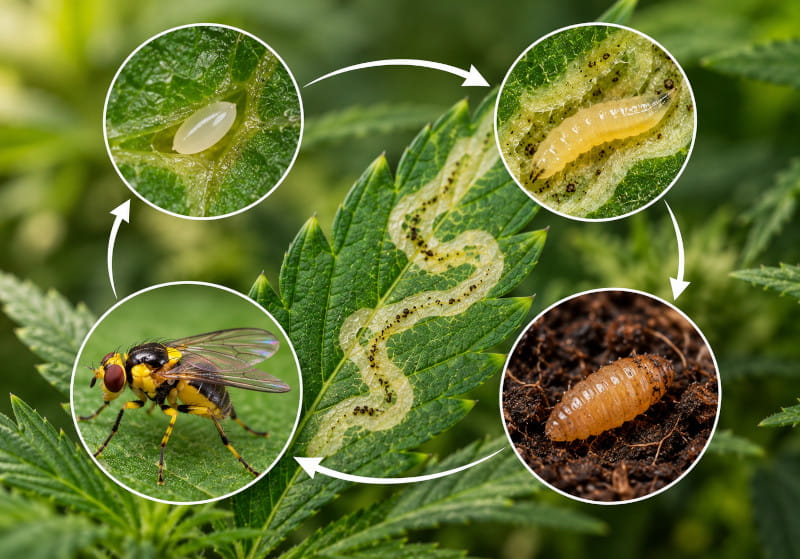
Leafminer flies pass through four developmental stages: egg, larva, pupa and adult fly. Their appearance and habits vary by species. The following characteristics mainly concern well-studied members of the Agromyzidae family, especially the genus Liriomyza. They provide general guidance and do not allow reliable identification of every leafminer fly species.
Adult leafminer flies: These small two-winged flies are usually only a few millimetres long. Several species of the genus Liriomyza have conspicuous yellow-and-black body markings. Adults can be found on leaf surfaces, among other places, where they may feed or lay eggs. They are also occasionally caught on yellow sticky traps. Because of their small size and the similarity between species, reliable identification from captured specimens is often difficult.
Eggs: In many leafminer fly species, females use a specialized ovipositor to deposit eggs directly into leaf tissue. This produces small punctures, which may also result from feeding by adult females. However, such pinpoint injuries are not exclusive to leafminer flies and are insufficient on their own to confirm an infestation.
Larvae: The generally pale, yellowish to cream-coloured larvae have no legs and, in leaf-mining species, develop within the leaf tissue. They feed between the outer leaf layers, leaving characteristic mines. These tunnels may widen as the larvae grow. In fresh, translucent mines, a larva can sometimes be seen with a magnifying glass or by carefully holding the leaf against the light.
Pupae: After completing their feeding development, the larvae pupate. In many species of the genus Liriomyza they leave the leaf and form a small puparium outside the mine, initially pale and later often brownish. It may be located on the leaf surface or in soil or growing substrate, for example. Other leaf miners pupate inside their mines. The pupation site therefore depends on the species and is not a universal feature of all leaf miners.
How Do Typical Leaf Mines Develop?
Characteristic leaf mines form when a larva feeds through the interior of a leaf, destroying plant tissue. Because the upper and lower epidermis can initially remain largely intact, the tunnel is visible from outside as a pale, whitish or slightly translucent track. As damage progresses, the affected tissue may turn yellowish to brown and eventually die. The visible lines are therefore not superficial feeding marks but damage within the leaf tissue.
In so-called serpentine mines the larva feeds along a narrow, often curved or winding path through the leaf. As the larva grows, the tunnel may gradually widen. Some species initially create tightly coiled tunnels that later extend into longer or irregular tracks. In blotch mines a larger continuous area inside the leaf is damaged instead. The resulting shape depends particularly on the insect species responsible, the larval stage and the characteristics of the leaf.
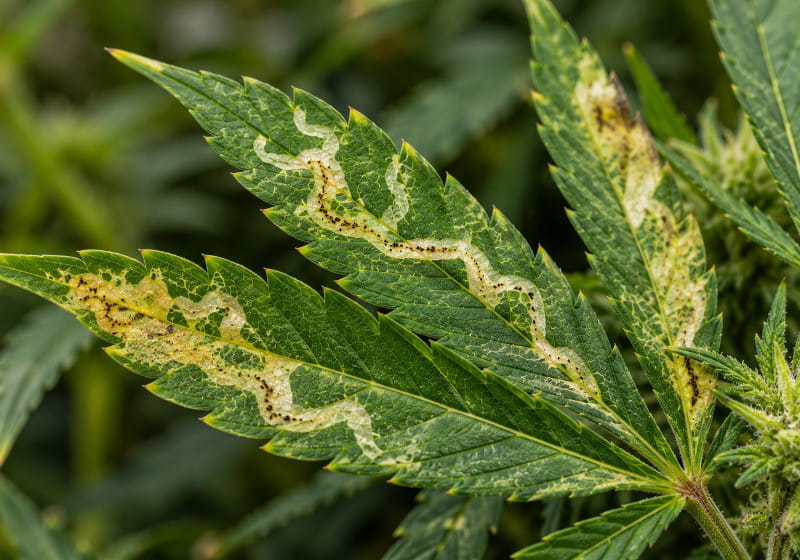
Small dark frass particles may be visible inside the mines, scattered individually or arranged in interrupted lines. Their distribution, together with the course and shape of the mine, can provide important clues about the culprit. However, frass patterns alone cannot reliably identify a species. Leaf veins, tissue structure and leaf thickness can also influence the direction in which a larva moves and how the mine develops.
Early and Advanced Damage Symptoms on Cannabis Leaves
An early leafminer fly infestation often appears as narrow, initially inconspicuous feeding tunnels in the leaf tissue. These may look like fine, whitish or slightly translucent lines. As larvae grow and continue feeding, the mines lengthen and widen. With more advanced damage, affected leaf areas may turn yellow, dry out or become brownish. If several tunnels are close together, the damaged areas can merge into larger, irregular patches.
When several larvae develop in the same leaf, numerous mines can form side by side. The loss of functional leaf tissue reduces photosynthesis in affected areas. A severe infestation may therefore also impair overall plant development. The actual impact on cannabis growth depends, among other things, on the number of mines, the total leaf area affected, the plant’s developmental stage and growing conditions. No scientifically established damage threshold specifically for leafminer flies on cannabis is currently available.
However, not all pale lines, yellowish spots or dead leaf areas are caused by leafminer flies. Imbalanced nutrient supply can also cause visible changes in cannabis leaves. Such deficiency or excess symptoms follow different patterns and do not normally produce actual feeding tunnels between leaf layers. Our Canna Wiki guide How to Fertilize Cannabis Properly explains how to assess nutrient problems. The key distinction is therefore not leaf colour alone but the structure of the damaged tissue.
Distinguishing Active Leaf Mines from Old Damage
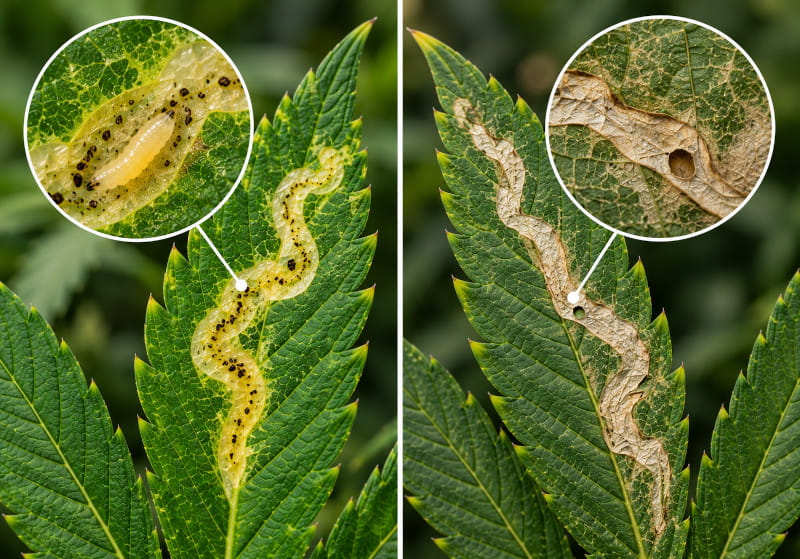
A visible leaf mine does not automatically mean that a live larva is still inside the leaf. Feeding marks often remain even after the insect has left the leaf or died. It is therefore important to distinguish an active infestation from older, inactive damage. Repeated leaf inspections, documenting how suspicious mines change over several days, are particularly helpful.
Signs of an active infestation: A live larva is visible within a mine or can be detected using a magnifying glass or transmitted light. A tunnel that becomes longer or wider between inspections also indicates continued feeding. New characteristic mines on previously undamaged leaves suggest further larval activity. Adult flies caught on yellow sticky traps merely indicate the presence of such insects and do not, by themselves, prove an active larval infestation.
Signs of older, inactive mines: A feeding tunnel no longer changes during repeated inspections, appears empty or has a possible exit hole. Dead leaf tissue may look dry, brownish or papery. These signs suggest that the original larva has completed its development or is no longer alive. They do not, however, rule out larvae elsewhere on the plant or newly laid eggs. A single inspection is therefore not always enough to assess the current infestation status reliably.
A pale line on a cannabis leaf alone does not prove a leafminer fly infestation. What matters is whether a feeding tunnel actually exists within the leaf tissue and whether there is evidence of current larval activity. Older mines may remain visible even after the larva has left the leaf.
Leafminer Flies or Other Leaf Damage?
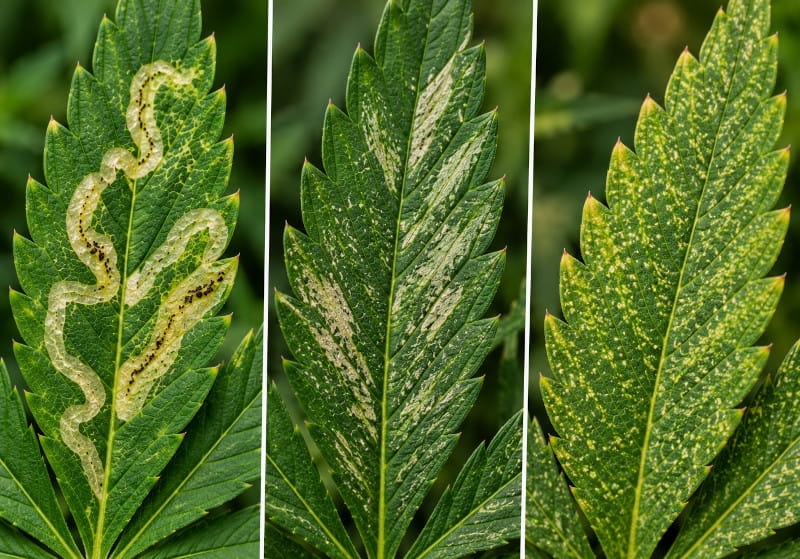
Pale changes in leaves can have different causes and may look similar at first glance. The key distinguishing feature is where the damage occurs within the leaf tissue. While leafminer flies and other leaf miners create actual tunnels inside leaves, thrips and spider mites cause different characteristic damage patterns. The following overview highlights the main differences.
| Characteristic | Leafminer flies / leaf miners | Thrips | Spider mites |
| Typical damage | Pale, often winding feeding tunnels or broad mines inside leaf tissue | Irregular, silvery feeding marks | Fine, often numerous pale specks that may merge under heavier infestation |
| Location of damage | Larvae feed between the outer leaf layers | Damage to cells near the plant surface, often on leaves | Piercing and sucking out individual plant cells, often from the underside of leaves |
| True leaf mines | Yes, characteristic of leaf-mining species | No, no feeding tunnels inside leaves | No, no feeding tunnels inside leaves |
| Other clues | Sometimes visible larvae and dark frass particles inside mines | Often small dark frass spots on the leaf surface | Web-producing species may form fine webbing, especially under heavier infestation |
| Targeted examination | Inspect mines with a magnifier and transmitted light, look for larvae and monitor changes | Inspect leaf surfaces for insects, feeding marks and frass spots | Inspect undersides of leaves in particular with a magnifier for mites and possible webbing |
An important distinction is the location of the damage: leafminer fly larvae feed inside the leaf, whereas thrips do not create such mines. Their characteristic silvery feeding marks, dark frass spots and suitable control measures are discussed in detail in our dedicated guide Thrips on Cannabis. The speckled leaf damage caused by Spider Mites on Cannabis also has different causes and requires a separate diagnosis.
Not every leaf miner is a leafminer fly. Certain moth and butterfly larvae can also develop inside leaf tissue and create mines. Other caterpillars feed on leaves externally, causing holes, irregular feeding edges or missing pieces of leaves. We discuss these types of damage in our Canna Wiki article Caterpillars on Cannabis. When leaf changes are unclear, examine the actual structure of the damage before assuming a particular cause.
Inspecting Leafminer Flies: Step by Step
A reliable assessment of a possible leafminer fly infestation begins with a targeted examination of affected cannabis leaves. First determine whether genuine feeding tunnels are present within the leaf tissue. Then check whether live larvae are still active or only older, abandoned mines remain. The following steps help document observations systematically and distinguish other causes of leaf changes.
1. Select suspicious leaves: Examine leaves with pale, curved or unusually shaped tracks more closely. Fresh mines with little discoloration are especially useful because their structure is often easier to see than in dead tissue. Photograph the affected areas and record which leaves and plants show them. Check neighboring leaves too, even if no obvious damage is initially visible.
2. Examine the leaf against the light: Carefully hold the affected leaf up to a suitable light source without damaging it. In translucent mines, the path of the tunnel, individual dark frass particles or even a larva inside the leaf may become clearer. Determine whether the pale track really lies within the leaf tissue rather than being merely surface discoloration. A negative result with transmitted light does not, however, rule out a mine.
3. Inspect mines with a magnifying glass: Carefully follow suspicious feeding tunnels with a magnifier. Look particularly for small, pale, legless larvae, dark frass marks and possible openings through which a larva may have left the leaf. The shape and width of a mine can provide further clues. Individual features are not always sufficient to identify the responsible insect species conclusively.
4. Document changes over several inspections: Photograph suspicious mines and compare their development with the original images during later inspections. If a mine grows longer or wider, this suggests continued feeding. Record new tunnels appearing on previously undamaged leaves as well. If a mine remains unchanged, it may already have been abandoned. Repeated observation is particularly important when no larva is directly visible.
5. Check other causes of leaf changes: If no actual feeding tunnels can be found inside the leaf, investigate other possible causes. These include surface feeding and sucking damage, mechanical injuries, light damage and changes caused by imbalanced nutrients. The structure of the damaged tissue matters more than its color alone. Different causes may also occur on the same plant at the same time.
6. Assess species identification carefully: Even when a leaf-mining larva is found, its exact species remains uncertain. Different leafminer flies and other leaf-mining insects can produce similar damage. Identification as Liriomyza cannabis or another species should therefore only be made when sufficient diagnostic characteristics are available. Unclear findings may require suitable specimens, sharp macro photographs or examination by an entomological expert.
Photographs of the same leaf areas make it easier to compare several inspections. This helps determine whether mines are still growing or new damage is appearing.
Life Cycle and Spread Within a Crop
Leafminer flies undergo complete metamorphosis through the stages of egg, larva, pupa and adult fly. In many species, females lay their eggs directly into leaf tissue. After hatching, the larvae begin feeding inside the leaf, creating characteristic mines. They pass through several larval stages during development. Once feeding is complete, pupation follows and an adult fly eventually emerges. It can reproduce and colonize further suitable host plants.
The speed of leafminer fly development and the number of generations possible within a given period depend on species, temperature, host plant and other environmental factors. In well-studied species of the genus Liriomyza development can be relatively rapid under favorable conditions. However, specific development times established on vegetables or ornamental plants cannot simply be applied to Liriomyza cannabis on cannabis. The pupation site also varies by species: many leafminer flies pupate outside the mine, sometimes in soil or substrate, whereas other leaf miners remain inside the leaf.
Spread within a crop occurs mainly through adult flies seeking other suitable leaves for egg laying. Infested young plants or other plant material may also introduce the insects, especially if larvae or pupae are still present. Protected growing areas are therefore not inherently safe from leafminer flies. Outdoors, incoming flies and natural enemies can also affect population development. The extent of an infestation depends on available host plants, environmental conditions and the particular leafminer fly species.
What Should You Do About a Confirmed Leafminer Fly Infestation?
When a leafminer fly infestation is confirmed, first determine whether live larvae are still present in the leaves and how far the damage has spread throughout the crop. A few older mines do not necessarily mean an infestation is still active. New mines, visible larvae and the number of affected plants are especially important. These observations help determine whether targeted measures are needed or close monitoring is sufficient for the time being.
Where space permits, affected plants can be temporarily separated and monitored closely. Individual leaves containing confirmed active larvae may be carefully removed, provided this does not sacrifice a disproportionate amount of healthy leaf area. Collect removed plant material immediately in a closed container and dispose of it in a way that prevents larvae or pupae from returning to the crop. Inspect neighboring plants for fresh mines at the same time. Removing large numbers of leaves solely because of old feeding marks is not advisable.
Yellow sticky traps can supplement monitoring by catching some adult leafminer flies and indicating the presence of flying insects. However, captured flies cannot always be reliably identified without closer examination. The number caught on a trap does not directly reflect the number of active larvae inside leaves. Trap catches should therefore always be assessed alongside new mine development and the presence of live larvae.
Biological Control: Parasitoid Wasps and Natural Enemies
Parasitoid wasps are among the most important natural enemies of various leafminer fly species. Certain species are deliberately used for biological control in professional vegetable and ornamental horticulture. Their effectiveness depends on several factors, including the leafminer fly species, larval developmental stage, temperature, growing conditions and timing of beneficial insect releases. Results from other crops cannot simply be transferred to cannabis.
Diglyphus isaea is a parasitoid wasp that attacks suitable leafminer fly larvae externally. The female paralyzes the host larva and lays an egg nearby inside the mine. The emerging wasp larva then feeds on the host. Dacnusa sibirica uses a different strategy: as an internal parasitoid, it lays eggs inside living leafminer larvae, where its offspring initially develop. Both species are used in certain greenhouse crops to control suitable Liriomyza species. However, this does not establish reliably proven effectiveness against all leaf miners or specifically against Liriomyza cannabis.
Alongside deliberately released parasitoid wasps, naturally occurring enemies can also help limit leafminer fly populations. Broad-spectrum insecticides may harm beneficial insects and alter the biological balance within a crop. Before releasing beneficial insects, check documented target species, recommended conditions and the supplier’s instructions. Local legal requirements must also be observed. A universal success rate for parasitoid wasps on cannabis would not be sufficiently supported by scientific evidence.
Contact Treatments and Plant Protection Products: Know the Limitations
The particular way leaf-mining larvae live makes some direct control measures difficult. Because larvae remain between the outer leaf layers, they are partly protected from many contact products that act only on the surface. Treating the leaf surface therefore does not necessarily reach insects inside the mines. Pupae located outside leaves in the substrate or other sheltered sites may also be unaffected. Actual effectiveness depends on the active substance, its mode of action and the leafminer fly species involved.
Blanket spraying recommendations, aggressive home remedies or homemade mixtures are therefore not a reliable basis for controlling leafminer fly infestations. Plant protection products must be used only in accordance with their current authorization and applicable conditions of use. The approved crop, application setting and regulations of the relevant country are particularly important. For cannabis, potential residues and the intended use of plant parts must also be considered. Approval for vegetables, ornamentals or other crops does not automatically mean that the same product may be used on cannabis.
The success of a measure can be assessed primarily by whether fewer new mines appear and the number of live larvae declines. Existing feeding marks often remain visible. The number of adult flies caught alone is therefore not a sufficient measure of treatment success.
Preventing Leafminer Flies and Monitoring Crops
Regular crop inspections are an important basis for detecting leafminer flies early and assessing their further spread. Newly introduced plants and cuttings should be carefully examined for suspicious mines before being integrated into an existing crop. Where practical, temporarily observing new plants separately may provide additional reassurance. Clear plant spacing, regular removal of infested plant material and cleaning shared tools also support structured crop hygiene. Cleaning tools is a general hygiene measure, not a specific way of controlling leafminer larvae living inside leaves.
In densely packed plants or hard-to-reach foliage, small mines may go unnoticed for some time. This can occur, for example, in compact growing systems such as Sea of Green (SOG) or plants whose shoots are trained along a net using the Screen of Green (SCROG) method. Neither growing method causes leafminer fly infestations. They can, however, affect how accessible individual leaves are and how thoroughly a crop can be inspected. Reliable monitoring should therefore include concealed and lower leaf areas.
Regular plant inspections can easily be combined with routine work throughout the year. Our Cannabis Grow Calendar provides a seasonal reference for planning indoor and outdoor activities. Outdoors, the occurrence and development of leafminer flies and the activity of their natural enemies can vary by region. The Cannabis Climate Map provides information about climatic growing conditions in different regions, but does not predict the occurrence of particular leafminer fly species.
When choosing suitable Outdoor Cannabis Seeds, the main considerations are the climatic requirements of each variety and the conditions at the intended location. This does not, however, establish scientifically proven resistance to leafminer flies. Reliable, broadly applicable data on specific leafminer fly resistance in individual cannabis strains are currently unavailable. The Cannapot Seedshop offers an overview of different genetics and seed categories. Regardless of strain selection, regular leaf inspections and careful assessment of suspicious mines remain important.
FAQ: Frequently Asked Questions About Leafminer Flies on Cannabis
What are leafminer flies on cannabis?
Leafminer flies are small two-winged insects belonging to the Agromyzidae family. The larvae of many species develop inside leaves and feed on plant tissue, creating characteristic tunnels or broad mines. Liriomyza cannabis is documented as a leafminer fly species associated with cannabis. However, not every leafminer fly species has been confirmed as a pest of this plant.
Are leafminer flies and leaf miners the same thing?
No. Leaf miners are insects whose larvae feed inside leaves and create mines. In addition to leafminer flies, they include certain moths, butterflies and other insect groups. Leafminer flies, by contrast, form a distinct family within the order Diptera. Not every leaf miner is therefore a leafminer fly.
Why do cannabis leaves have white, winding lines?
Pale, winding lines can be caused by leaf-mining larvae feeding on plant tissue between the outer leaf layers. This creates narrow, sometimes translucent tunnels that may widen as larvae grow. To assess them reliably, check whether a genuine mine exists inside the leaf and whether larvae or dark frass marks are visible. Not every pale line is necessarily a mine.
What does a leafminer fly larva look like?
Agromyzidae larvae are legless, usually pale and have elongated, soft bodies. Depending on species and developmental stage, they may appear whitish, cream-coloured or yellowish. Leaf-mining species live inside leaf tissue and are therefore not always visible from outside. A magnifying glass or carefully applied transmitted light can help reveal a larva in a fresh mine.
How can you identify an active leaf mine?
A particularly clear indication is a live larva inside the tunnel. Mines that lengthen or widen between repeated inspections also indicate continued feeding. New tunnels on previously undamaged leaves suggest further larval activity. An unchanged, empty mine is not sufficient evidence of an active infestation.
Can leaf mines disappear again?
Damaged leaf tissue does not normally regain its original structure. Mines therefore often remain visible as pale, yellowish or later brownish marks even long after the larva has left. The plant can still develop new, healthy leaves. The key issue is not whether old damage disappears, but whether additional mines form.
How do leafminer flies differ from thrips?
The key difference is where damage occurs. Leafminer fly larvae feed inside leaf tissue and create genuine tunnels. Thrips damage cells near the surface and do not produce these mines. Their characteristic damage patterns and suitable control measures are covered in our dedicated Canna Wiki guide to thrips.
Can leafminer flies occur indoors?
Yes. Leafminer flies can also occur in greenhouses and other protected growing spaces. Already infested young plants or other plant material are possible introduction routes. Adult flies can then move between suitable host plants within the crop and lay eggs. An enclosed growing space therefore does not offer complete protection.
Which parasitoid wasps help against leafminer flies?
The parasitoid wasps Diglyphus isaea and Dacnusa sibirica are used in professional horticulture for biological control of certain leafminer fly species. While Diglyphus isaea attacks the host larva externally, Dacnusa sibirica initially develops inside its host. Effectiveness depends on the target species and application conditions. Generally proven effectiveness specifically against Liriomyza cannabis cannot be inferred from this.
Are yellow sticky traps sufficient against leafminer flies?
No. Yellow sticky traps mainly catch adult leafminer flies and help monitor their presence in a crop. Larvae live protected inside leaf tissue and are not directly caught by the traps. Trap catches should therefore always be assessed alongside regular leaf inspections, searches for live larvae and monitoring of new mines.
Sources & Further Reading
Agromyzidae of the World – Liriomyza cannabis: Species profile of Liriomyza cannabis. Taxonomic classification, documented host-plant associations and information on the biology of this leafminer fly species.
Leaf and Stem Mines – Cannabis: Leaf miners on cannabis. Specialist identification resource covering documented leaf mines and their possible causes.
University of California – Integrated Pest Management, Leafminers in Lettuce: Leafminers in Lettuce. Specialist information on damage symptoms, life cycle, monitoring and integrated pest management of leafminer flies in lettuce crops.
University of California – Integrated Pest Management, Leafminers in Cucurbits: Leafminers in Cucurbits. Information on leafminer flies in cucurbits, natural enemies and biological control options.
Utah State University Extension – Leafminers in Vegetables: Leafminers in Vegetables. Practical information on typical feeding tunnels, infestation monitoring and integrated pest management in vegetable production.
University of Minnesota Extension – Leafminers: Leafminers. General information on leaf-mining insects, different types of mines and how to distinguish typical damage patterns.