Cannabis Genetics: F1, F2, BX, S1 & IBL
Generations, Crosses and Stable Genetics
Updated: August 2026 | F1, F2, BX, S1 and IBL in cannabis genetics: generations, backcrossing, selfing and stabilization
Author: Cannapot Grow Team | Reading time: approximately twenty minutes
The Most Important Points at a Glance
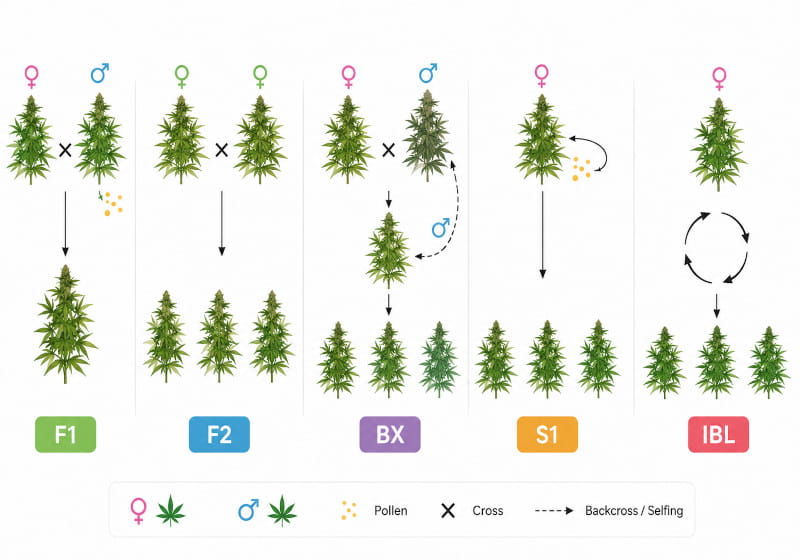
✓ F1 and F2 refer to successive filial generations. F1 is the first offspring generation of a defined cross, while F2 is produced by crossing F1 plants with each other or by selfing an F1 plant.
✓ An F2 generation often shows greater genetic and visible variation. Alleles are recombined, allowing traits to segregate and previously hidden recessive characteristics to become visible again.
✓ BX stands for backcross. An offspring is crossed again with one of its parents or with a genetically corresponding parental line in order to move the genetic background deliberately closer to that parent.
✓ S1 refers to the first generation after self-fertilization of a genotype. IBL stands for Inbred Line and describes a line developed through repeated inbreeding, with a high degree of homozygosity and correspondingly more predictable inheritance.
✓ Terms such as F1 and IBL are sometimes used less strictly in the cannabis seed market than in classical plant breeding. A cross labeled F1 is therefore not automatically a genetically highly uniform F1 hybrid derived from largely homozygous parental lines.
Terms such as F1 Cannabis, F2 Cannabis, BX1, S1 or IBL frequently appear in pedigrees and descriptions of cannabis genetics. At first, these abbreviations may look like different quality levels, but they actually describe different generations, relationships and breeding methods. They show how a population was created – not automatically how high-quality, productive or genetically stable it is.
For a correct interpretation, a distinction must be made between the terminology of genetics and plant breeding and the way these terms are used within the cannabis industry. This is particularly clear with the term F1. In classical hybrid breeding, F1 hybrids are typically produced by crossing genetically uniform, highly homozygous parental lines. In the cannabis market, by contrast, F1 is often already used for the first cross between two strains or selected clones, even though the parents themselves may still be highly heterozygous. With cannabis seeds, the generation designation alone therefore says nothing about how genetically uniform the offspring actually are.
What Does Cannabis Genetics Mean?
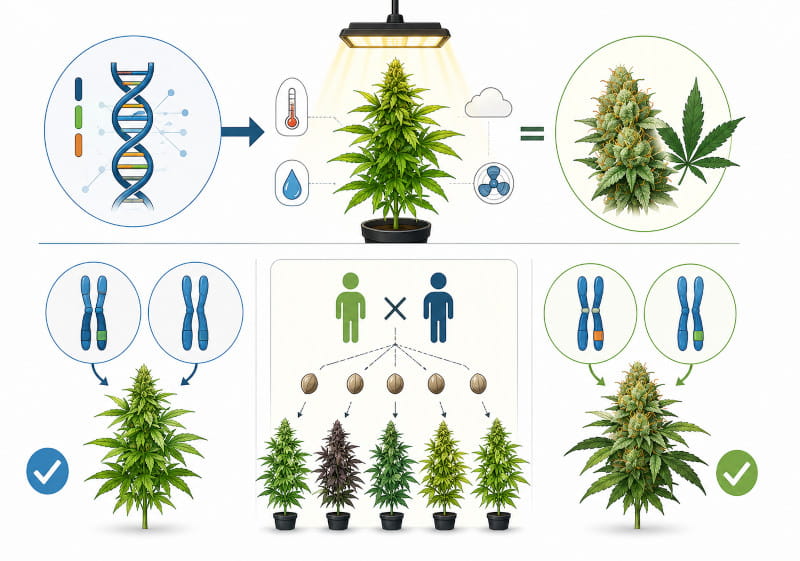
Cannabis genetics refers to the heritable genetic information of a plant or population and therefore forms the basis for which traits can be passed on to the next generation. This includes genetic variants at numerous gene loci, whose totality and combination determine the genotype of a plant. Which traits actually become visible or measurable then depends on the interaction between genotype and environment.
Cannabis genetics therefore encompasses far more than strain names or ancestry lines in a pedigree. Growth form, maturation time, sex expression, cannabinoid profile, terpene composition, pigmentation, resistance and numerous other traits can be genetically influenced. Many of these traits are complex and are affected by multiple genes as well as environmental factors. They therefore cannot be reduced to a single gene or a simple dominant-recessive inheritance pattern.
What Do Genotype and Phenotype Mean in Cannabis?
The genotype refers to the genetic makeup of a cannabis plant, while the phenotype describes its observable or measurable traits that arise from the interaction between genetics and environment. Two plants can be genetically very similar and still develop differently under different conditions. Conversely, plants can look similar even though they carry different alleles at certain gene loci.
In the cannabis sector, the term “phenotype” is often used for different variants within a seed population, for example when individual plants show differences in growth form, flower structure, aroma or maturation time. Scientifically, however, a phenotype is not the plant itself and is also not a fixed genetic package. It refers to the specific expression of one or more traits influenced by the genotype and the respective environmental conditions.
What Do Homozygosity and Heterozygosity Mean?
Homozygous means that a plant carries two identical variants of a particular gene, while heterozygous means that it carries two different variants of that gene. Such different variants of a gene are referred to as alleles in genetics. Put simply, for many genes a plant receives one variant from each parent.
If, for example, a plant carries the same variant twice for a particular gene, it is homozygous at that locus, meaning true-breeding there. If it carries two different variants, it is heterozygous at that locus. A cannabis plant is therefore not simply homozygous or heterozygous as a whole. It can be homozygous in some regions of its genome and heterozygous in others.
Through repeated inbreeding, the proportion of homozygous regions in the genome normally increases. This can allow certain genetic traits to be passed on to offspring more reliably. At the same time, however, undesirable recessive characteristics may become more apparent and genetic diversity may be lost. How uniform a cannabis genetic line actually is therefore cannot be judged solely from its strain name or generation designation.
What Are Dominant and Recessive Traits?
Dominance describes how two different alleles at the same gene locus affect a phenotype in the heterozygous state; a dominant allele can mask the effect of a recessive allele for the trait being considered. Recessive therefore does not mean “weak,” and dominant does not mean “better” or “more common.”
The classical Mendelian model is very useful for individual traits that follow such inheritance patterns. However, many cannabis traits of interest to breeders are quantitative, polygenic or influenced by gene-environment interactions. Even with cannabinoids, the genetic architecture is more complex than simple strain descriptions may suggest. Aroma, yield, plant form or overall effects therefore cannot be reliably explained by a single “dominant gene.”
What Do F1, F2, F3 and Further Generations Mean in Cannabis?
F1, F2, F3 and further F designations refer to successive offspring generations within a particular cross and breeding line. The “F” comes from the technical term filial generation and, put simply, means offspring generation. F1 therefore refers to the first generation after crossing the original parents, F2 to the second generation produced from it, F3 to the next one, and so on. For these designations to be meaningful, they must always relate to traceable ancestry and continued breeding.
|
Designation |
Simplified Scheme |
What Does It Mean? |
|
P |
Parental generation A × B |
original parents of the cross |
|
F1 |
A × B → F1 |
first offspring generation from crossing the original parents |
|
F2 |
F1 × F1 or selfing an F1 |
second offspring generation; genetic traits can recombine and segregate more strongly |
|
F3 |
continued breeding of selected F2 offspring |
third offspring generation; its characteristics depend strongly on which F2 plants were selected and crossed with one another |
|
F4, F5 … |
continued breeding within the line |
with consistent inbreeding, homozygosity increases on average; selection determines which traits are carried forward |
A higher F number therefore does not automatically mean that a cannabis genetic line is better or fully stabilized. An F5 may already pass on certain desired traits very reliably, while other traits may still show clear differences among the offspring. What matters is not only the number of generations, but also the choice of parents, the size of the breeding population and consistent selection over several generations.
What Is an F1 Generation in Cannabis?
The F1 is the first filial generation produced directly from a defined cross between two parents. In formal plant breeding, the term has particular significance when two largely homozygous and genetically different inbred lines are crossed. At the parts of the genome where the parents differ genetically, their F1 offspring typically receive one gene variant from each parent and can therefore be genetically very uniform.
With cannabis, this qualification is particularly important. If a breeder crosses two highly heterozygous clones or seed lines, their direct offspring are indeed the first generation of that cross. However, they do not necessarily possess the genetic uniformity expected from a classical F1 hybrid made from largely homozygous parental lines. Specialist literature on cannabis breeding therefore more accurately refers to many historical crosses as heterozygous hybrids or “pseudo-F1” configurations.
An example of the use of the F1 designation in the cannabis seed market is Killer Kush F1 Fast Version by Sweet Seeds. Its genetics are listed as OG Kush x Secret 3G Auto. As with other cannabis genetics sold as F1, the designation should first be read as information about the documented cross or generation and should not automatically be equated with a classical F1 hybrid derived from highly homozygous parental lines.
Why Is Not Every “F1 Cannabis” a Classical F1 Hybrid?
A first cross can produce F1 offspring without meeting the genetic requirements of a classical commercial F1 hybrid derived from highly homozygous parental lines. In seed marketing, “F1” is often used as a synonym for “the first cross between strain A and strain B.” This describes the ancestry, but by itself says little about the homozygosity of the parents, the genetic uniformity of the offspring or proven heterosis.
If both parents are heterozygous at many loci (specific positions in the genome), they can pass different alleles, meaning variants of a gene, to individual seeds. As a result, even the first offspring generation can vary considerably. A scientifically well-documented F1 hybrid therefore requires more information than two strain names: the origin and genetic uniformity of the parents, a controlled cross, progeny testing and – if hybrid vigor is claimed – a suitable performance comparison.
What Is an F2 Generation in Cannabis?
An F2 is produced when F1 individuals are crossed with one another or – where reproductive biology permits or self-fertilization is technically enabled – when an F1 is crossed with itself. In this second filial generation, the alleles inherited from the parents, meaning different variants of a gene, are recombined during the formation of gametes and subsequent fertilization.
The F2 is particularly informative for geneticists and breeders because combinations of traits can segregate there. A classic cannabis example comes from research into the inheritance of chemical phenotypes: with certain true-breeding parents and a studied cannabinoid locus (a specific position in the genome), the F2 showed the expected segregation of different chemotypes. However, this specific result must not be generalized to complex traits such as aroma, plant height or yield.
A practical example of such a second generation is Headbanger F2 by Cannapot Seeds. The underlying Headbanger genetics, Sour Diesel K.G. Cut x Biker Kush V1, were crossed further within the following generation. An F2 can be particularly interesting for selection because the existing gene variants recombine and can be distributed differently among the offspring. This can make different trait expressions visible.
Why Does an F2 Often Show More Genetic Variation?
An F2 can show greater phenotypic variation because heterozygous loci in the F1 segregate and recombination creates new allele combinations. Recessive alleles that were phenotypically masked in the heterozygous F1 state can come together in homozygous form in the F2 and become visible.
At a single idealized gene locus with the alleles A and a, Aa × Aa produces the genotypes AA, Aa and aa in a 1:2:1 ratio under the classical Mendelian model. Real cannabis traits, however, often depend on many genes, linkage, epistasis and environmental influences. An F2 can therefore display a broad spectrum without every trait fitting into simple 3:1 or 1:2:1 ratios.
What Does BX or Backcross Mean in Cannabis?
BX or backcross refers to a cross in which a hybrid offspring is crossed again with one of its parents or with a genetically corresponding line of that parent. In scientific plant breeding, the abbreviation BC is generally used for backcross; BX is very common in the cannabis sector.
A common goal of backcrossing is to restore a large part of the genetic background of the so-called recurrent parent while retaining a desired trait from a donor. Whether this goal is actually achieved depends on selection, population size, the inheritance of the target trait and the genetic makeup of the parents.
A practical example of the use of a backcross is Zkittlez by Medical Seeds. With such BX genetics, after a previous cross the line is backcrossed toward a selected parental background. This can help preserve or enrich certain genetic characteristics of the recurrent parent more specifically in the offspring, without a backcross alone already meaning complete genetic stability.
What Do BX1, BX2 and BX3 Mean?
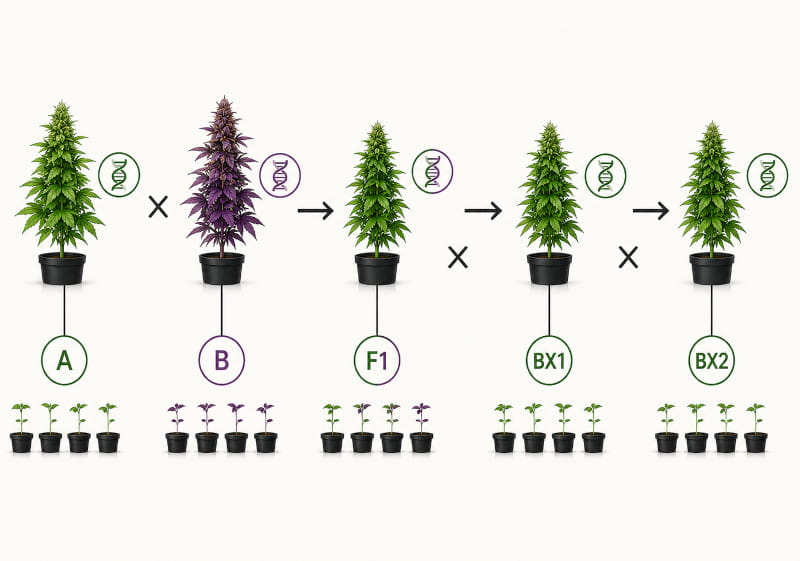
BX1 refers to the first backcross to a selected parent, BX2 to the second, and BX3 accordingly to the third round of backcrossing. A simplified scheme is: A × B → F1; F1 × A → BX1; selected BX1 × A → BX2; selected BX2 × A → BX3. In this scheme, A is the so-called recurrent parent, meaning the parent to which repeated backcrossing is performed.
The number after BX therefore describes how many times backcrossing has been carried out within this breeding scheme. However, it does not automatically indicate how genetically uniform or “stable” the resulting line is. This is particularly important in cannabis: if repeated backcrosses are made to a heterozygous parent or clone, that parent can continue to pass different gene variants to its offspring. Several backcrosses therefore do not automatically create a fully homozygous, largely true-breeding line that reliably passes its desired traits to all offspring.
What Does S1 Mean in Cannabis?
S1 refers to the first generation after self-fertilization, also called selfing, of a specific genotype. Both the egg cells and the pollen used for fertilization are genetically derived from the same original plant. In female cannabis plants, such selfing can be enabled for breeding purposes by inducing the plant to produce functional pollen and using that pollen to fertilize the same genetics.
Through selfing, homozygosity, meaning true-breeding, increases on average in the offspring. At the same time, previously hidden recessive gene variants can become visible – both desired and undesired ones. An S1 is therefore not a genetic copy of the mother plant. If the original plant is heterozygous, meaning it carries different variants at certain parts of its genome, these gene variants can be distributed differently among the S1 offspring. Some plants may be very similar to the original phenotype, while others may differ considerably.
A concrete example of such selfed offspring is Airborne G13 S1 by Brothers Grimm Seeds. The S1 designation indicates that the seeds were produced by selfing the underlying Airborne G13 genotype. The same applies here: the seeds are not genetic copies of the original plant. Existing genetic differences can be redistributed during selfing and thereby produce different trait combinations among the offspring.
What Is an IBL in Cannabis?
IBL stands for Inbred Line and, in plant breeding, refers to a line developed through repeated inbreeding with a high degree of homozygosity, meaning true-breeding. This makes many genetic characteristics within the line more uniform and allows them to be passed on to offspring more predictably. However, an IBL is not created simply because a strain has existed for several years or has reached a particular F number.
In the cannabis industry, the term IBL is often used somewhat more broadly. It is also applied to lines that have been selected over several generations within a limited gene pool, meaning a restricted genetic starting base, and that produce relatively uniform offspring for certain traits. However, this is not automatically the same as a nearly fully homozygous inbred line of the kind used as a parental line in classical hybrid breeding programs for other crops.
A concrete example of genetics explicitly described as an Inbred Line in the cannabis seed market is Lemon Whhip Haze IBL by Ethos Genetics. Its ancestry is given as Super Lemon Haze IBL × Super Lemon Haze IBL. The strain designation therefore illustrates the use of the term IBL in the commercial cannabis sector. For scientifically precise classification, however, the actual degree of homozygosity or true-breeding within the line is decisive.
The term “true breeding,” meaning the reliable inheritance of certain traits, must also always be related to specific characteristics. A line can, for example, be homozygous for a particular gene variant or trait and pass it on reliably, while genetic differences remain in other parts of its genome. A fixed rule such as “from F5 onward cannabis is automatically an IBL” is therefore not scientifically valid.
What Is the Difference Between F1, F2, BX, S1 and IBL?
F1 and F2 describe filial generations, BX a backcross, S1 the first generation after self-fertilization, and IBL a line developed through repeated inbreeding. The terms therefore describe different breeding paths and genetic relationships. They are not successive stages of a single breeding sequence.
|
Term |
What Does It Describe? |
Typical Scheme |
Important Interpretation |
|
F1 |
first filial generation |
A × B → F1 |
particularly genetically uniform F1 hybrids typically arise from largely homozygous, true-breeding parental lines |
|
F2 |
second filial generation |
F1 × F1 or selfing an F1 |
gene variants are recombined and traits can segregate more strongly |
|
BX |
backcross |
F1 × selected parent |
often used to move genetically closer again to a particular parent and carry desired traits forward |
|
S1 |
first generation after self-fertilization |
A × A, the same genotype provides egg cells and pollen |
increases homozygosity or true-breeding on average; however, the offspring are not genetic copies of the original plant |
|
IBL |
inbred line |
repeated inbreeding + selection |
a high degree of homozygosity or true-breeding is decisive; a particular F number does not automatically make a line an IBL |
What Is Heterosis and When Is the Term Useful for Cannabis?
Heterosis means that the offspring of a cross perform better for certain traits than their parents or than a defined parental comparison value. The term hybrid vigor is also commonly used. In plant breeding, heterosis can be expressed, for example, in growth rate, biomass, fertility or yield. However, it must always be measured for specific traits and compared with the parents.
A particularly vigorous cannabis F1 is therefore not automatically proof of heterosis. A reliable statement requires defined parents, controlled offspring and suitable comparative data. Depending on the study, the comparison may be made, for example, with the average performance of both parents or with the better-performing parent. The terms “F1” and “heterosis” are therefore not synonyms.
Hybrid breeding also plays an important role in cannabis in principle. Scientific studies deal, among other things, with heterozygous hybrids, with inbreeding depression – possible reductions in performance as inbreeding increases – and with the development of homozygous, largely true-breeding parental lines for more genetically uniform F1 populations. Whether and to what extent a particular cross actually benefits from heterosis must, however, be investigated experimentally for that specific genetic combination.
What Does Stabilization of Cannabis Genetics Mean?
In breeding, stabilization means that desired traits are inherited increasingly reliably over several generations and that undesirable differences among offspring are reduced. A cannabis genetic line therefore does not become more stable simply because it is propagated over several generations. Controlled crosses, targeted selection and testing of the resulting offspring are decisive.
The term “stable” should therefore always be related to specific traits. A line may, for example, reliably inherit a particular chemotype or flower color, while plant height, growth form or aroma profile continue to vary. Practical uniformity in selected traits therefore does not mean that all plants in a seed population are genetically identical.
What Role Does Selection Play in Cannabis Breeding?
Selection involves deliberately choosing as parents those plants whose traits are intended to be preserved or strengthened in subsequent generations. Especially in classical breeding with regular cannabis seeds, male and female parents can be selected and combined with one another. An F2 with high genetic variation initially provides only the starting material. How different plants within a population are systematically compared and promising phenotypes selected as keepers is explained in detail in our Canna Wiki guide to cannabis pheno hunting. Only by deliberately selecting suitable plants and subsequently testing their offspring can it be determined whether desired traits are actually heritable and recur reliably.
However, restricting breeding too strongly to only a few parent plants can significantly reduce the genetic diversity of a line. This may make it possible to standardize certain traits more quickly, but undesirable gene variants may also be retained or valuable genetic differences may be lost. In plants that naturally reproduce predominantly through cross-pollination, inbreeding depression can also occur. This refers to possible disadvantages such as reduced vigor, fertility or performance as a result of increasing inbreeding.
What Role Does Backcrossing Play in Stabilization?
Backcrossing can be used to carry certain traits forward deliberately or to move a genetic line closer again to a selected parent. However, it does not automatically create a fully stabilized line. In classical backcross programs, suitable offspring with the desired traits are selected after each backcross and crossed again with the relevant parent.
In cannabis, BX is often used to make certain characteristics of a selected clone more prominent again in a seed line. If that clone itself is heterozygous, meaning it carries different variants at many parts of its genome, it can pass different gene variants on with every backcross. Repeated backcrossing alone therefore does not guarantee complete genetic uniformity. Targeted selection and, depending on the breeding goal, further inbreeding or other breeding strategies are necessary.
How Are Landraces, Heirloom Genetics, IBLs and Modern Hybrids Related?
Landraces, heirloom genetics, inbred lines and modern hybrids describe different forms and stages of development of cannabis genetics and must not be treated as interchangeable terms. Landraces are populations that developed regionally and adapted over long periods to particular environmental conditions. Considerable genetic diversity can still exist within such a population. A landrace is therefore not automatically an IBL.
Heirloom is generally used for older lines preserved outside their region of origin, but it is not a strictly uniform genetic technical term. An IBL, by contrast, is created through targeted inbreeding with the aim of increasing homozygosity and therefore the reliable inheritance of certain traits. Modern hybrids can originate from landraces, heirloom material, older hybrids, clones or inbred lines. Historical lines and hybrid groups such as Haze, Kush and Skunk show how different genetic origins were brought together in later crosses. The frequently used terms Sativa and Indica are also not simple genetic categories, but historically developed classifications with complex ancestry. The more heterozygous and genetically complex the original parents are, the less can be inferred from a strain name alone about how uniform their offspring will be.
Why Are Cannabis Pedigrees Alone Not Proof of Genetic Stability?
At best, a pedigree shows which parents were used and which crosses were made, but it does not prove how homozygous or uniform a cannabis genetic line actually is. Two lines with the same strain name can differ genetically from one another. A polyhybrid, meaning genetics whose ancestry combines several different hybrids, can also remain highly heterozygous at many parts of its genome despite an extensive pedigree. Especially with classic and modern cannabis strains, well-known names can therefore conceal very different breeding histories.
Genetic studies of cannabis show clear differences between named strains and populations. For a scientifically robust assessment, genetic analyses, controlled pedigree data, chemical analyses and repeated testing of visible and measurable traits are therefore more informative than a strain name or generation designation alone.
How Do You Read Cannabis Crosses Correctly?
A cross designation should be read as a description of the documented ancestry and breeding path used – not as a guarantee of particular traits. “A × B F1” refers to the first filial generation from crossing A and B. “(A × B) F2” refers to the second filial generation continued from that cross. “(A × B) BX1 A” refers to a first backcross toward A, while “A S1” stands for the first generation after self-fertilization of A.
The more precisely cannabis genetics are documented, the clearer the parents used, the generation, the breeding path and the selection goal should be. Terms such as “stable,” “F1 hybrid” or “IBL” become particularly meaningful when it is also known how uniform the offspring actually are and how the line was developed over several generations.
What Common Misunderstandings Exist About Cannabis Genetics?
The most common misunderstandings arise when generation designations are automatically equated with quality, stability or performance. F1 does not always mean genetically uniform, F2 does not mean “worse,” BX is no guarantee of stability, S1 is not a clone in seed form, and IBL is not a protected quality grade.
-
“F1 is always uniform”: Particularly high uniformity is mainly to be expected when the parents used are genetically correspondingly uniform and largely true-breeding.
-
“F2 is unstable and worthless”: In an F2, gene variants can recombine and different traits can become more pronounced. It is precisely this diversity that makes F2 populations especially interesting for selection and genetic studies.
-
“BX3 is automatically more stable than BX1”: The number after BX merely shows how many rounds of backcrossing have been carried out. It does not automatically indicate how uniformly or reliably individual traits are inherited.
-
“S1 copies the mother”: An S1 consists of newly produced seeds and is not a genetic copy of the original plant. If that plant was heterozygous at certain parts of its genome, the existing gene variants can be distributed differently among the offspring.
-
“IBL means genetically identical”: Even an inbred line does not have to be fully homozygous at every part of its genome. What matters is a high degree of homozygosity and reliable inheritance of the traits that were selected over several generations.
-
“Dominant means stronger”: In genetics, dominant does not mean better, more vigorous or more productive. The term describes which of two different gene variants is expressed in the appearance of a particular trait.
FAQs
Q: What does F1 mean in cannabis?
A: F1 is the first filial generation from a defined cross between two parents. Particularly genetically uniform F1 hybrids typically arise when the parents used are largely homozygous, meaning true-breeding, and genetically different.
Q: What does F2 mean in cannabis?
A: F2 is the second filial generation and is produced by crossing F1 plants with each other or by selfing an F1 plant. Existing gene variants are recombined, allowing traits to segregate more strongly among the offspring.
Q: Is F2 worse than F1?
A: No. F2 describes a generation, not a quality level. The greater genetic variation of an F2 can even be especially valuable for breeding and selection.
Q: What does BX1 mean in cannabis?
A: BX1 refers to the first backcross of an offspring with a selected parent or a genetically corresponding parental line. Further backcrosses are referred to as BX2, BX3 and so on.
Q: What is the difference between BX and F2?
A: In an F2, F1 plants are crossed with one another or an F1 is self-fertilized. In a BX, by contrast, an offspring is backcrossed with a selected parent or a corresponding parental line.
Q: What does S1 mean in cannabis seeds?
A: S1 refers to the first generation after self-fertilization of a specific genotype. The resulting plants are not clones of the original plant. If the original plant was heterozygous at certain parts of its genome, the existing gene variants can be distributed differently among the S1 offspring.
Q: What does IBL mean in cannabis?
A: IBL stands for Inbred Line. In plant breeding, the term refers to a line developed through repeated inbreeding with a high degree of homozygosity, meaning true-breeding, and correspondingly reliable inheritance of certain traits.
Q: From which generation is cannabis considered an IBL?
A: There is no generally valid F number from which a cannabis line automatically qualifies as an IBL. What matters is the degree of homozygosity actually achieved, the breeding method used and the reliable inheritance of the selected traits.
Q: Why do new phenotypes appear in an F2?
A: In an F2, the gene variants inherited from the parents are recombined and distributed among the offspring. This can create new trait combinations and make previously hidden recessive characteristics visible.
Q: Is a landrace automatically an IBL?
A: No. A landrace is a historically developed and regionally adapted population in which substantial genetic diversity can still exist. An IBL, by contrast, is created through targeted inbreeding and selection with the aim of achieving high homozygosity and reliable inheritance of certain traits.
Q: Does F1 automatically mean heterosis?
A: No. Heterosis means that a cross shows higher performance for certain traits than a defined comparison with its parents. This effect must be measured. The F1 designation alone is therefore not evidence of heterosis or hybrid vigor.
How Should F1, F2, BX, S1 and IBL Be Classified Correctly?
F1, F2, BX, S1 and IBL should be understood as information about ancestry, breeding path and genetic status – not as a quality ranking. F1 and F2 refer to filial generations, BX documents one or more backcrosses, S1 identifies the first generation after self-fertilization, and IBL refers to a line developed through repeated inbreeding. How uniform and predictable cannabis genetics actually are additionally depends on the genetic makeup of the parents, the selection of breeding plants, population size and the reliable inheritance of the desired traits.
This distinction is especially important in cannabis because many historical and modern genetics originate from landraces, hybrids and selected clones that may themselves still contain considerable genetic diversity. For classical crossing and selection work, regular seeds therefore continue to play an important role today. Terms from genetics and plant breeding help classify such ancestry correctly – provided they are used according to their actual meaning and not merely as marketing labels.
Scientific and Technical Sources
-
National Human Genome Research Institute (NHGRI): Mendelian Inheritance and specialist glossary entries on dominant and recessive alleles.
-
FAO: Glossary of biotechnology and genetic engineering – definitions of hybridization, hybrid seed and heterosis.
-
Kovalchuk et al. (2020): Potentials and Challenges of Genomics for Breeding Cannabis Cultivars, Frontiers in Plant Science.
-
de Meijer et al. (2003): The inheritance of chemical phenotype in Cannabis sativa L., Genetics 163(1):335–346.
-
Campbell et al. (2020): Cannabinoid Inheritance Relies on Complex Genetic Architecture.
-
Dufresnes et al. (2017): Broad-Scale Genetic Diversity of Cannabis for Forensic Applications, PLOS ONE.
-
Frontiers in Plant Science (2023): Challenges and potentials of new breeding techniques in Cannabis sativa.
-
Toth et al. (2024): HASCH – a high-throughput SNP platform for medicinal cannabis and industrial hemp genotyping applications.
-
Campbell et al. (2021): Morphometric relationships and their contribution to biomass and cannabinoid yield in hybrids of hemp (Cannabis sativa).