Cannabis Flowering Stage: Week-by-Week
Cannabis Flowering Stage: Week-by-Week Guide, Key Signs, Best Practices, and Common Mistakes
Updated: March 2026 | Cannabis Flowering Stage: Week-by-Week Guide | Cannapot
Author: Cannapot Grow Team | Reading time: approximately sixteen minutes
The Most Important Things At A Glance
✓ The flowering stage is the most important part of the grow because this is where weight, aroma, resin and potency develop.
✓ Temperature, humidity, airflow and stable conditions become increasingly important as buds get denser.
✓ Harvesting too early, light leaks and poor airflow are among the most common flowering-stage mistakes.
The cannabis flowering stage is that turning point where a plant finally stops focusing on growing stems and leaves, and starts putting all its energy into developing flowers. It's the moment the plant starts looking, smelling, and behaving totally differently. Bud sites pop up, white pistils stretch out, the smell gets super loud, and you'll start noticing sticky resin coating the sugar leaves as harvest gets closer.
Let's be honest, for most people, this is the best part of the whole grow cycle. It's where all the hard work starts to actually look like something. But it’s also the phase that stresses people out the most. Everyone always wants to know: when does it actually start? How long is this going to take? What is a healthy plant supposed to look like in week 3 versus week 7? And how do you tell the difference between buds naturally fading and an actual problem?
If you need to zoom out and look at the bigger picture first, check out Cannapot’s guide to the cannabis growth cycle. For more background on genetics and plant types, you can also browse through the Canna Wiki.
Quick takeaway: The flowering stage is when the plant builds and ripens its buds. Early flowering is all about the "stretch" and white hairs. Mid-flowering brings the weight, the smell, and heavy trichome production. The late phase is the ripening zone—buds swell up, pistils change color, and the plant signals it's ready for harvest.
Contents
-
What exactly is the flowering stage?
-
When does the magic happen?
-
How long are we waiting?
-
The Week-by-Week Breakdown (With Nutrient & Environment Data)
-
Photoperiod vs Autoflower
-
Pro Tips for a Heavier Harvest
-
Common Mistakes People Keep Making
-
How to tell it's actually done
-
Related Cannapot pages
-
FAQ
What exactly is the flowering stage?
Think of the vegetative stage as building the foundation and the frame of a house. The flowering stage is putting on the roof and painting the walls. The plant stops caring about getting wider and shifts entirely to reproduction—which means creating flowers. This phase is crucial because it dictates your final yield and quality. You'll notice the plant drinking differently, smelling wild, and demanding a different kind of attention. It stops looking like a generic green bush and starts taking on the unique characteristics of its specific strain.
When does the magic happen?
Flowering doesn't just kick off magically for every plant at the same time. The trigger totally depends on the genetics you're working with.
Photoperiod plants: These rely on the light cycle. In nature, as summer ends and days get shorter, the longer nights trigger the plant to flower. Indoors, this is usually mimicked by switching the lights to a 12 hours on, 12 hours off schedule.
Autoflower plants: These don't care about the sun or the light timer. They flower based on their internal clock. After a few weeks of vegetative growth, they just start blooming on their own. If you want a deep dive into how these work, check out Growing Autoflowering Cannabis.
How long are we waiting?
There's no magic number here. The length of the flowering stage is tied heavily to genetics. A fast-finishing heavy Indica might be completely done and dusted in 7 to 8 weeks. A wispy, tall Sativa could easily test your patience and push 10, 12, even 14 weeks or more. Autoflowers have their own fast-track timelines entirely.
Instead of marking a calendar and blindly chopping on day 60, you have to learn to read what the plant is telling you. Let's break down what those milestones actually look like, along with the specific environment your plants need to thrive.
The Week-by-Week Breakdown (With Nutrient & Environment Data)
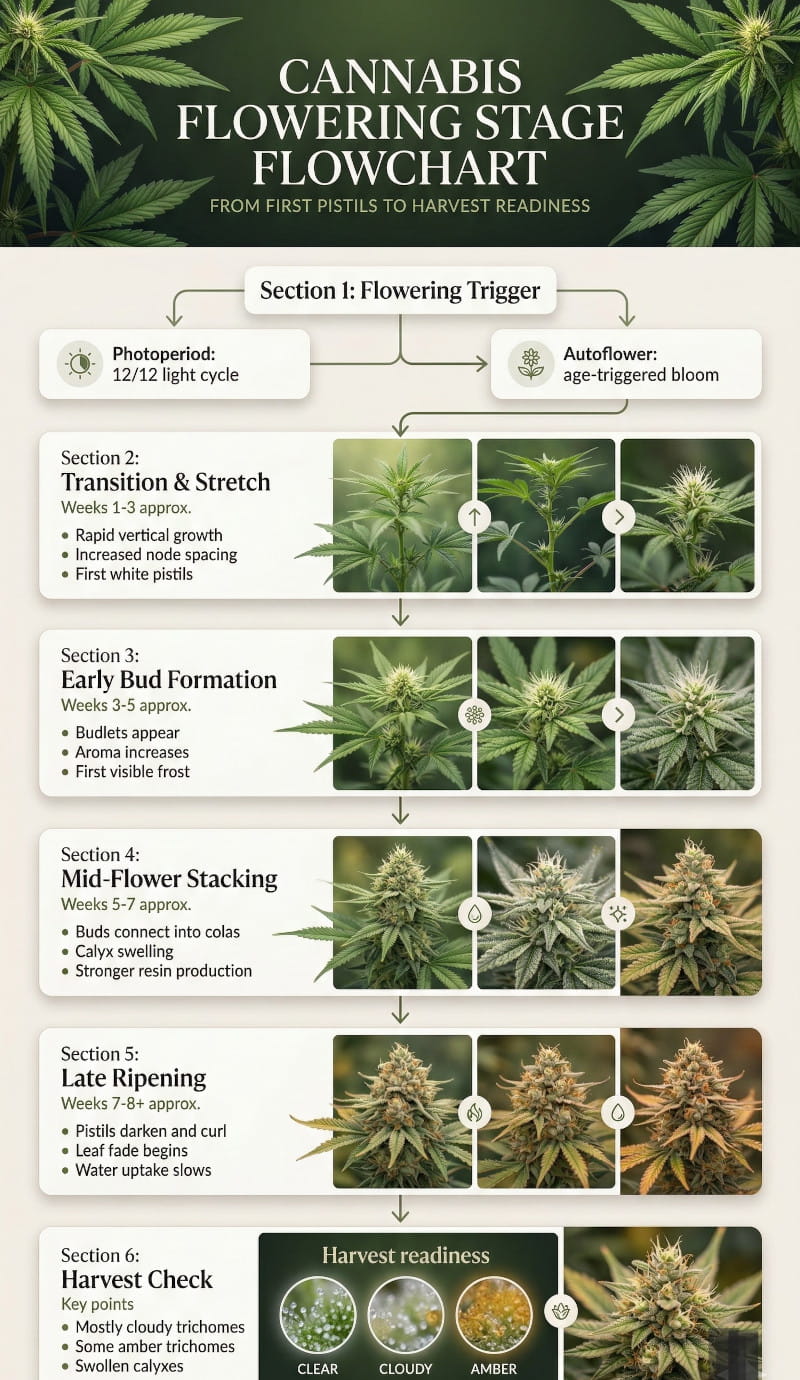
Weeks 1–3: The Transition and "The Stretch"
A lot of people flip their light schedule and expect massive buds the next morning. That’s not how it works. The first few weeks feel more like a messy transition.
The most shocking thing here is the "flowering stretch." Some plants will literally double or triple in height during these first few weeks. They reach up aggressively toward the light, creating the framework where the buds will eventually sit. At the nodes (where the branches meet the main stem), you'll start seeing little white hairs—these are the pistils.
Nutrients, Lighting, Temperature, and Humidity
|
NPK |
EC |
Humidity (RH) |
Temperature (Day/Night) |
|
5-7-10 approx. |
1.4–1.6 |
50–60% |
22–26°C / 18–20°C |
What to watch for:
-
Explosive vertical growth.
-
White wispy hairs popping up everywhere.
-
Increased thirst—they are growing fast and need water.
What you should be doing: Keep things stable. Don't go crazy with defoliation or high-stress training right now; the plant is already going through a massive hormonal shift. Gently tucking leaves or minor bending is fine, but mostly just let it do its thing.
Weeks 4–5: Budlets, Smell, and Stopping the Stretch
Okay, now we're talking. Around week 4, the crazy stretching usually slams on the brakes. The plant stops trying to touch the ceiling and starts putting its energy into fattening up those white hairy nodes into actual "budlets."
This is when the odor really starts to kick in, and you'll likely see the first real sugar leaves getting a frosty coating of trichomes. The flowers look like little spiky pom-poms.
Nutrients, Lighting, Temperature, and Humidity
|
NPK |
EC |
Humidity (RH) |
Temperature (Day/Night) |
|
3-10-12 approx. |
1.6–1.8 |
40–50% |
20–25°C / 18–20°C |
What to watch for:
-
Noticeable bud structure forming.
-
A serious uptick in aroma.
-
The branches stop getting taller and start getting heavier.
What you should be doing: This is a good time to make sure your airflow is solid. As buds get thicker, stale air becomes your worst enemy. Make sure fans are keeping the air moving to prevent mold. Also, if you need to support heavy branches with stakes or a trellis, do it now before they start leaning.
Weeks 6–7: Swelling Up and Stacking
This is the fun part. The buds stop looking like scattered pom-poms and start connecting along the branches to form long, thick colas. The calyxes (the tear-drop shaped parts of the flower) begin to swell up significantly.
You'll also notice the trichomes—the tiny, sticky crystals—multiplying rapidly. The smell will be overwhelmingly strong. You might also notice some of the older, lower fan leaves starting to yellow and drop off. Don't freak out; this is perfectly natural as the plant redirects all its energy to the top buds.
Nutrients, Lighting, Temperature, and Humidity
|
NPK |
EC |
Humidity (RH) |
Temperature (Day/Night) |
|
5-9-12 approx. |
1.5–1.7 |
35–45% |
20–24°C / 16–18°C |
What to watch for:
-
Buds getting noticeably fatter and denser.
-
Lower leaves yellowing naturally.
-
Some white pistils starting to curl inward and turn orange/brown.
What you should be doing: Keep a close eye out for any signs of bud rot or pests. The denser the flowers, the riskier it gets if your environment isn't dialed in. Start looking closely at the trichomes with a jeweler's loupe or a macro lens.
Week 8+: The Final Ripening and The Flush
We're in the endgame. The buds aren't really putting on much new size anymore; instead, they are ripening. Almost all of the white pistils will have darkened and curled in. The whole plant might look a bit tired, with more leaves fading to yellow, purple, or red—this is called the "fade" and it's a beautiful sign of a natural end of life.
Many growers choose to "flush" during the last week or two. This just means giving the plant plain, clean water with nothing added to it, helping it use up its stored reserves, which many believe leads to a smoother final product.
Nutrients, Lighting, Temperature, and Humidity
|
NPK |
EC |
Humidity (RH) |
Temperature (Day/Night) |
|
0-0-0 (Flush) |
0.0–0.4 |
30–40% |
18–22°C / 15–17°C |
What to watch for:
-
Trichomes changing from clear glass, to milky white, to amber.
-
A beautiful color fades in the leaves.
-
Very little water uptake compared to week 4.
Photoperiod vs Autoflower Flowering
It's super important to remember that not all plants play by the same rules. If you're reading forums, make sure the advice matches the kind of seed you planted.
|
Plant Type |
How It Triggers |
What It Means For You |
Explore Seeds |
|
Photoperiod |
Changes in light cycle (longer dark periods) |
You control exactly when it flowers by flipping the lights to 12/12. |
|
|
Autoflower |
Age and internal genetics |
It flowers when it wants to, usually 3–4 weeks from sprout. Fast and automatic. |
|
|
Regular Seeds |
Can be auto or photo, but includes males |
You have to identify and remove males early in flower to avoid seeded buds. |
Pro Tips for a Heavier, Healthier Harvest
To really get the most out of your flowering phase and maximize those authority E-E-A-T signals in your garden, keep these concepts in mind:
-
Light Leaks are the Enemy: If you are growing photoperiods, their 12 hours of darkness must be pitch black. Even a small light leak from a cracked tent zipper or an LED indicator can stress the plant and cause it to turn hermaphroditic (producing seeds).
-
Strategic Defoliation: Stripping a few large fan leaves that are blocking light to lower bud sites is great, but don't overdo it. The plant still needs leaves to process light into energy. A good rule of thumb is to do a light clean-up around week 3, and then leave it alone.
-
Support Your Heavy Yielders: As buds stack, the branches can snap under their own weight. Use yo-yos, bamboo stakes, or a scrog net to keep them upright so the plant doesn't waste energy repairing broken stems.
Common Mistakes People Keep Making
It's easy to get inside your own head during flowering. Here are the traps people fall into:
1. Panicking during the stretch
People see their plants doubling in size in week 2 and try to aggressively train or tie them down late in the game. You can easily snap a stiff, flowering branch. Just expect the stretch and manage your canopy early.
2. Chopping way too early
This is the number one mistake. The buds might look big and smell great at week 6, but they aren't done. The last two weeks are when the final swelling and trichome ripening happen. Chopping early literally costs you weight and potency.
3. Freaking out over yellow leaves
In week 3, yellowing leaves might be a nutrient issue. But in week 7 or 8? It's completely normal. The plant is cannibalizing its own leaves to push everything into the flowers. Let it happen.
4. Staring at pistils instead of trichomes
Don't just look at the white or orange hairs to decide if it's done. You have to look closely at the tiny resin glands (trichomes) on the buds themselves.
How to tell it's actually done
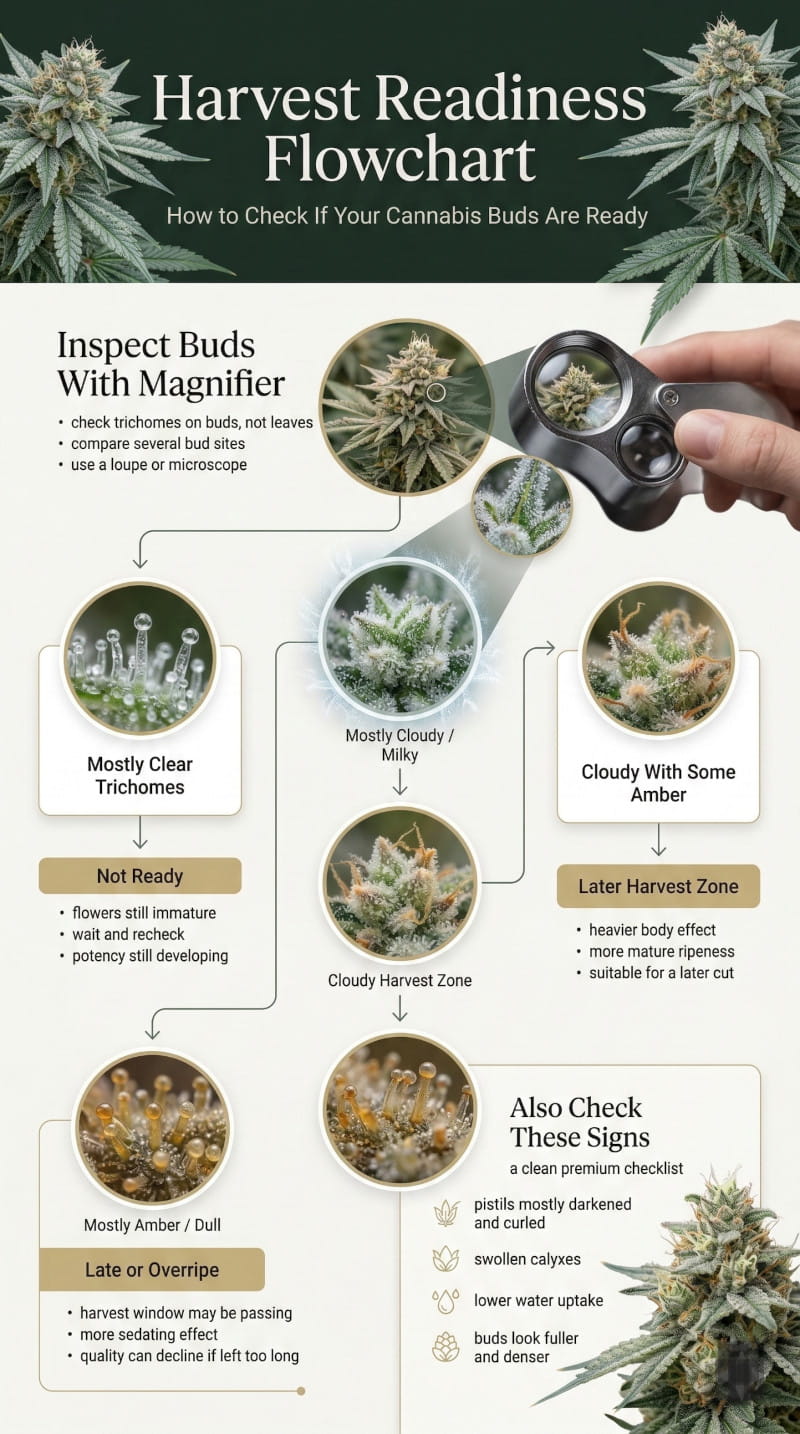
Forget the calendar. The plant will tell you when it's ready if you know what to look for. You want to examine the trichomes under a magnifying glass or jeweler's loupe.
-
Clear Trichomes: Look like glass. The plant is not ready. The effects will be weak and a bit racey.
-
Cloudy/Milky Trichomes: Look like cloudy plastic. This is peak THC. The bud is ripe.
-
Amber Trichomes: Look brown or golden. The THC is degrading into CBN, which gives a heavier, more couch-lock effect.
Most growers chop when they see about 70-80% cloudy trichomes and 20-30% amber. Combine that with swollen calyxes, receding orange hairs, and fading fan leaves, and you've got a plant that is ready for the scissors.
Related Cannapot pages
Keep your research going with these resources:
FAQs - Cannabis Flowering Stage
What is the cannabis flowering stage?
It’s the final phase of the plant's life cycle where it shifts entirely from growing leaves and stems to producing sticky, resinous buds.
When does it actually start?
For photoperiod strains, it starts when they receive 12 hours of uninterrupted darkness per day. Autoflowers just do it automatically after a few weeks of vegetative growth, regardless of the light schedule.
What are the very first signs of flowering?
You'll notice the plant shooting up quickly (known as the stretch) and little white hairs (pistils) appearing at the joints of the branches.
Why do plants stretch so much in early flower?
It’s a natural hormonal response to the change in light or age. The plant is literally reaching up to create space for the buds to grow and catch pollen in the wild.
Should I be worried if my leaves are turning yellow late in flower?
Not at all. In the final weeks, the plant naturally drains the nutrients from its older fan leaves to feed the swelling buds. It’s part of the normal ripening process called the "fade."
How do I know when it’s finally time to harvest?
Look at the trichomes (the shiny crystals on the buds) using a magnifier. When most of them turn from clear to a milky cloudy color, with a few turning amber, it’s time to chop.