Cannabichromene (CBC): Overview & Facts
What Research Shows About CBC in Cannabis
Updated: October 2026 | Cannabichromene (CBC) explained clearly: formation via CBCA, plant biochemistry, properties, research, CBC-rich chemotypes, and differences from THC, CBD, CBG, and CBN.
Author: Cannapot Grow Team | Reading time: approximately twenty minutes
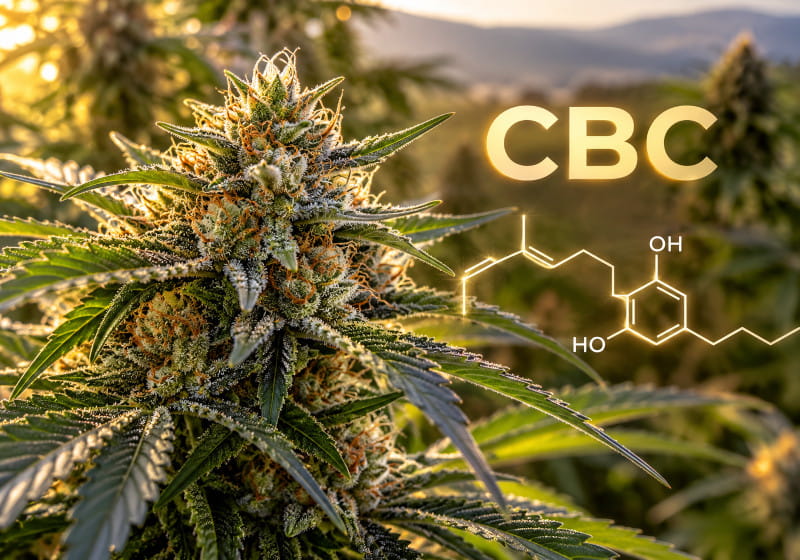
The Most Important Points at a Glance
✓ CBC stands for cannabichromene and is a naturally occurring phytocannabinoid in the cannabis plant.
✓ Unlike CBN, CBC is not a typical aging product. Its acidic precursor CBCA is formed from CBGA in cannabinoid metabolism.
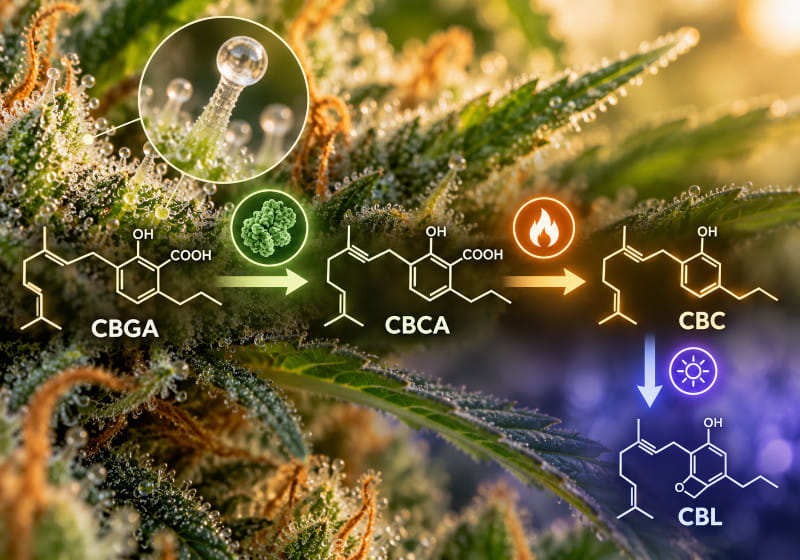
✓ In simplified terms, the pathway can be represented as CBGA → CBCA → CBC. The first step is enzymatic; neutral CBC can form from CBCA through decarboxylation.
✓ Under exposure to light, CBC can be photochemically transformed into cannabicyclol (CBL). This process must be distinguished from biosynthesis and decarboxylation.
✓ CBC is not considered intoxicating in the THC-typical sense. Its pharmacology is nevertheless complex and includes research on CB2 and various TRP receptors.
✓ Most claims about the possible biological properties of CBC come from cell and animal studies. No clinically proven therapeutic effect has been established for isolated CBC.
✓ Human data are available, including on pharmacokinetics. However, CBC was administered together with CBD and THC in a cannabis product.
✓ CBC-rich chemotypes have been scientifically described and are genetically plausible in principle. This clearly distinguishes CBC from CBN.
What Is Cannabichromene (CBC)?
Cannabichromene, or CBC for short, is one of the naturally occurring phytocannabinoids in cannabis. It has the same molecular formula as THC and CBD, but differs from these molecules in its structure, formation, and pharmacology.
CBC is often classified as a so-called minor cannabinoid because it occurs in many cannabis samples at substantially lower concentrations than the dominant cannabinoids THC or THCA and CBD or CBDA. “Minor” does not mean that CBC is insignificant to plant biochemistry. Its formation clearly illustrates how different cannabinoid pathways can emerge from a common biosynthetic starting point.
It is particularly important to distinguish CBC from CBN. While cannabinol is primarily associated with subsequent oxidative changes in THC-related cannabinoids, CBC has a biosynthetically formed acidic precursor, cannabichromenic acid (CBCA). CBC is therefore not merely a degradation product of another major cannabinoid.
In short: The CBC pathway begins in the plant with the formation of CBCA. Through decarboxylation, neutral CBC can form from this acidic precursor.
How Is CBC Formed in Cannabis?
The central pathway leading to CBC begins with cannabigerolic acid (CBGA). Enzymatic reactions can convert it into cannabichromenic acid (CBCA). CBCA can subsequently decarboxylate, producing neutral CBC.
CBGA as a Common Starting Point
CBGA is a central branching point in cannabinoid biosynthesis. Related oxidocyclase enzymes convert this molecule into various cannabinoid acids. These include THCA, CBDA and CBCA.
Biochemically, CBC therefore differs fundamentally from a typical aging product: the key compound initially is not neutral CBC, but the acidic precursor CBCA formed in the plant.
What Role Does CBCA Synthase Play?
Cannabichromenic acid synthase (CBCAS) has been characterized as an enzyme capable of catalyzing the formation of CBCA. In the classic enzyme study by Morimoto and colleagues, the purified enzyme converted both CBGA and cannabinerolic acid. However, the kinetic data indicated that CBGA is the physiologically more important substrate for CBCA formation.
The genetic interpretation is more complex than a simple “one gene = one cannabinoid” model. Modern studies show sequence variability and overlap within the cannabinoid synthase family. For a clear biochemical understanding, however, CBGA → CBCA remains the key CBC branch.
How Does CBCA Become CBC?
CBCA contains a carboxyl group. During decarboxylation, carbon dioxide (CO₂) is released and neutral CBC is formed. Heat can accelerate this process; however, decarboxylation can also occur without deliberate heating during processing and storage.
| Step | Process | Classification |
|---|---|---|
| CBGA → CBCA | enzymatic oxidocyclization | part of cannabinoid biosynthesis in the plant |
| CBCA → CBC | decarboxylation | release of CO₂; can be accelerated by heat |
| CBC → CBL | photochemical transformation | experimentally demonstrated under exposure to light |
CBC in the Cannabis Plant
How much CBCA and CBC a plant or sample contains depends on several factors. These include genetics, developmental stage, tissue, processing, and post-harvest conditions.
Do Young Plants Contain Particularly High Levels of CBC?
Genetic and developmental studies have described cannabis lines in which CBC, or the CBC pathway, can account for a high relative proportion of the cannabinoid profile during juvenile stages, with this proportion declining as the plant matures.
This does not automatically mean that young plants generally contain the greatest absolute amount of CBC. A relative proportion describes the share within the cannabinoids measured. At the same time, the total cannabinoid content can change substantially during plant development.
What Role Do Trichomes Play?
The biosynthesis and accumulation of cannabinoids are closely associated with specialized glandular structures. Glandular trichomes, particularly on the flowers, are important sites of cannabinoid production and storage. Our overview of cannabis plant anatomy explains how these structures are integrated into the plant. Developmental stage, tissue type, and trichome maturity can influence the cannabinoid profile measured analytically.
CBC, Light, and Cannabicyclol (CBL)
CBC is not chemically immutable after it has formed. As early as 1968, experiments showed that cannabichromene can be photochemically transformed into cannabicyclol (CBL) under exposure to light.
This process must be distinguished from biosynthesis. CBGA → CBCA describes an enzymatic pathway; CBCA → CBC is a decarboxylation; CBC → CBL, by contrast, is a subsequent photochemical reaction.
It would therefore be too simplistic to say that “old CBC turns into CBL.” Whether and to what extent this transformation occurs in a real sample depends, among other things, on light exposure, time, the sample matrix, and other post-harvest conditions. Plant material also continues to change during fermentation or curing; however, this does not allow a specific degree of CBC-to-CBL conversion to be assumed in general.
Important: A cannabinoid profile is not static. After biosynthesis, decarboxylation, oxidation, light, and other chemical processes can continue to alter the composition of a sample.
History of CBC Research
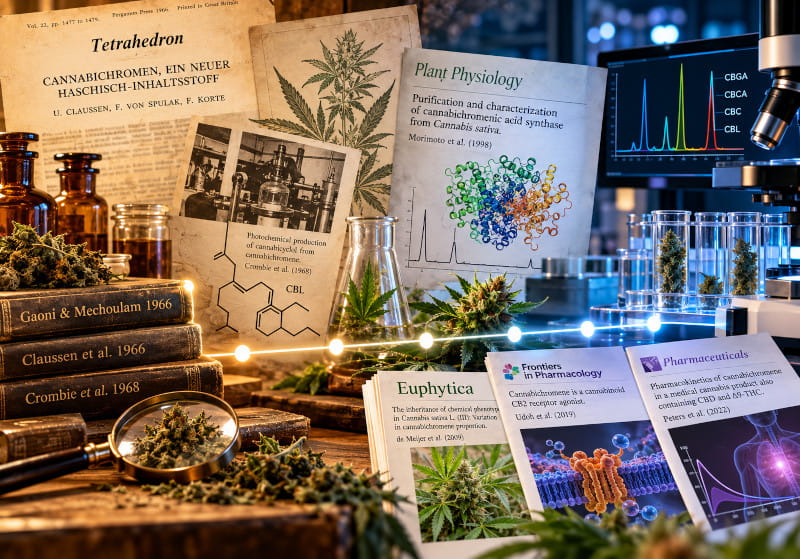
Cannabichromene was described in 1966 during a period of intensive chemical research into cannabis. In the same year, papers by Gaoni and Mechoulam and by Claussen, von Spulak, and Korte were published on this newly characterized cannabis constituent.
In 1968, the photochemical formation of cannabicyclol from CBC was investigated. Decades later, plant biochemistry became a stronger focus: in the 1990s, the enzymatic formation of CBCA was studied and cannabichromenic acid synthase was characterized.
The history of CBC thus reflects a broader shift in cannabis research: from the isolation and structural elucidation of individual constituents toward biosynthesis, genetics, receptor pharmacology, pharmacokinetics, and metabolism.
What Chemical Properties Does CBC Have?
Cannabichromene has the molecular formula C21H30O2 and a molar mass of approximately 314.5 g/mol. THC and CBD have the same molecular formula but a different structure.
Such compounds are known as structural isomers: they consist of the same types and numbers of atoms but differ in how those atoms are connected. These structural differences in turn influence physicochemical properties and interactions with biological targets.
Is All Naturally Occurring CBC Stereochemically Identical?
No. CBC is chiral and can occur in two mirror-image forms known as enantiomers. A 2023 study of natural cannabis samples showed that both enantiomeric excess and the dominant CBC enantiomer can differ among the cannabis lines examined.
The authors consider a genetic basis for these differences plausible and discuss different CBCAS isoforms as well as other factors involved in stereoselectivity. The possibility that stereochemistry may be biologically relevant is consistent with more recent receptor studies: (-)-CBC and (+)-CBC did not show identical pharmacological profiles in every respect in experimental models.
Why this matters: A laboratory value for “CBC” describes the total amount of the cannabinoid, but does not automatically indicate the ratio of its enantiomers. This distinction could become relevant for future CBC research.
CBC and the Endocannabinoid System
The receptor pharmacology of CBC is more complex than simple statements such as “CBC acts on CB2” might suggest. Results depend on the experimental model, concentration, signaling pathway examined, and in some cases stereochemistry.
A functional cell study from 2019 showed activation of CB2, but not CB1, in AtT20 cells. A later study of CBC enantiomers refined this picture: (-)-CBC activated CB2, whereas (+)-CBC did not within the concentration range examined. Only at a high concentration did (-)-CBC show measurable CB1 activity in this model.
Such data are valuable because they investigate molecular mechanisms. On their own, however, they do not establish what clinical effects CBC may produce in humans.
CBC and TRP Channels
In addition to cannabinoid receptors, ion channels from the TRP family are a particular focus of CBC research. These include TRPA1 and various TRPV channels.
TRP channels are membrane proteins involved in processing various physical and chemical stimuli. In the enantiomer study, for example, both (-)-CBC and (+)-CBC activated TRPA1 even though their activity at CB2 differed markedly.
The same principle applies here: activation or inhibition of a receptor in a cell assay is a mechanistic observation, not evidence of a therapeutic effect in humans.
Is CBC Psychoactive or Intoxicating?
According to current research, CBC is not considered an intoxicating cannabinoid in the THC-typical sense. It lacks the pronounced central CB1 pharmacology that contributes substantially to the characteristic intoxication caused by Δ9-THC.
The frequently used statement “CBC is not psychoactive” is less precise. A molecule can influence neurobiological or pharmacological processes without producing a THC-typical high. For clear classification, “not intoxicating in the THC-typical sense” is therefore the more accurate wording.
CBC Effects: What Does the Research Really Show?
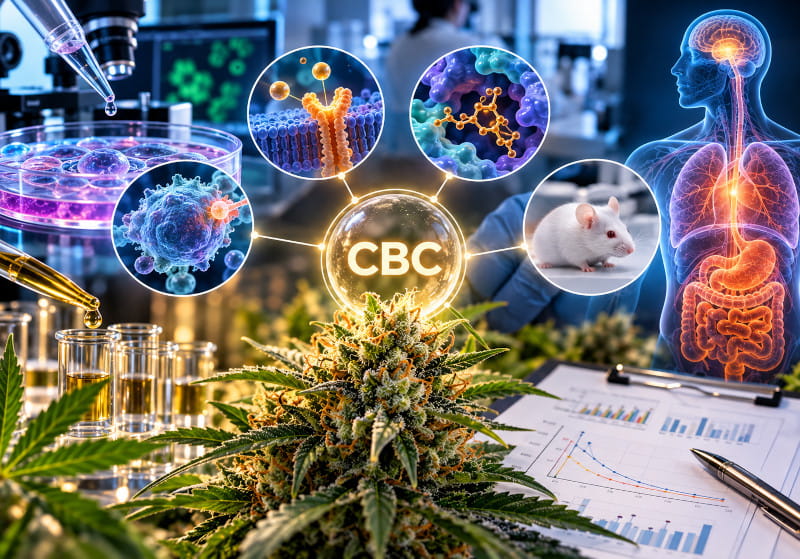
The keyword “CBC effects” quickly leads to far-reaching claims. Scientifically, however, a clear distinction must be made between molecular experiments, cell studies, animal models, human pharmacokinetics, and clinical efficacy.
CBC has been investigated preclinically in various research areas, including inflammation-related signaling pathways, pain models, neurobiological questions, antimicrobial effects, and other cellular processes. This research can provide mechanisms and hypotheses, but it does not prove that isolated CBC treats disease in humans.
| Level of evidence | Current status for CBC | Classification |
|---|---|---|
| Biochemistry/biosynthesis | well studied | CBGA, CBCA, and CBCAS have been studied experimentally. |
| Receptor/mechanism data | available | Multiple targets; results depend on the assay and model. |
| In vitro studies | available | Mechanistic indications, no clinical efficacy. |
| Animal studies | available | Not directly transferable to humans. |
| Human pharmacokinetics | initial data available | CBC was studied together with CBD and THC. |
| Clinical efficacy of isolated CBC | not established | No robust basis for therapeutic claims. |
Are There Human Studies on CBC?
Human data on CBC do exist, but they must not be confused with clinical efficacy research on isolated CBC. A pilot study published in 2022 investigated pharmacokinetics in 43 adults. CBC was administered as part of an oral cannabis product together with CBD and Δ9-THC.
Among other findings, the study showed dose-dependent changes in CBC plasma concentrations and provided initial pharmacokinetic parameters. However, it does not answer whether isolated CBC treats a specific disease or provides a clinical benefit.
What Is Known About CBC Metabolism?
CBC metabolism is being investigated in increasing detail. Studies using human liver microsomes and other in vitro systems describe oxidative and conjugative metabolic pathways. Such research helps identify potential metabolites and the enzymes involved.
Here too, the level of evidence is crucial: a metabolite formed in human liver microsomes is an important analytical indication, but this does not automatically establish its quantitative significance in the human body.
CBC vs. THC: What Is the Difference?
CBC and THC have the same molecular formula but different molecular structures and pharmacological properties. Both cannabinoid pathways originate from CBGA but proceed through different acidic intermediates.
| Feature | CBC | THC |
|---|---|---|
| Acidic precursor | CBCA | THCA |
| Common starting point | CBGA | CBGA |
| THC-typical intoxication | no | yes |
| CB1 activity | comparatively low and model-dependent | central to typical THC pharmacology |
CBC vs. CBD: What Is the Difference?
CBC and CBD are both considered non-intoxicating in the THC-typical sense, but they arise from different cannabinoid acids. CBC is derived from CBCA, while CBD is derived from CBDA.
Both pathways share CBGA as an important biosynthetic starting point. Pharmacologically, however, CBC and CBD are not interchangeable. Differences can be seen, among other things, in the receptor and ion-channel profiles studied and in the much more extensive human and clinical research on CBD.
CBC vs. CBG: How Are They Related?
The relationship between CBC and CBG becomes particularly clear when the acidic forms are considered. CBGA serves as the starting material for the formation of CBCA; CBC can subsequently form from CBCA.
The popular phrase “CBG is the mother of all cannabinoids” is therefore somewhat oversimplified chemically. For biosynthesis, it is primarily CBGA that serves as the central branching point from which several important cannabinoid acids arise.
CBC vs. CBN: Why Their Formation Differs
CBC and CBN are both frequently described as minor cannabinoids, but they are formed in fundamentally different ways. CBC, together with CBCA, belongs to a biosynthetic cannabinoid pathway. CBN, by contrast, is primarily associated with oxidative changes in THC-related cannabinoids.
This distinction is also crucial when interpreting laboratory values. A high CBC proportion can be influenced by genetics and plant development. An elevated CBN level can, by contrast, be substantially influenced by aging, processing, and storage.
Are There Really CBC-Rich Cannabis Strains?
Yes – although the scientifically more precise term is a CBC-rich chemotype. Unlike CBN, there is robust evidence that an elevated CBC proportion can be genetically determined and selectable through breeding.
Genetic studies of variation in CBC proportion described cannabis lines in which a high relative CBC proportion persisted further into plant development. A 2026 study of various hemp accessions additionally identified CBC-elevated subpopulations whose trait remained stable across generations and different growing conditions. In Cherry Wine in particular, elevated-CBC phenotypes were associated with genetic variation in the CBCA synthase region. This provides a sound basis for “CBC-rich” as a biological or breeding trait.
Nevertheless, not every commercially marketed CBC-rich strain should automatically be regarded as a stable CBC chemotype. Reproducible analytical data across suitable plants, developmental stages, and batches are far more informative than a single laboratory value.
When selecting cannabis seeds by cannabinoid profile, CBC should therefore be assessed differently from CBN: CBC-rich chemotypes can be genetically determined, whereas elevated CBN content depends much more strongly on subsequent transformation and aging processes.
Important: “CBC-rich” can describe a genetically relevant trait in cannabis. For a specific strain, however, this designation should still be supported by reproducible chemical analyses.
Which Strains Have Been Studied for Elevated CBC?
Here, caution is more important than compiling the longest possible strain list. Cannabis strain names do not guarantee a uniform cannabinoid profile, and the CBC value of a single sample cannot automatically be applied to every seed line with the same name.
A 2026 HPLC study of 36 cannabis varieties assigned Sour Diesel and Cinderella Jack to a CBC-enriched subcluster among the THC-dominant plants examined. This makes these names interesting in the context of CBC, but it explicitly does not mean that every Sour Diesel or Cinderella Jack line is a “CBC-rich strain.”
| Strain / line | What the data show | Classification |
|---|---|---|
| Original Sour Diesel | The strain name Sour Diesel was placed in the CBC-enriched THC subcluster in a 2026 HPLC study. | Example from the same strain family; no evidence that this specific seed line has the same CBC content. |
| Auto Cinderella Jack | Cinderella Jack was assigned to the CBC-enriched THC subcluster in the same study. | The linked autoflower is a specific Dutch Passion line; the study finding must not be interpreted as a guaranteed CBC value for these seeds. |
| Auto Skywalker Haze | For analyzed samples of this line, measurable CBC levels were reported alongside high THC. | An interesting analytical example, but not scientific evidence of a stable CBC-rich chemotype. |
Other materials are even more informative for genuine CBC breeding research: the literature has examined, for example, an Afghan line RJ97.11, a Korean fiber-hemp line, and, in 2026, CBC-elevated subpopulations of Cherry Wine and HBA-2. However, these research accessions must not be equated with arbitrary commercial strains bearing the same names.
CBC in Cannabis Laboratory Analysis
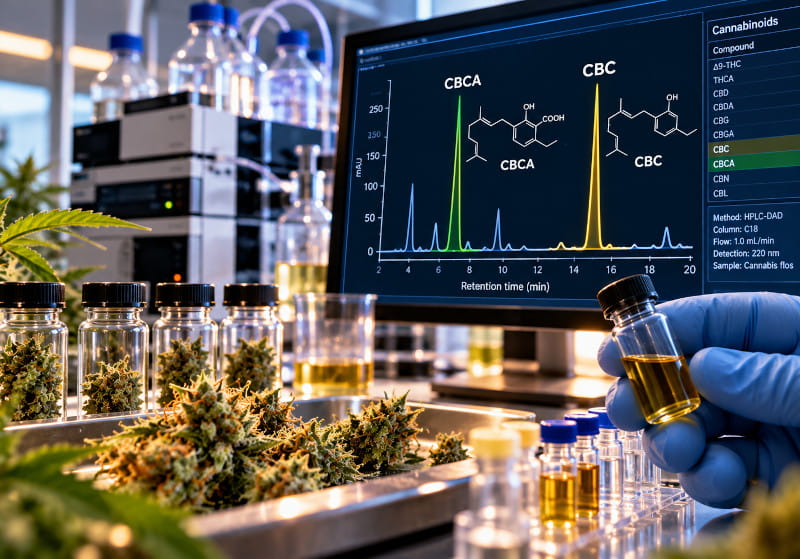
For the analytical assessment of a cannabis sample, CBC and CBCA should be considered separately. In plant material that has not been strongly heated, a relevant portion of the CBC pathway may be present as the acidic precursor CBCA.
Liquid chromatographic methods can measure acidic and neutral cannabinoids separately. With gas chromatographic methods, however, it must be taken into account that the heat used for analysis can decarboxylate acidic cannabinoids unless the method compensates for this appropriately or prevents it through derivatization.
A single CBC measurement therefore does not automatically describe the full biosynthetic potential of a plant. For questions about chemotype, genetics, or developmental stage, CBCA, CBC, and the rest of the cannabinoid profile are more informative when considered together.
Why CBC Is Interesting for Cannabis Research and Breeding
CBC brings together plant biochemistry, developmental biology, genetics, analytics, and pharmacology in a particularly illustrative way. Its acidic precursor CBCA belongs to a cannabinoid pathway connected to the THCA and CBDA pathways through the common starting point CBGA.
CBC is also interesting for breeding research because CBC-rich chemotypes have been described. In pharmacology, the molecule opens up research questions beyond the classic THC-CB1 perspective, including CB2, TRP channels, stereochemistry, and metabolic pathways.
At the same time, CBC clearly illustrates why preclinical research must not be confused with clinical evidence. The molecular and animal-study evidence base is substantially larger than the human research base.
Frequently Asked Questions About Cannabichromene (CBC)
What Is CBC?
CBC stands for cannabichromene and is a naturally occurring phytocannabinoid in cannabis. Its acidic precursor CBCA is formed from the cannabinoid precursor CBGA.
How Is CBC Formed?
In simplified terms, the pathway is CBGA → CBCA → CBC. CBCA is formed enzymatically from CBGA; through decarboxylation, it can become neutral CBC.
What Is CBCA?
CBCA is cannabichromenic acid and the acidic precursor of CBC. It is part of the plant’s natural cannabinoid biosynthesis.
Is CBC Intoxicating?
CBC is not considered intoxicating in the THC-typical sense. It nevertheless has pharmacological activity and is being studied in relation to various receptors and ion channels.
What Effects Does CBC Have?
No therapeutic effects in humans have currently been clinically established for isolated CBC. Many commonly cited properties come from cell or animal studies and must not be presented as clinically proven effects.
Are There Human Studies on CBC?
Yes, initial human data are available, including on pharmacokinetics. However, in a pilot study CBC was investigated as part of a cannabis product together with CBD and THC.
What Is the Difference Between CBC and CBD?
CBC is formed from CBCA, while CBD is formed from CBDA. Both cannabinoid pathways share CBGA as an important starting point but differ structurally and pharmacologically.
What Is the Difference Between CBC and CBN?
CBC has a biosynthetic precursor in CBCA, whereas CBN is formed primarily through oxidative changes in THC-related cannabinoids. CBC-rich and CBN-rich samples must therefore be interpreted differently.
Can CBC Become CBL?
Yes. The photochemical conversion of CBC to cannabicyclol (CBL) has been demonstrated experimentally. The extent to which this process occurs in a specific sample depends on the conditions involved.
Are There CBC-Rich Cannabis Strains?
CBC-rich chemotypes have been scientifically described and can be genetically determined. For specific commercial strains, the designation should be supported by reproducible analytical data.
What Should You Know About Cannabichromene?
Cannabichromene is more than a little-known minor cannabinoid. Its biosynthesis illustrates how the cannabis plant can produce different cannabinoid acids from CBGA.
For the CBC pathway, the route via CBCA is well established. Decarboxylation produces neutral CBC; under suitable light exposure, CBC can in turn be photochemically transformed into CBL. These processes should be clearly distinguished from one another chemically.
CBC also differs clearly from CBN genetically: CBC-rich chemotypes have been scientifically described. At the same time, developmental stage and other factors influence the measured profile, which means individual laboratory values must be interpreted carefully.
Caution remains essential when discussing possible biological properties. CBC has interesting preclinical pharmacology and initial human pharmacokinetic data, but no clinically proven therapeutic effect of isolated CBC can yet be derived from this evidence.
Scientific Sources
- Gaoni Y, Mechoulam R (1966): Cannabichromene, a new active principle in hashish.
- Claussen U, von Spulak F, Korte F (1966): Cannabichromen, ein neuer Haschisch-Inhaltsstoff.
- Crombie L et al. (1968): Photochemical production of cannabicyclol from cannabichromene.
- Morimoto S et al. (1998): Purification and characterization of cannabichromenic acid synthase from Cannabis sativa.
- de Meijer EPM, Hammond KM, Micheler M (2009): The inheritance of chemical phenotype in Cannabis sativa L. (III): Variation in cannabichromene proportion.
- Udoh M et al. (2019): Cannabichromene is a cannabinoid CB2 receptor agonist.
- Peters EN et al. (2022): Pharmacokinetics of cannabichromene in a medical cannabis product also containing CBD and Δ9-THC.
- Natural Cannabichromene (CBC) Shows Distinct Scalemicity Grades and Enantiomeric Dominance in Cannabis sativa Strains (2023).
- Cannabichromene (CBC): a comprehensive review of biosynthesis, pharmacology, therapeutic potential, and translational perspectives (2026).