CBD Drug Interactions: Medications & Risks
CBD Interactions: Which Medications Should Not Be Combined with CBD?
Updated: August 2026 | CBD interactions with medications, CYP450, blood thinners, antidepressants, antiepileptic drugs, painkillers and other medication groups
Author: Cannapot Grow Team | Reading time: approximately twenty-five minutes
The Most Important Points at a Glance
✓ CBD can interact with medications. Particularly important are changes in drug metabolism as well as additive effects, such as increased drowsiness when combined with other sedating substances.
✓ Inhibition of an enzyme demonstrated in the laboratory does not automatically mean that a clinically relevant interaction occurs with a particular medication.
✓ The interaction between cannabidiol and clobazam is particularly well documented: CBD can significantly increase the concentration of the active clobazam metabolite N-desmethylclobazam.
✓ Clinical evidence of relevant interactions exists for warfarin and tacrolimus. Both active substances already require careful monitoring of their effect or blood concentration.
✓ For many frequently searched combinations – for example CBD with ibuprofen, L-thyroxine, metformin or various blood pressure medications – the clinical evidence is considerably weaker than internet lists often suggest.
✓ A general intake interval of a few hours does not reliably prevent metabolic interactions. Anyone who regularly takes medication should have the specific combination checked by a doctor or pharmacist before using CBD.
Does CBD Interact with Medications?
Yes, cannabidiol can alter the effect, concentration or tolerability of certain medications; however, how relevant a CBD interaction is depends on the specific active substance, the dose, the interaction mechanism and the available clinical evidence.
CBD is processed in the body with the involvement of various enzymes and can itself affect enzymes or transport processes that are also important for medications. This can increase or decrease exposure to a medication. Pharmacodynamic interactions are also possible: two substances can, for example, both impair alertness even if they do not significantly affect each other's breakdown. You can find a detailed overview of the effects and risks of CBD in our separate guide.
For practical assessment, the question “Does this medication use the same enzyme?” is therefore not sufficient on its own. What matters is whether an interaction merely appears plausible from laboratory or model studies, whether it has been measured pharmacokinetically in humans and whether clinically significant consequences are actually known.
What Does an Interaction Between CBD and Medications Mean?
A drug interaction occurs when CBD or a simultaneously used active substance affects the absorption, distribution, metabolism, excretion or effect of the other substance.
Pharmacokinetic interactions change what the body does with a substance. If the breakdown of a medication is inhibited, its concentration may increase; if a metabolic pathway is enhanced, exposure may decrease. Such changes can be investigated, for example, using maximum plasma concentrations, the area under the concentration-time curve or therapeutic drug monitoring.
Pharmacodynamic interactions, on the other hand, concern the effect on the body. A clear example is sedation: CBD can cause drowsiness, and together with other centrally depressant medications, impairment of alertness may become more pronounced. Both forms of interaction can occur at the same time.
What Role Do CYP450 Enzymes Play in CBD Interactions?
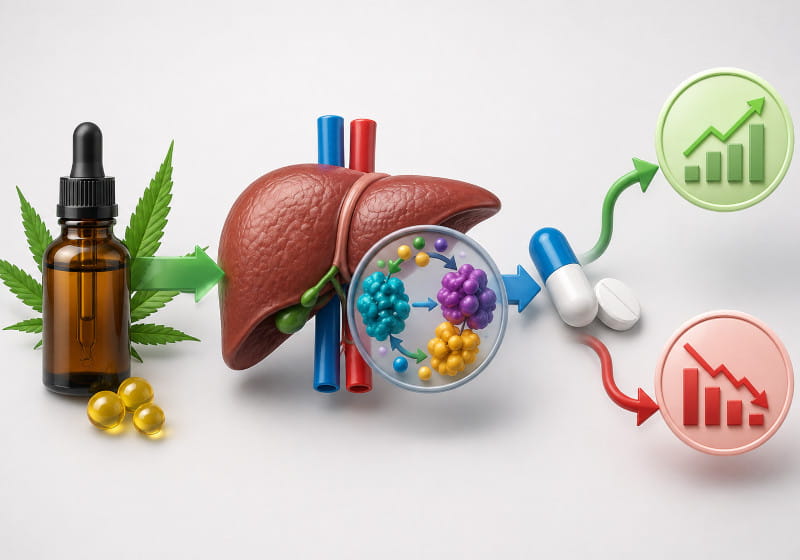
Cytochrome P450 enzymes are relevant to many CBD interactions because cannabidiol is metabolized through several of these enzymes and can also affect their activity.
Particular attention is given to CYP3A4 and CYP2C19, which are significantly involved in CBD metabolism. Depending on the study model, effects on other CYP enzymes have also been described. A systematic review of cannabinoids and CYP450 shows that the strength of the observed inhibition varies depending on the enzyme and experimental conditions, and that further human research is needed to translate many findings into specific clinical situations.
The principle also works in both directions. CBD can alter exposure to other active substances, while strong enzyme inducers or inhibitors can in turn affect CBD concentrations. The product information for the approved cannabidiol medicine Epidyolex, for example, describes interactions with various antiepileptic drugs and changes in CBD exposure caused by certain concomitant medications.
Which Medications Can Interact with CBD?
Particular attention should be paid to medications with documented human interactions, a narrow therapeutic index, required blood-level monitoring or additional sedating effects; a blanket prohibition list for all medications metabolized via CYP enzymes would not be scientifically justified.
|
Medication / Group |
Possible Interaction |
Evidence |
Practical Assessment |
| Clobazam | Marked increase in the active metabolite N-desmethylclobazam | Controlled human PK data and product information | Well-documented interaction; monitoring and, if necessary, dose adjustment by the treating physician |
| Valproate / Valproic acid | No clinically relevant PK change in valproate demonstrated; elevated liver values were nevertheless reported more frequently | Clinical data | Liver-function monitoring is particularly relevant during medical cannabidiol therapy |
| Warfarin | Possible increase in anticoagulant effect or INR | Case reports plus pharmacological plausibility | Requires particularly careful assessment and INR monitoring because of the narrow therapeutic index |
| Tacrolimus | Increased tacrolimus exposure described | Clinical human evidence | Particularly relevant because of the narrow therapeutic index and routine blood-level monitoring |
| Benzodiazepines / sedatives | Depending on the active substance, a metabolic interaction and/or additive sedation may be possible | Active-substance dependent | Do not assess as a uniform medication group; clobazam is particularly well studied |
| Antidepressants | Depending on the active substance, possible CYP-mediated changes and additive CNS effects | Limited for many individual active substances | Sertraline, citalopram, escitalopram, fluoxetine, amitriptyline and other active substances must be assessed individually |
| Ibuprofen and other NSAIDs | Metabolic interaction theoretically plausible, varying by active substance | Limited clinical CBD data | Do not derive a blanket statement of “prohibited” from CYP data |
| Blood pressure medications | Depending on the active substance, metabolic and possibly additive cardiovascular effects | Insufficiently studied for many combinations | Do not equate ramipril, amlodipine, bisoprolol and other active substances |
| L-thyroxine / Levothyroxine | No well-established specific clinical CBD interaction | Insufficient | Do not infer definite reassurance or a prohibition from a lack of data |
| Metformin | No established clinically relevant CBD interaction demonstrated | Insufficient | For diabetes medication, individual assessment rather than blanket clearance |
Why Is the Interaction Between CBD and Clobazam Particularly Important?
CBD and clobazam are among the best-documented cannabidiol-drug interactions because CBD can significantly increase exposure to the pharmacologically active clobazam metabolite N-desmethylclobazam.
In a phase 1 study, exposure to N-desmethylclobazam increased to approximately three to three and a half times the original level during concomitant cannabidiol administration, while clobazam exposure itself changed only slightly. A controlled phase 2 study in patients with epilepsy confirmed a marked increase in the active metabolite.
The interaction is largely explained by inhibition of CYP2C19. Clinically, this may be relevant for drowsiness and other clobazam-related adverse effects, among other things. Nevertheless, the combination is not generally “prohibited”: the approved cannabidiol medicine Epidyolex is specifically used together with clobazam for certain epilepsy syndromes. Medical management and monitoring are decisive.
What Interactions Are Possible Between CBD and Blood Thinners?
With anticoagulants, the specific active substance must be distinguished; for warfarin, clinical case reports with increased INR values during CBD use exist, whereas this evidence cannot simply be generalized to all so-called blood thinners.
Warfarin has a narrow therapeutic index and its effect is monitored using the INR. In a published case report, the INR increased while pharmaceutical cannabidiol was being titrated upward, requiring adjustment of the warfarin dose. Possible mechanisms include overlapping CYP metabolic pathways and inhibition of warfarin breakdown.
For direct oral anticoagulants such as apixaban or rivaroxaban, the clinical CBD evidence is less clear. Mechanistic considerations therefore must not be presented as proof of the same effect as with warfarin. Anyone taking anticoagulants should have CBD use professionally assessed in advance because of the potentially serious consequences of altered anticoagulation.
Can CBD Interact with Antidepressants and Psychotropic Medications?
Interactions between CBD and antidepressants are pharmacologically plausible depending on the active substance, but many commonly used antidepressants have not yet been adequately studied clinically.
Antidepressants are not a uniform substance group. SSRIs such as sertraline, escitalopram or fluoxetine differ from tricyclic antidepressants such as amitriptyline and from other active substances such as venlafaxine or mirtazapine. Their metabolic pathways, half-lives and possible additive effects therefore also differ.
Laboratory and pharmacological data show that CBD can affect several CYP enzymes that are also involved in the metabolism of psychotropic medications. However, this does not allow reliable prediction, for every individual active substance, of how strongly its plasma level will change at a specific CBD dose. In addition, fatigue, drowsiness or other central nervous system effects may be perceived more strongly when combined. Independently of possible drug interactions, research on CBD for depression is a separate topic and should not be equated with interaction research.
Are There Interactions Between CBD and Blood Pressure Medications?
No single CBD interaction can be stated for blood pressure medications because ACE inhibitors, beta blockers, calcium channel blockers and other antihypertensives are pharmacologically very different.
For some active substances, CYP-mediated changes are theoretically plausible, while for others this mechanism plays a smaller role. Cardiovascular reactions may also be relevant. Whether this results in a clinically significant interaction with ramipril, amlodipine, bisoprolol, losartan or another blood pressure medication must be assessed on an active-substance-specific basis.
It would be particularly problematic to use a possible blood-pressure effect of CBD as a reason to reduce prescribed medication independently. Blood pressure medications should neither be stopped nor have their dose changed because of CBD without discussing this with the treating physician.
What Should Be Considered with CBD and Painkillers Such as Ibuprofen?
There are pharmacological reasons to consider an interaction between CBD and ibuprofen, but there is no robust clinical evidence from which a general prohibition on combining them could be derived.
Ibuprofen is metabolized in part via CYP2C9, and CBD can affect CYP-mediated metabolic processes in experimental systems. The actual significance, however, depends on exposure, dose and other individual factors. The fact that two substances share a metabolic pathway or that CBD inhibits an enzyme in vitro is not sufficient to predict the magnitude of an interaction in humans.
“Painkillers” are also not a uniform category. Paracetamol, diclofenac, naproxen, tramadol and opioids have different risks and metabolic pathways. An individual assessment is particularly sensible when painkillers are used regularly, several medications are taken, or liver, kidney or gastrointestinal problems already exist.
What Interactions Between CBD and Antiepileptic Drugs Are Known?
Antiepileptic drugs are among the most intensively studied concomitant medications of pharmaceutical CBD, with the type and strength of interaction differing substantially between individual active substances.
In addition to the well-established clobazam interaction, clinical studies have observed changes in the serum levels of various antiepileptic drugs. These findings are not all equally strong or clinically significant. With valproate, it is particularly important that controlled pharmacokinetic data did not show a clinically relevant increase in valproate exposure, while elevated transaminases were nevertheless observed more frequently with the combination.
The product information for Epidyolex therefore contains specific guidance on concomitant medications and monitoring of liver function. Data from this prescription use are particularly valuable for interaction research, but because of the defined pharmaceutical formulation and the sometimes high therapeutic CBD doses, they cannot be transferred without qualification to every over-the-counter CBD product.
Can CBD Interact with Sleeping Pills and Benzodiazepines?
With sleeping and sedative medications, increased sedation may be particularly relevant in addition to possible metabolic interactions.
CBD can cause drowsiness. When it is used together with medications that also cause fatigue, slowed reactions or drowsiness, these effects may add up. This is particularly relevant to safety when driving, operating machinery and performing other activities requiring a high level of attention. We discuss findings on the use of CBD for sleep problems that are independent of such drug interactions in a separate article.
Benzodiazepines should nevertheless not be treated as a uniform interaction group. Diazepam, lorazepam, alprazolam and clobazam differ in their metabolic pathways. Specific pharmacokinetic data are available for clobazam; for other combinations, the evidence is in some cases considerably more limited.
What Should Be Considered with CBD and Immunosuppressants Such as Tacrolimus?
Tacrolimus deserves particular attention with CBD because substantial changes in tacrolimus exposure have already been described in humans and the active substance has a narrow therapeutic index.
A clinical case report described an approximately threefold increase in dose-normalized tacrolimus concentration with high-dose purified CBD. For an active substance whose blood levels are specifically monitored after transplantation, such a change is potentially significant.
The report does not prove that every small amount of CBD causes the same change. However, it shows why even limited clinical interaction data must be taken seriously for medications with a narrow therapeutic window. Independent CBD use alongside tacrolimus or similarly critically dosed immunosuppressants is therefore not a situation for blanket internet recommendations.
Can CBD Be Combined with Pantoprazole or Omeprazole?
For proton pump inhibitors, the specific active substance must be distinguished; CYP2C19 in particular makes omeprazole pharmacologically relevant, but a blanket clinical CBD interaction for all acid-suppressing medications has not been established.
Omeprazole can affect CYP2C19, an enzyme that is also relevant to cannabidiol metabolism. This again shows that an interaction does not only mean that CBD changes a medication: concomitant medications can in turn affect cannabidiol exposure.
Pantoprazole and omeprazole should not automatically be equated despite belonging to the same drug class. With long-term use, high amounts of CBD or several medications used at the same time, the entire medication regimen is more important for assessment than a single theoretical enzyme overlap.
Can CBD Affect the Contraceptive Pill?
Whether CBD clinically alters the contraceptive effect of hormonal contraceptives has not been adequately studied; a reliable loss of contraceptive effectiveness cannot be inferred from theoretical metabolic interactions.
Hormonal contraceptives differ in their active substances and metabolic pathways. Because some hormones are processed via CYP3A4 and CBD can affect this enzyme system, an interaction is pharmacologically conceivable. However, suitable clinical data are lacking for a robust statement about actual contraceptive reliability during simultaneous CBD use.
For a method whose purpose is to prevent pregnancy, “not adequately studied” is not a basis for blanket reassurance. The specific combination should be checked with a doctor or pharmacist, particularly with regular or higher-dose CBD use.
Are There Interactions Between CBD and Thyroid Medications?
No well-established clinical interaction has been demonstrated for CBD and levothyroxine or L-thyroxine, but at the same time the available data are insufficient for a general statement that the combination is always unproblematic.
Levothyroxine has particular requirements for consistent intake and absorption. Many known interactions occur in the gastrointestinal tract through food, minerals or other medications and should not be equated with classic CYP450 interactions. This is precisely why it would be technically incorrect to answer every CBD question solely in terms of liver enzymes.
Anyone who is regularly monitored because of a thyroid disorder should report changes in additionally used products. Dose changes to thyroid medication should be based on medical monitoring and not on a presumed CBD interaction.
Can CBD Be Used Together with Metformin or Other Diabetes Medications?
No established clinically relevant CBD interaction has been demonstrated for metformin, but diabetes medications are pharmacologically different and should not be treated as a uniform group.
Metformin is processed differently from many classic CYP substrates. Other diabetes medications, in turn, have their own metabolic pathways and risks. A theoretical CBD-CYP interaction therefore cannot simply be transferred to every antidiabetic therapy.
It is also essential that existing diabetes treatment should not be changed on the basis of presumed effects of CBD. When several medications are used or metabolic values fluctuate, the complete medication list is a more useful basis for an interaction assessment.
Can CBD Interact with Antibiotics?
With antibiotics, the CBD interaction potential depends on the specific active substance because some antibiotics can strongly affect CYP enzymes while others are processed through entirely different pathways.
The search query “CBD and antibiotics” is therefore pharmacologically too broad. Amoxicillin, clarithromycin and azithromycin differ significantly. An active substance that strongly inhibits CYP3A4 can theoretically also alter CBD exposure, while this mechanism may play hardly any role with another antibiotic.
During a short course of antibiotic treatment, it makes sense to have the specific combination checked in an up-to-date drug interaction database or by a doctor or pharmacist rather than inferring safety or risk from membership in the drug class.
Which Factors Determine the Actual Risk of a CBD Interaction?
The actual interaction risk is not determined by the name of a medication alone, but among other things by CBD exposure, dose and duration of use, metabolic pathway, therapeutic index, concomitant medication and individual organ function.
Medications for which even small changes in concentration can become problematic are particularly relevant. These include various drugs with a narrow therapeutic window. Polypharmacy also increases complexity because several substances can affect the same enzymes or transporters.
The amount of CBD also plays a role. We explain in detail in a separate guide which factors should generally be considered when determining CBD dosage. Many of the most informative interaction data come from studies with purified pharmaceutical cannabidiol at therapeutic doses. It therefore cannot be concluded that every over-the-counter product carries the same risk, nor that small amounts are automatically free of interactions. Product composition and actual CBD absorption may also vary.
Is a Time Interval Between CBD and Medications Sufficient?
A general interval of two, four or six hours cannot reliably prevent a metabolic CBD interaction.
An intake interval can be useful for certain interactions in the gastrointestinal tract if substances directly affect each other's absorption, for example. CYP-mediated interactions work differently, however: the influence on an enzyme can extend beyond the time at which CBD and the medication were swallowed.
There is therefore no scientifically robust general rule such as “always take CBD two hours after medication.” Whether an interval is useful must be derived from the specific mechanism, half-lives and medication regimen.
Why Can Data on Medical Cannabidiol Not Be Transferred One-to-One to CBD Oil?
Studies with approved cannabidiol provide particularly valuable safety data, but they investigate a standardized medicine with a precisely defined composition and often significantly higher CBD doses than over-the-counter products.
The approved medicine Epidyolex contains 100 mg of cannabidiol per milliliter and is dosed according to body weight. Its product information is based on controlled studies and pharmacokinetic investigations. Commercial CBD products, by contrast, may differ in concentration, purity, accompanying substances and the amount actually absorbed.
The medicinal-product data reliably show that cannabidiol can, in principle, cause clinically relevant interactions. However, they do not allow the simple conclusion that, for example, a few milligrams of a particular CBD oil have exactly the same effect on a medication level as a therapeutic cannabidiol dose.
What Is the Current Safety Assessment of CBD During Medication Use?
The current European safety assessment explicitly highlights the uncertainty: in 2026, EFSA was unable to establish the safety of CBD as a novel food for people taking medication.
For certain highly purified CBD food supplements, EFSA derived a provisional safe intake level of 0.0275 mg per kilogram of body weight per day in February 2026, corresponding to approximately 2 mg daily for a person weighing 70 kg. Because of existing data gaps, this assessment includes additional uncertainty factors and is not a dosage recommendation for achieving an effect.
An important limitation for this article is that EFSA was unable to establish safety for people under 25, pregnant women, breastfeeding women and people taking medication. This does not mean that every combination is demonstrably dangerous. It means that the available data do not allow a general safety conclusion.
When Should a Combination of CBD and Medications Be Assessed Particularly Carefully?
A professional interaction assessment is particularly important with long-term prescribed medication, a narrow therapeutic index, anticoagulation, immunosuppression, antiepileptic drugs, pronounced sedation, liver problems and the simultaneous use of several medications.
For the assessment, the exact medication name, dose, time of administration, other medications and supplements, and the CBD product used should be known wherever possible. “I take a blood thinner” is less informative than specifying the exact active substance and dosage.
Particular attention is also advisable if new pronounced fatigue, drowsiness, unusual bleeding, significant cardiovascular symptoms or other unexpected changes occur after starting or changing CBD use. Such symptoms do not prove an interaction, but with existing medication they should not be addressed through independent dose experiments.
How Do CBD Interactions Differ from CBD Side Effects?
A side effect can be caused by CBD itself, whereas an interaction requires CBD and another substance to influence each other in their effects or processing.
Fatigue, for example, can occur as an adverse effect of CBD. If a sedating medication is used at the same time and drowsiness increases as a result, an additional pharmacodynamic interaction may be involved. Likewise, an increased drug concentration due to metabolic inhibition can intensify the typical side effects of that medication.
This distinction is important because the question of interactions requires a different medical and pharmacological assessment from the general tolerability of CBD. The focus here is therefore on combinations with medications. We explain in detail which adverse effects can be caused by cannabidiol itself and how the current safety situation should be assessed in our guide to CBD side effects.
How Should the Evidence on CBD and Medications Be Interpreted?
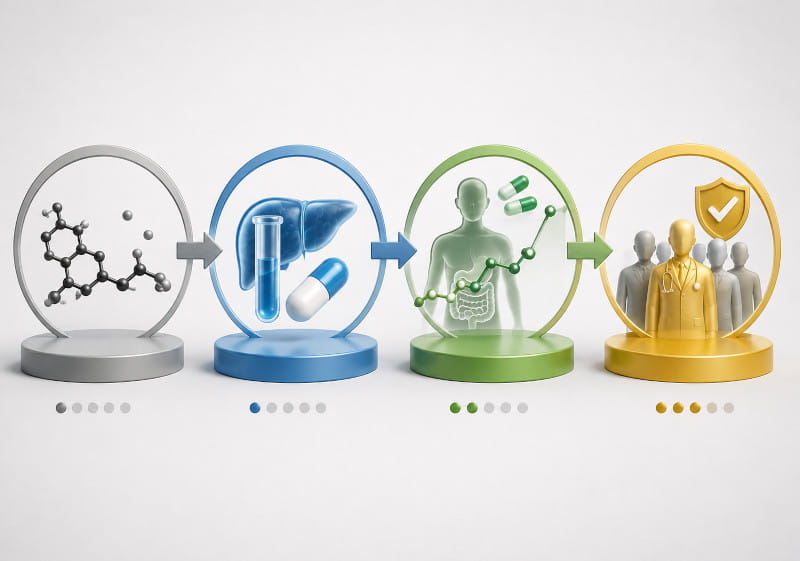
The most robust assessment of CBD interactions distinguishes mechanistic indications from measured changes in humans and from actually documented clinical consequences.
The first level consists of laboratory findings and pharmacological models. They help identify potential interactions. At the second level, human studies show whether concentrations of CBD, a medication or metabolites actually change. At the third level, it becomes relevant whether this leads to adverse effects, necessary dose adjustments, altered laboratory values or other clinical consequences.
This evidence hierarchy explains why clobazam must be assessed differently from many popular search combinations. With clobazam, the change in an active metabolite has repeatedly been measured in humans and incorporated into the product information. For many other medications, by contrast, there is mainly a plausible mechanism or a thin evidence base.
Which Sources Are Particularly Helpful for CBD Interactions?
For CBD-drug interactions, current prescribing information for approved cannabidiol medicines, controlled pharmacokinetic studies, clinical interaction reports, systematic reviews and safety assessments by authorities are particularly informative.
The following sources allow a more detailed review of the most important statements. It should always be considered whether purified pharmaceutical cannabidiol or another product was studied, which CBD dose was used and whether the data came from laboratory experiments, healthy volunteers, patient studies or individual case reports.
- European Medicines Agency: Epidyolex – current product information on cannabidiol
- Systematic review: Cannabidiol, THC and cytochrome P450 enzymes
- Morrison et al.: Pharmacokinetic interactions of cannabidiol with clobazam, stiripentol and valproate
- Controlled phase 2 study: Cannabidiol and clobazam
- Grayson et al.: Case report on the interaction between cannabidiol and warfarin
- Leino et al.: Clinical report on the interaction between cannabidiol and tacrolimus
- Gaston et al.: Cannabidiol and serum levels of various antiepileptic drugs
- EFSA 2026: Provisional safe intake level and particular uncertainty for people taking medication
- Wikipedia: Cytochrome P450
- Wikipedia: Cannabidiol
FAQs
Q: Does CBD interact with medications?
A: Yes. CBD can affect the metabolism or effects of certain medications. However, the clinical significance differs greatly between individual active substances.
Q: Which medications should not be combined with CBD?
A: A universally applicable prohibition list is not scientifically appropriate. Particular care should be taken with documented interactions such as clobazam and with critically dosed active substances such as warfarin or tacrolimus.
Q: Can CBD increase medication levels?
A: Yes. If CBD inhibits a metabolic pathway that is important for drug breakdown, exposure to certain active substances or active metabolites can increase. This is well documented for N-desmethylclobazam, for example.
Q: Can CBD reduce the effect of a medication?
A: Interactions can in principle also lead to lower exposure. The direction and extent depend on the active substance and mechanism and cannot be inferred generally from a CYP list.
Q: What role does CYP450 play with CBD?
A: CYP450 enzymes are involved in the metabolism of many medications and also of CBD. CBD can affect several of these enzyme systems, although laboratory findings do not automatically prove a clinically relevant interaction.
Q: Can CBD be combined with blood thinners?
A: This must be assessed for the specific active substance. For warfarin, case reports with increased INR values during CBD use exist; for other anticoagulants, the clinical evidence differs and is in some cases limited.
Q: Can CBD be taken with antidepressants?
A: A blanket answer is not possible. Antidepressants differ significantly in their metabolic pathways, and robust clinical interaction studies are lacking for many specific CBD combinations.
Q: Can CBD and ibuprofen be taken together?
A: A metabolic interaction is pharmacologically plausible, but a clinically relevant interaction is not as well documented as, for example, with clobazam. Regular or high-dose use should be assessed individually.
Q: Can CBD be combined with blood pressure medications?
A: Blood pressure medications are not a uniform drug group. Possible metabolic and cardiovascular effects depend on the specific medication.
Q: Can CBD be combined with L-thyroxine?
A: A specific clinically relevant CBD-levothyroxine interaction is not well established. However, a lack of data is not proof that every combination is unproblematic under all conditions.
Q: Can CBD be combined with metformin?
A: No established clinically relevant CBD interaction has been demonstrated for metformin. With diabetes medication, however, the overall therapy should still be assessed individually.
Q: Can CBD be combined with pantoprazole?
A: A blanket clinically relevant interaction has not been established. Proton pump inhibitors differ in their metabolism, however, which is why pantoprazole and omeprazole should not automatically be assessed in the same way.
Q: Can CBD make the contraceptive pill ineffective?
A: There is no robust clinical evidence for this. Since hormonal contraceptives and CBD could interact via relevant metabolic pathways, the specific combination should be professionally assessed when CBD is used regularly.
Q: How much time should there be between CBD and medications?
A: There is no universally applicable hourly rule. A time interval does not reliably prevent CYP-mediated interactions.
Q: Are interactions only possible at high CBD doses?
A: Many well-documented data come from therapeutic, sometimes high CBD doses. However, this does not mean that low amounts carry the same risk, nor that they are inherently free of interactions.
Q: Why are online lists of CBD interactions often problematic?
A: They often equate theoretical CYP overlaps with clinically demonstrated interactions. For a sound assessment, mechanism, human findings and actual clinical consequences must be considered separately.