Grow Cannabis With No Experience
Grow Cannabis With No Experience: A Beginner Guide That Actually Makes Sense
Updated: September 2026 | Grow Cannabis With No Experience: Beginner Guide | Cannapot
Author: Cannapot Grow Team | Reading time: approximately twenty minutes
The Most Important Things at a Glance
✓ A first grow is easier to understand when the setup stays simple and changes are made one at a time.
✓ Light, growing medium, airflow, temperature, nutrients and water are closely connected. None of these factors should be judged completely in isolation.
✓ Feminized seeds can simplify planning because they are bred to produce female plants. Autoflowers simplify the transition to flowering, but their shorter life cycle can leave less time to recover from early problems.
✓ A visible symptom is not automatically a diagnosis. Watering, nutrition, root conditions, light and climate can produce similar-looking plant responses.
✓ This guide explains the overall process of a first grow. Common cultivation mistakes and their diagnosis are covered separately in our dedicated beginner-mistakes guide.
Who this guide is for: This article is intended for beginners who want to understand the basic growing process, choose a suitable seed type and build a manageable first setup without having to follow several conflicting methods at once.
Start Here: Keep Your First Grow Simple
During a first grow, it is tempting to use as many techniques, products and recommendations as possible. That quickly makes the setup unnecessarily complicated and makes it difficult to understand which change caused which response. For a beginner, it is usually more useful to work with a limited number of variables and first learn the basic growing process.
A practical starting point is to focus on:
-
A small number of plants rather than a setup that is difficult to monitor.
-
One growing method rather than combining techniques from several different systems.
-
Realistic goals rather than trying to maximize yield or optimize every variable during the first grow.
-
One change at a time whenever a problem needs to be investigated.
The first grow does not need to achieve every possible goal at once. It is more valuable to learn how plants respond under your own conditions and how changes in watering, light, nutrition and climate affect their development. That experience provides a much better foundation for later grows.
What Does a Cannabis Plant Need to Grow?
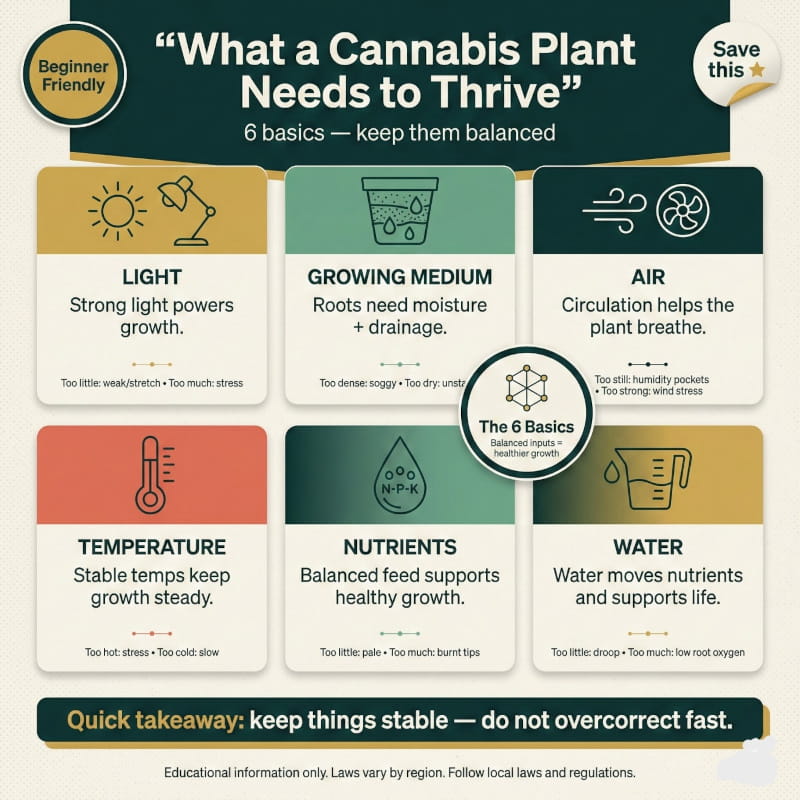
Whether cannabis is grown indoors or outdoors, the same basic resources remain important. The exact requirements change with genetics, plant size, developmental stage, growing medium and environmental conditions.
Light
Cannabis requires sufficient light for photosynthesis and plant development. Outdoors, the available light depends on location, season, orientation, shading and weather. Indoors, lamp type, intensity, distance, illuminated area and light distribution all influence how much usable light reaches the canopy. More wattage alone does not automatically mean better growing conditions.
Growing Medium
The growing medium is the environment around the roots. Soil, coco coir, rockwool and hydroponic systems differ in water retention, drainage, nutrient supply and the amount of control they require. For a first grow, the medium should match the chosen cultivation method and allow a healthy balance of moisture and air in the root zone.
Air and Ventilation
Air exchange and air movement have different functions. Exhaust ventilation helps remove heat and moisture from an indoor growing area, while circulation moves air around the plants and reduces stagnant zones. As the canopy becomes denser, airflow becomes increasingly important for managing the microclimate around leaves and flowers.
Temperature
Temperature affects growth, water use and plant metabolism. Suitable conditions depend on developmental stage, light, humidity and other environmental factors. Temperature should therefore not be judged as an isolated number. Extreme heat or cold can slow development and create additional stress.
Nutrients
Cannabis requires mineral nutrients, but more fertilizer does not automatically produce more growth. Nutrient requirements change with developmental stage and cultivation system. A pre-fertilized soil may already provide nutrients, while coco and hydroponic systems are managed differently. Fertilizer recommendations should therefore be treated as system-specific guidance rather than universal rules.
Water
Cannabis needs an adequate water supply while the root zone also needs sufficient oxygen. How often a plant needs water depends on plant size, container volume, growing medium, drainage and climate. Water quality can also matter depending on the cultivation system. A fixed watering schedule is therefore less useful than assessing the actual condition of the root zone.
The goal is not to maximize each of these factors individually. Successful cultivation depends on keeping them in a suitable relationship to one another and adjusting them as the plant develops.
How Long Does It Take to Grow Cannabis?
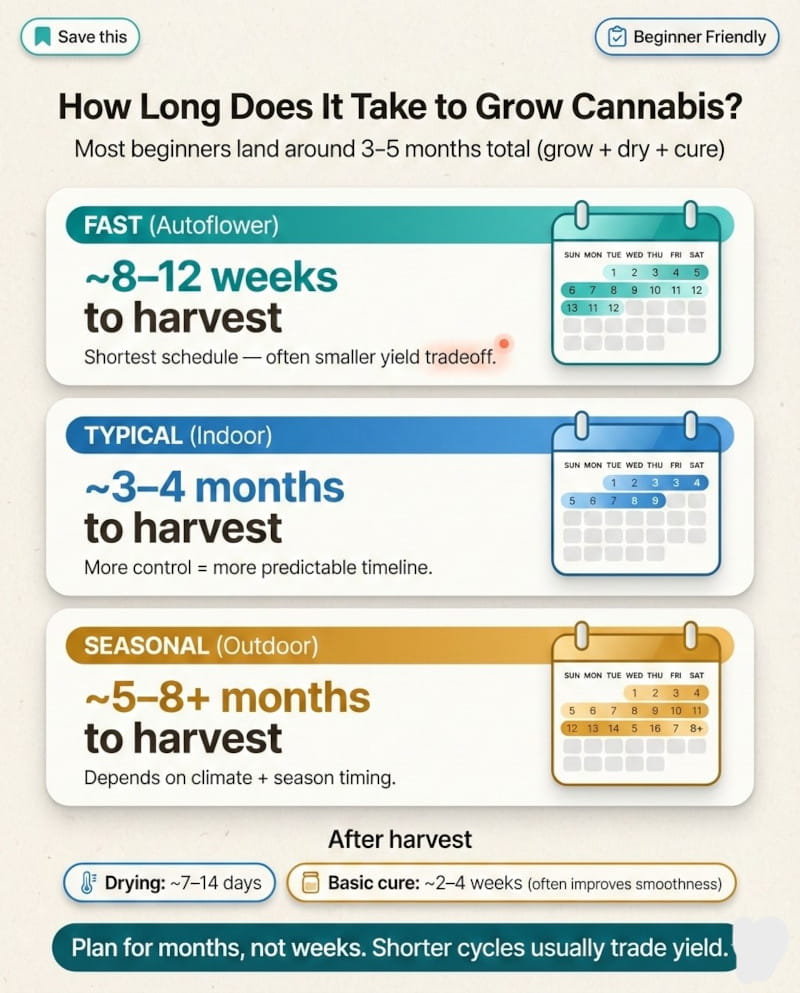
There is no single grow duration that applies to every cannabis plant. The total time depends on seed type, genetics, length of the vegetative stage, flowering time, indoor or outdoor cultivation and the time required for drying and curing after harvest.
Autoflowering genetics generally complete their life cycle faster because flowering begins according to plant age rather than a change in day length. Photoperiod plants can remain in vegetative growth for longer, particularly indoors where the light cycle is controlled. Outdoor photoperiod plants are additionally influenced by season and regional day length.
Breeder specifications are useful orientation values, but they should not be interpreted as guaranteed harvest dates. Phenotype, environment and plant health can all affect development. For beginners, it is more useful to understand the individual growth stages than to plan around a single fixed number of weeks.
Growing Cannabis for the First Time: 10 Steps
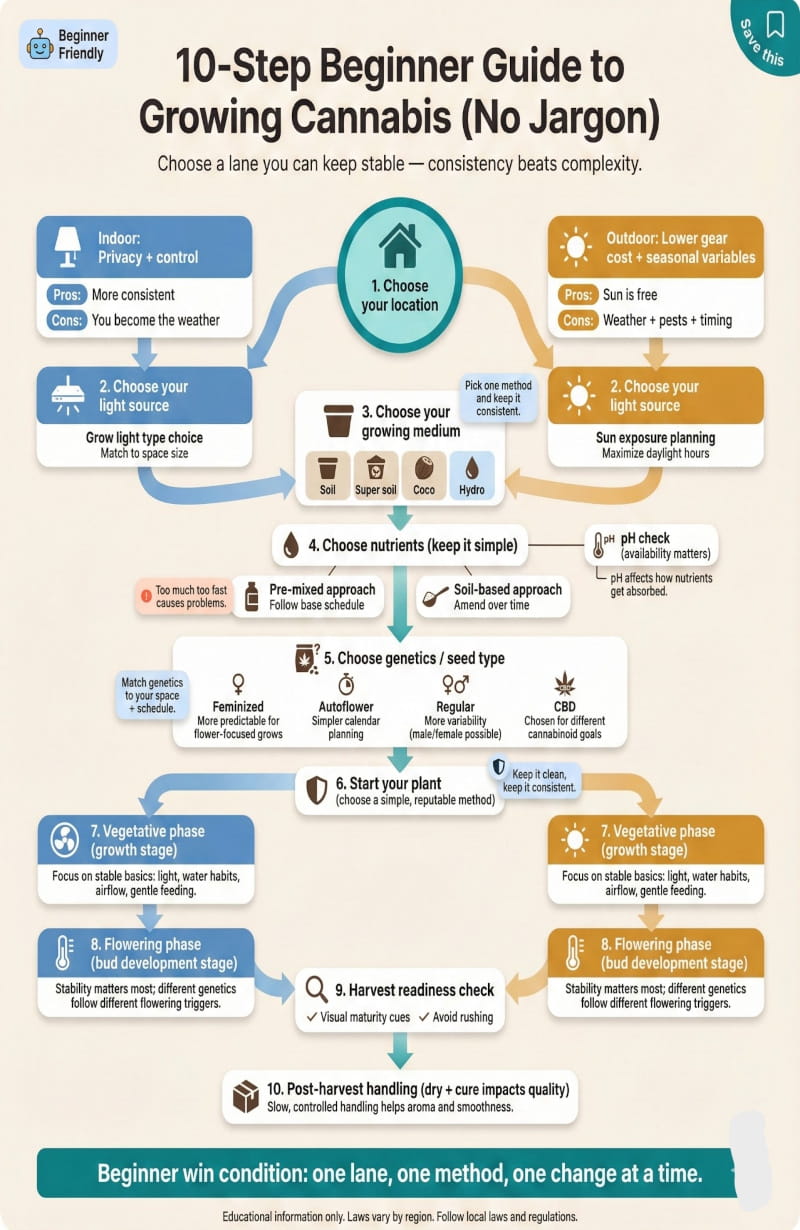
Step 1: Choose Between Indoor and Outdoor Growing
Indoor cultivation provides more control over light, temperature, airflow and the timing of photoperiod flowering, but the grower is responsible for creating and maintaining those conditions. A grow tent can make a small indoor setup easier to organize because lighting and ventilation are concentrated in a defined space.
With outdoor growing, natural sunlight provides the main source of light. Weather, temperature, rainfall and humidity are less controllable than indoors, and pests or animals can also become relevant. Climate, location and genetics suited to those conditions therefore play a particularly important role.
Beginner advice for both approaches: Choose a cultivation method that you can maintain reliably under your own conditions. A simple, stable setup is usually more useful for a first grow than a technically complex system in which many variables need to be controlled at the same time.
Step 2: Choose Suitable Lighting
For outdoor cultivation, a location with as much direct sunlight as reasonably available is generally advantageous. The actual amount of light depends on season, latitude, orientation, shading and weather.
For indoor cultivation, several lighting technologies are available, including LED, HID and CMH systems. Modern LED grow lights are widely used and can be practical for compact setups because of their efficiency and comparatively manageable heat output. The important question is not simply which technology is used, but whether light intensity and distribution suit the cultivation area and developmental stage of the plants.
Step 3: Choose the Growing Medium
Cannabis can be grown in soil, coco coir, rockwool and different hydroponic systems. Each medium changes the way water, nutrients and oxygen are managed around the roots.
-
Soil is familiar and can provide some buffering of water and nutrients, depending on its composition.
-
Coco coir provides substantial control over irrigation and nutrient supply, but should not simply be managed like soil.
-
Hydroponics allows direct control of water and nutrient supply, but requires closer monitoring and can respond quickly to errors involving nutrients, pH or irrigation.
Step 4: Understand Nutrient Supply and pH
The nutrient strategy should match the growing medium. A rich or pre-fertilized soil can already contain a substantial nutrient supply, while soilless and hydroponic systems depend more directly on nutrient solutions. Young plants also have different requirements from established plants.
Avoid treating every pale or discolored leaf as proof that more fertilizer is required. Watering, root conditions, pH, light, developmental stage and plant problems can produce overlapping symptoms. When something changes, consider the whole plant and the recent growing conditions before adjusting nutrient levels.
The pH of the root zone or nutrient solution can influence the availability of individual nutrients. How closely pH needs to be monitored or adjusted depends on the growing medium and cultivation system. If conditions remain outside a suitable range, nutrient uptake problems can occur even when nutrients are present.
Common reference ranges are approximately pH 6.0–7.0 for soil and pH 5.5–6.5 for many soilless or hydroponic systems. These are orientation ranges rather than a reason to chase a single decimal value continuously.
Step 5: Choose Seeds and Genetics That Fit the Setup
A grow can begin from seeds or clones. Seeds are easy to store and, compared with bringing established cuttings into a grow, can reduce the risk of introducing pests or pathogens that are already present on plant material. Clones can shorten the initial development period but require careful inspection and handling.
For beginners, the most important question is not which strain has the highest THC value or the most famous name. Plant size, development time, growth behavior, indoor or outdoor suitability and seed type are often more useful selection criteria.
Seed Types Explained: Feminized, Autoflower, Regular and CBD
The choice of seed type influences how the grow is planned. Feminization and autoflowering describe different characteristics, so they should not be treated as opposites.
Feminized seeds
Feminized seeds are bred to produce female plants with very high probability. This can simplify planning because the grower normally does not need to identify and remove male plants simply to maintain a flower-producing crop.
Browse: Feminized Marijuana Seeds on Cannapot
Autoflower seeds
Autoflowering genetics begin flowering primarily according to age rather than requiring the grower to trigger flowering through a shorter light cycle. This simplifies one part of the schedule, but the comparatively short life cycle can also leave less time to compensate for serious problems during early development.
Browse: Autoflower Seeds on Cannapot
Regular seeds
Regular seeds can produce male or female plants. They remain important for breeding and for growers interested in particular traditional genetic lines, but they add an additional step because plant sex has to be identified when seedless flowers are the goal.
Browse: Regular Weed Seeds on Cannapot
CBD seeds
CBD-rich genetics are selected for cannabinoid profiles that differ from high-THC varieties. The exact cannabinoid ratio is more informative than a general label, so compare the breeder's information for the specific genetics rather than assuming that every CBD variety has the same profile.
Browse: CBD Seeds on Cannapot
Read: CBD Explained: What It Is and Why People Use It, Choose the Right Cannabis Seeds (2026)
Step 6: Germinate the Seeds
During germination, the goal is to provide suitable moisture, warmth and oxygen without keeping the seed permanently waterlogged. Seeds can be germinated directly in a suitable growing medium or with a separate germination method before being transferred carefully.
Avoid repeatedly handling or checking the seed once germination has started. The emerging root is delicate, and a young seedling initially needs a much smaller and more controlled root-zone environment than an established plant.
Step 7: Vegetative Growth
During vegetative growth, the plant develops roots, stems, branches and leaves. This stage establishes much of the structure that later supports flowering.
-
Indoor: Photoperiod plants are generally cultivated with a long daily light period during vegetative growth. The duration of lighting is only one part of the environment; light intensity, temperature and humidity should also suit the developmental stage and the overall setup.
-
Do not water according to a rigid calendar. Use the actual water demand of the plant and the condition of the growing medium as your guide. Additional nutrients should likewise be supplied according to the medium, developmental stage and nutrients already available.
Step 8: Flowering
During flowering, the plant shifts its development toward inflorescence formation. Indoor photoperiod plants are commonly induced to flower by changing to a short-day schedule with a long uninterrupted dark period. Autoflowering genetics do not require this change to initiate flowering.
-
During flowering, temperature and relative humidity should be considered together. Suitable conditions depend on developmental stage, genetics, light intensity and air movement. As flowers become denser, a stable climate and sufficient air exchange become increasingly important.
-
If regular seeds are used, plant sex must be identified in time when the goal is to avoid pollination. Plant height should also be planned before flowering because many photoperiod plants continue to stretch after the light cycle is changed.
Step 9: Assess Harvest Maturity
Breeder flowering times are useful reference values, but they are not guaranteed harvest dates. Plant development should be assessed directly. Changes in flower structure, pistils and glandular trichomes can all provide information, but no single sign should be treated as a perfectly precise countdown.
The calendar can indicate when closer observation is likely to become useful. The final decision should be based on the actual maturity of the plant rather than a fixed date alone.
Step 10: Dry and Cure Carefully
Harvest does not end the process. Drying is a controlled postharvest stage in which moisture has to be reduced under suitable environmental conditions. Excessive heat or strong direct airflow can dry the outside of flowers too quickly, while persistently damp conditions increase other risks.
Curing follows drying and is part of the controlled storage and maturation of dried flowers. Rather than relying on one rigid number or timetable, the process should be managed according to the actual moisture condition of the material and stable storage conditions.
Helpful reads on Cannapot:
If you want help narrowing down seed options, you can also use CannapotGPT and describe your available space, indoor or outdoor conditions, experience level and preferred seed type.
Common Beginner Mistakes: What This Guide Does Not Cover in Detail
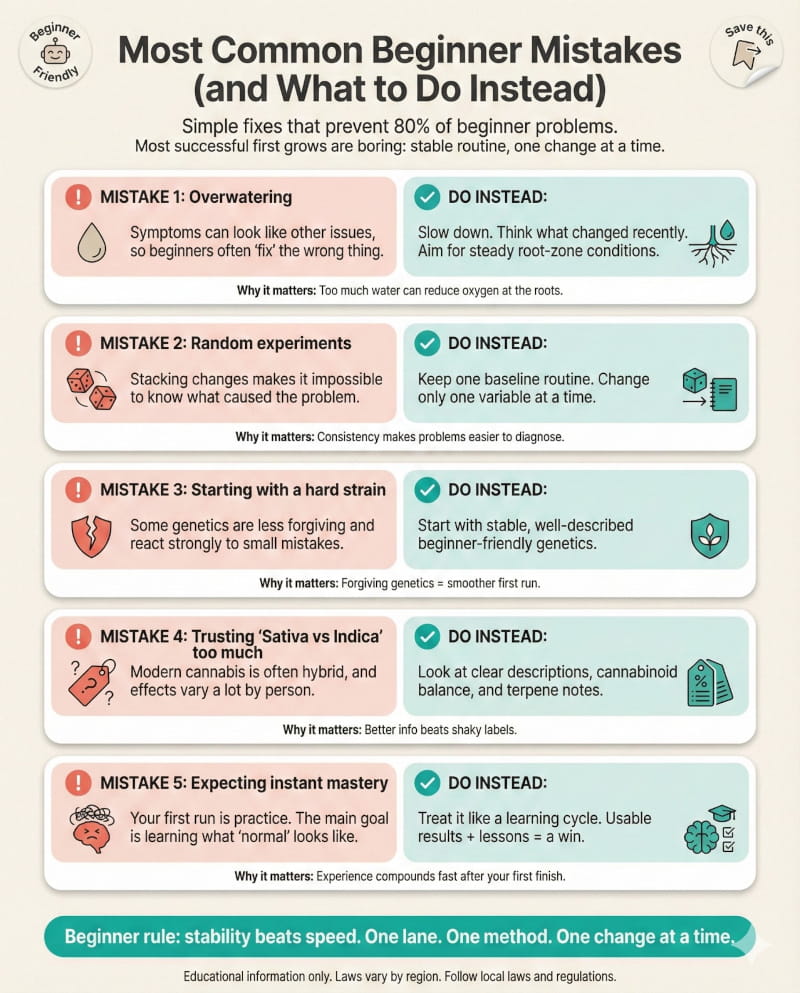
Many problems during a first grow are caused not by too little care, but by reacting too quickly or changing several conditions at the same time. Watering, nutrient supply, light, root conditions, temperature and humidity can influence one another, and similar symptoms can have different causes.
For that reason, this beginner guide focuses on the overall growing process: what a plant needs, how the main stages fit together and which basic decisions need to be made. The separate guide Common Beginner Mistakes When Growing Cannabis is designed specifically for troubleshooting and explains frequent mistakes, why symptoms are often misinterpreted and how possible causes can be narrowed down systematically.
A useful general rule is simple: observe the plant and its environment, narrow down the most plausible causes, change one variable where possible and then allow enough time to evaluate the response. This makes it much easier to understand what actually helped or made the situation worse.
Realistic Expectations for a First Grow
Time
Plan in months rather than weeks. The exact duration depends on genetics, seed type, vegetative growth, flowering and postharvest processing. A shorter advertised flowering time does not automatically mean that the entire grow will be completed within that period.
Odor and Privacy
Flowering cannabis can produce a strong odor. In indoor cultivation, odor management and ventilation should therefore be considered when the setup is planned rather than only after flowering has begun.
Budget
A first setup does not need to include every available product or technology. Spend first on the elements that establish stable growing conditions and choose genetics that actually fit the available space and cultivation method. Additional complexity can be added later when there is a clear reason for it.
Helpful Cannapot Guides for Beginners
Browse Cannabis Seed Categories
Frequently Asked Questions About a First Cannabis Grow
Q: Is it better to start with feminized or autoflower seeds?
A: Both can simplify different parts of a first grow. Feminized seeds reduce the likelihood of male plants and are available as photoperiod or autoflowering genetics. Autoflowers begin flowering without a change to a short-day light schedule, but their shorter life cycle can leave less time to recover from early problems. The better choice depends on available space, schedule and the level of control you want over the vegetative stage.
Q: Which mistakes should I avoid during my first grow?
A: Rigid watering schedules, unnecessary overfeeding and changing several conditions at the same time can make problems more difficult to diagnose. The dedicated guide Common Beginner Mistakes When Growing Cannabis covers these issues in detail and explains how to narrow down possible causes before making corrections.
Q: Do Sativa and Indica labels matter?
A: They can provide some historical or descriptive context, but they are not sufficient on their own to predict growth behavior or chemical profile. Modern cannabis is extensively hybridized, and individual genetics should be evaluated using their specific characteristics. For more context, read Sativa Explained.
Q: How do I choose cannabis seeds if I have no experience?
A: Start with the conditions you actually have: indoor or outdoor location, available height and space, regional climate, desired grow duration and seed type. Then compare genetics that fit those conditions rather than choosing only by THC value or strain popularity. You can also use CannapotGPT to narrow down options from the live catalog.
Q: Should I change several things at once when a plant looks unhealthy?
A: Unless an acute problem requires immediate action, it is usually more informative to narrow down the most plausible causes and make changes in a way that can be tracked. If watering, nutrients, light and climate are all changed simultaneously, it becomes difficult to identify which change actually helped or made the problem worse.
Q: Is a breeder's flowering time the exact harvest date?
A: No. Flowering-time specifications are reference values. Genetics, phenotype and growing conditions can affect development, so the actual maturity of the flowers should be assessed rather than relying only on a calendar.
Scientific Sources and Further Information
Many of the topics in this beginner guide are treated in greater depth in the linked Cannapot specialist articles. Scientific publications on cannabis lighting, mineral nutrition and postharvest processing were also consulted for the horticultural background of this guide. Results from individual studies should always be interpreted in the context of the genetics, developmental stage, cultivation system and experimental conditions used.
• Rodriguez-Morrison, V., Llewellyn, D. & Zheng, Y. (2021): Cannabis Yield, Potency, and Leaf Photosynthesis Respond Differently to Increasing Light Levels in an Indoor Environment. Frontiers in Plant Science, 12:646020.
• Bevan, L., Jones, M. & Zheng, Y. (2021): Optimisation of Nitrogen, Phosphorus, and Potassium for Soilless Production of Cannabis sativa in the Flowering Stage Using Response Surface Analysis. Frontiers in Plant Science, 12:764103.
• Das, P. C., Vista, A. R., Tabil, L. G. & Baik, O.-D. (2022): Postharvest Operations of Cannabis and Their Effect on Cannabinoid Content: A Review. Bioengineering, 9(8):364.
• Baek, Y., Grab, H. & Chen, C. (2025): Postharvest Drying and Curing Affect Cannabinoid Contents and Microbial Levels in Industrial Hemp (Cannabis sativa L.). Plants, 14(3):414.