CBD in Everyday Life: Use, Products & Practical Tips
CBD in Everyday Life: Products, Quality and Practical Use
Updated: September 2026 | CBD in everyday life: product types, morning or evening use, regular use, full spectrum, CBD content, quality, laboratory analyses and proper storage.
Author: Cannapot Grow Team | Reading time: approximately twenty minutes
The Most Important Points at a Glance
✓ CBD products differ significantly: in addition to CBD content, product type, composition, carrier ingredients and the cannabinoid profile play an important role.
✓ Whether CBD fits better into your routine in the morning or evening cannot be answered in general terms. The specific product, personal routine and intended use are what matter.
✓ Percentages and milligrams express CBD content in different ways. When comparing products, you should therefore consider not only the concentration but also the total amount of CBD and the fill volume.
✓ Full-spectrum, broad-spectrum and CBD isolate products differ primarily in their composition. The most reliable way to determine which type a product is involves checking the product information and a suitable laboratory analysis.
✓ A high-quality CBD product should clearly state its CBD content, ingredients, manufacturer and batch. A certificate of analysis matching the batch provides additional transparency.
✓ CBD products should be protected from unnecessary heat, direct light and prolonged exposure to air. The manufacturer's storage instructions should be followed for the specific product.
✓ Anyone who uses CBD regularly or takes medication at the same time should consider dosage, possible side effects and interactions separately.
What matters when using CBD products in everyday life?
Anyone who wants to compare and properly assess CBD products for everyday use should not focus solely on the percentage shown on the packaging. Product type, actual CBD content, composition, cannabinoid profile, quality and storage are equally important.
CBD stands for cannabidiol, one of the naturally occurring cannabinoids in the cannabis plant. Commercial CBD products include oils, capsules and cosmetic products. Depending on the product, both the intended use and the way CBD content and composition are stated can differ.
CBD oils, for example, may display information in percentages and milligrams and use terms such as full spectrum, broad spectrum or CBD isolate. Ingredients, manufacturer and batch information, as well as a certificate of analysis that matches the product, are also useful when assessing quality. Proper storage also matters because light, heat and oxygen can affect product stability.
Good to know: Product quality and individual use are two separate issues. A transparently labelled and analysed CBD product provides information about its composition, but this does not automatically indicate what amount is suitable for a particular person.
What CBD products are available for everyday use?
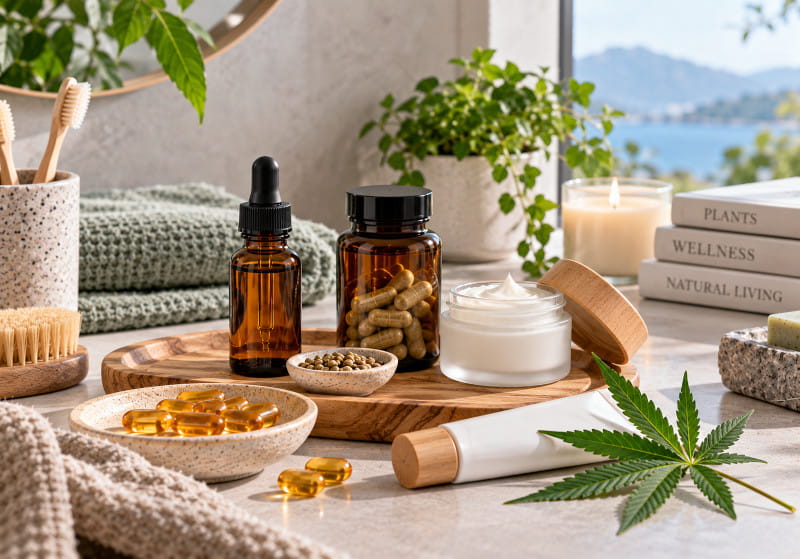
CBD is available in different product forms. CBD oils and capsules are particularly common, while creams, ointments and other cosmetic products containing cannabidiol are also available.
Which product form makes sense depends on more than personal preference. Oils, capsules and cosmetics differ in composition, labelling and intended use. CBD content is not always stated in the same way either: oils often use percentages and milligrams, while capsules frequently state a fixed amount of CBD per unit.
| CBD product | How is the CBD content stated? | What should you look for? |
|---|---|---|
| CBD oil | often as %, mg per bottle or mg/ml | CBD content, fill volume, carrier oil, full or broad spectrum or isolate, and laboratory analysis |
| CBD capsules | often mg CBD per capsule | amount of CBD per unit, number of capsules and other ingredients |
| CBD creams & ointments | depending on the product, as %, mg or a total amount | intended use, CBD content, ingredients and manufacturer information |
| Other CBD products | depends on the product and product category | composition, CBD content, intended use and labelling |
CBD oil: flexible and available in many concentrations
CBD oil is one of the best-known CBD products and is available in different concentrations. It usually contains CBD or a hemp extract together with a carrier oil, such as MCT oil or another suitable plant oil.
When comparing different CBD oils, it is therefore worth taking a close look at the packaging. A higher percentage initially means a higher CBD concentration, but on its own says little about the product's composition or quality. The total amount of CBD in milligrams, bottle size, carrier oil used, cannabinoid profile and, ideally, a batch-specific laboratory analysis are also relevant.
Our guide explains in detail how CBD-containing oil can be made from cannabis flowers and why a homemade infused oil differs from a standardised product: Make Your Own CBD Oil.
CBD capsules: a fixed amount of CBD per unit
CBD capsules differ from oils primarily because the amount of CBD they contain is usually fixed per capsule. For example, if the packaging states 10 mg CBD per capsule, the declared amount per unit can be identified immediately.
Even with capsules, however, you should not look only at the highlighted milligram figure. The total number of capsules, the complete ingredient list and the composition of the CBD product are also important. Depending on the manufacturer, carrier oils and other ingredients may be included.
CBD creams, ointments and other products
CBD is also used in creams, ointments and other cosmetic products. For these products, the stated CBD content cannot be directly compared with the concentration of a CBD oil or the milligram amount in a capsule.
The intended use, overall composition and labelling of the individual product are what matter. Especially across different product categories, a direct comparison based solely on a percentage is therefore of limited value.
CBD in the morning or evening – when is the right time?
Whether CBD fits better into everyday life in the morning or evening cannot be answered in general terms. There is no universally optimal time to use CBD. Relevant factors include the specific product, personal routine, reason for use and individual differences.
The idea that CBD must be used at a particular time of day is also too simplistic. Anyone integrating CBD into a daily routine should instead try to observe how the particular product suits them under comparable conditions. Frequent changes in product, amount and time of day make assessment more difficult.
Using CBD in the morning
Anyone who uses CBD in the morning can, for example, incorporate it into an existing morning routine. Using it at a similar time on a regular basis can help keep conditions as consistent as possible and make changes easier to assess.
However, no specific effect can be inferred from morning use. Claims that CBD is generally stimulating in the morning or particularly suitable for all users are too broad. Individual responses can vary.
Using CBD in the evening
The evening can also be a suitable time within a personal CBD routine. This is particularly true if using it at this time of day makes it easier to maintain a regular routine.
However, using CBD in the evening should not automatically be equated with a sleep-promoting effect. We therefore address what research on CBD and sleep actually shows separately in our guide to CBD and Sleep Problems.
Practical tip: Instead of looking for a universal “best time”, maintaining a consistent routine is often more helpful. However, anyone using CBD together with medication should not independently set the timing based on general time intervals, as this does not reliably rule out possible interactions.
Can CBD be used every day?
Some people use CBD regularly or daily. Whether this is appropriate in an individual case cannot be assessed based on frequency alone. Relevant factors include the specific product, the amount of CBD used, individual circumstances and possible concurrent medication use.
Daily use also does not automatically mean that the same number of drops from different CBD oils is comparable. With the same volume of liquid, a 5% CBD oil contains significantly less CBD than a 20% product. Anyone changing the product or concentration should therefore always consider the actual amount of CBD.
For regular use, keeping the routine as consistent as possible is also helpful. If product, concentration, amount or timing are frequently changed at the same time, it becomes more difficult to determine which differences are actually related to the CBD product.
Important: “Daily” describes only the frequency of use and is not a dosage specification. The amount of CBD used is a separate question. Our guide explains in detail how to interpret concentrations, milligrams and drops: CBD Dosage.
CBD with or without food?
Whether CBD is taken with a meal or on an empty stomach can make a difference for orally used products. Studies show that food can influence CBD absorption; high-fat meals in particular can significantly increase bioavailability.
However, this does not mean that CBD should always be taken with a high-fat meal. Rather, it shows that the conditions surrounding intake can influence how much CBD is absorbed by the body. Anyone using CBD regularly should therefore consider this factor and follow the instructions for the specific product.
For a routine that is as comparable as possible, it can be useful not to change the conditions constantly. For example, taking CBD once on an empty stomach and another time with a larger meal may result in different absorption conditions.
Full spectrum, broad spectrum or CBD isolate – what is the difference?
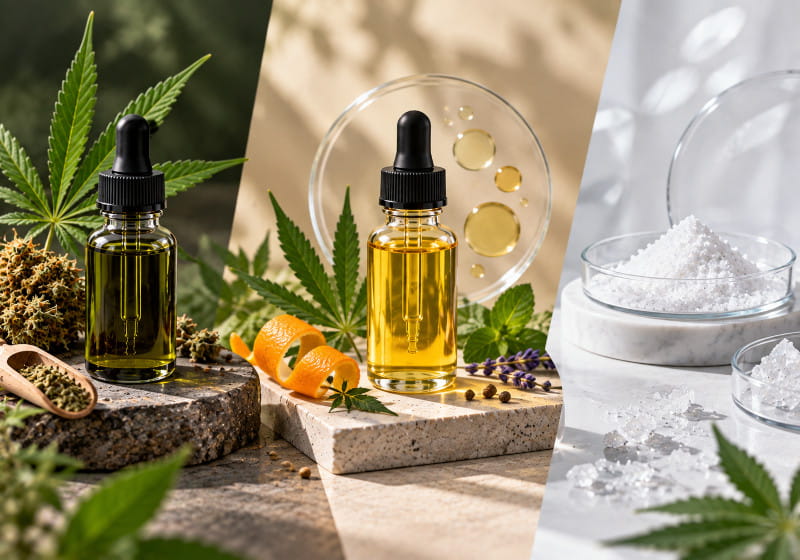
Full-spectrum, broad-spectrum and CBD isolate products differ primarily in which components of the cannabis plant or the extract used are present in the finished CBD product. The terms therefore provide an initial indication of composition, but on their own say nothing about a product's quality.
For practical product selection, it is therefore worth looking beyond terms such as “Full Spectrum” or “Broad Spectrum” on the front label. Assessment becomes more meaningful when combined with the ingredient list, stated cannabinoid profile and, ideally, a certificate of analysis matching the relevant batch.
| Product type | What does it contain? | What should you look for? |
|---|---|---|
| Full spectrum | CBD and other components of the hemp or cannabis extract used, including other cannabinoids. Depending on the source material and product, small amounts of THC may also be present. | Check the cannabinoid profile, actual THC content, ingredients and batch-specific laboratory analysis. |
| Broad spectrum | CBD and other components of the extract or other cannabinoids. The exact profile depends on the original extract and processing. | Do not automatically equate this with “THC-free”. The values actually measured in the laboratory analysis are what matter. |
| CBD isolate | Largely isolated and highly purified CBD rather than the broader cannabinoid profile of a plant extract. | Check the CBD content and purity as well as the other ingredients in the finished product. |
Important: The term “broad spectrum” does not automatically mean that a product is guaranteed to be free of THC. The cannabinoid profile actually measured is what matters. Anyone wishing to avoid THC should therefore not rely solely on terms such as “Broad Spectrum” or “THC-free” on the packaging, but should check the laboratory analysis for the product and, ideally, the specific batch.
How can you identify a high-quality CBD product?
A high-quality CBD product should transparently show what it actually contains. What matters is not marketing claims on the front label, but verifiable information about CBD content, composition, manufacturer and batch, together with a suitable laboratory analysis.
It is particularly useful to examine the packaging and certificate of analysis together: Does the stated CBD content match the laboratory value? Is the THC content shown? Can the analysis be linked to a specific batch? And are all other ingredients clearly stated? The easier this information is to verify, the better the product's actual composition can be assessed.
Terms such as “premium”, “natural” or “high quality” are not proof of quality on their own. Verifiable product information and laboratory values that match the product actually being sold are more meaningful.
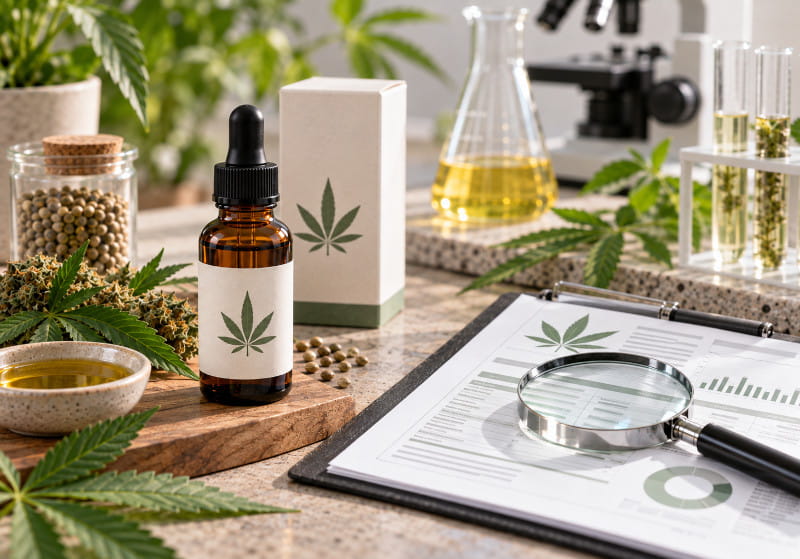
How to read a CBD label correctly: Which information matters?
A CBD label should make it as clear as possible what the product contains and what CBD content is declared. In addition to concentration and fill volume, the complete ingredient list, manufacturer information, batch number and shelf-life information are particularly important. These details help not only when comparing products but also when matching a laboratory analysis to the correct product.
Especially with CBD oils, it is worth considering several pieces of information together. A prominently advertised percentage alone does not tell you how much CBD the entire bottle contains, which other cannabinoids are present, or whether it is a full-spectrum, broad-spectrum or CBD-isolate-based product.
| Information | What does it tell you? |
|---|---|
| CBD content | Shows the declared concentration or amount of CBD and allows different products to be compared. |
| Fill volume | Important for correctly interpreting the concentration and total amount of CBD – for example, in a 10 ml or 30 ml bottle. |
| Ingredient list | Shows, among other things, the carrier oils used and other components of the finished product. |
| Batch number | Enables traceability and, ideally, a clear match to a certificate of analysis for the same batch. |
| Best-before date | Helps assess the product's shelf life and should be considered together with the storage instructions. |
| Manufacturer / responsible party | Identifies who is responsible for the product and who can be contacted with questions. |
Understanding CBD content: What do percentages and milligrams mean?
Percentages and milligrams describe CBD content in different ways: the percentage indicates concentration, while milligrams indicate the absolute amount of CBD. Only when considered together with the fill volume can the total amount of CBD in a product be meaningfully assessed.
A typical example: in a 10 ml CBD oil, 10% CBD corresponds mathematically to about 1,000 mg of CBD in the entire bottle, or approximately 100 mg per millilitre. In a larger bottle, the same concentration can therefore represent a higher total amount of CBD. The manufacturer's information remains authoritative for the specific product.
Our CBD dosage guide explains in detail how percentages and milligrams can be converted, why drop size is not standardised and how different concentrations can be compared: CBD Dosage.
CBD laboratory analysis: What does a Certificate of Analysis (COA) show?
A Certificate of Analysis (COA) documents the results of a laboratory test and can show which cannabinoids were actually detected in the tested sample. For CBD products, the measured values for CBD and THC are particularly relevant, along with other cannabinoids where the analysis is sufficiently comprehensive.
However, it is not enough simply for a laboratory report to be available somewhere. A meaningful COA should be clearly attributable to the specific product and batch wherever possible. If, for example, the batch number on the packaging matches the analysis, it is much easier to verify whether the report actually belongs to the purchased product.
Depending on the scope of testing, laboratory analyses may also cover additional quality parameters. These can include certain residues, heavy metals or microbiological contaminants. However, not every certificate of analysis includes the same tests – so it is worth checking what was actually tested rather than merely whether a laboratory logo is present.
Practical check: For a CBD product, compare at least product name, CBD content and batch number with the certificate of analysis. Then check which cannabinoids were actually measured and whether additional tests are listed. A generic or unassignable laboratory report is considerably less informative than an analysis of the specific batch.
Understanding cannabinoid profiles and traces of THC
The cannabinoid profile shows which cannabinoids were detected in the tested sample and at what concentrations. Depending on the product, other cannabinoids may appear in the analysis report alongside CBD. The profile can therefore also help clarify the actual composition of a product labelled as full spectrum or broad spectrum.
Careful interpretation is particularly important when it comes to THC content. Terms such as “THC-free”, “0% THC” or “not detectable” should not automatically be treated as identical statements. A laboratory may, for example, report a value below its detection or quantification limit without necessarily proving that absolutely no THC is present.
A legal limit is also different from a laboratory's analytical detection limit. When assessing a specific CBD product, the laboratory value actually reported, the measurement notation used and the legal requirements applicable to the relevant product category should therefore be considered separately.
How to store CBD correctly: light, heat and shelf life
CBD products should be stored in a cool, dry place and protected from direct light wherever possible. For CBD oils, light, heat and oxygen are particularly relevant because unfavourable storage conditions can affect the stability of the product and its ingredients.
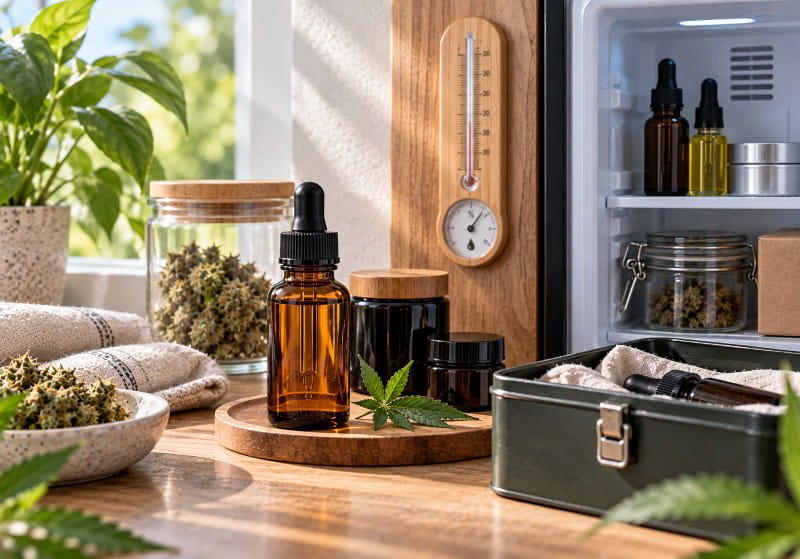
For many CBD oils, a closed cupboard or drawer in a place with a relatively stable temperature is more suitable than a sunny windowsill, bathroom or a location directly next to a stove or heater. Amber glass or other dark bottles provide additional protection from light but do not replace an appropriate storage location.
The bottle should be carefully closed again after each use to reduce unnecessary contact with air. The dropper should also be kept clean and, where possible, should not come into contact with the mouth, hands or other surfaces, so that contaminants do not enter the bottle.
| Factor | Practical storage |
|---|---|
| Light | Protect from direct sunlight and store in a dark place wherever possible. |
| Heat | Do not store for prolonged periods next to radiators or stoves, in a hot car or in other warm places. |
| Oxygen | Close the bottle completely after use and do not leave it open unnecessarily. |
| Moisture | Store the product in a dry place and protect the packaging and closure from unnecessary moisture. |
Does CBD oil need to be stored in the refrigerator?
CBD oil does not generally need to be stored in the refrigerator. For many products, a dark, dry place that is not too warm is sufficient – however, the manufacturer's storage instructions should always be followed.
Very cool temperatures can alter the consistency of certain carrier oils. The oil may, for example, become thicker or temporarily appear cloudy or form precipitates. Such changes do not automatically mean that the product has spoiled.
Conversely, an instruction to “store at room temperature” does not mean that every location in the home is suitable. Direct sunlight and major temperature fluctuations should be avoided wherever possible. If refrigerated storage is explicitly recommended for a particular CBD product, the manufacturer's instruction should be followed.
How long does CBD oil last?
How long a CBD oil lasts depends on the specific product. The best-before date and any manufacturer information on storage and shelf life after opening provide guidance.
Factors affecting stability include the composition, carrier oil used, packaging, storage conditions and how the product is handled after opening. For this reason, no single shelf-life period can meaningfully be applied to all CBD oils.
Noticeable changes in smell, taste, colour or consistency may indicate that a product has changed. Particularly in the case of clear or unusual changes, it should not continue to be used solely because the printed best-before date has not yet been reached.
Practical tip: For many CBD oils, a closed cupboard in a cool, dry place is a simple solution. Close the bottle tightly, avoid direct sunlight and intense heat, and follow the specific storage instructions on the packaging.
What else should you consider when using CBD in everyday life?
Product quality is only one aspect of using CBD safely. The actual amount of CBD used, individual tolerance and possible interactions with medication are equally important. These questions cannot be answered based on a label or laboratory analysis alone.
Especially with regular use, it is therefore useful to consider product quality and personal use separately. A transparently labelled and analysed product can make its composition easier to understand, but it does not indicate what amount is individually suitable or whether interactions can be ruled out.
| Question | Detailed guide |
|---|---|
| How can the amount of CBD be assessed? | CBD Dosage: How Much CBD Should You Take? |
| What side effects are possible? | CBD Side Effects, Risks and Safety |
| What should be considered when taking medication? | CBD Interactions with Medication |
Especially important: Anyone who regularly takes medication should not try to avoid possible interactions with CBD solely by leaving a time interval between them. Such an interval does not necessarily prevent metabolic interactions. Prescribed medication should therefore not be skipped, rescheduled or have its dosage changed without appropriate medical guidance.
CBD and the cannabis plant: What role does genetics play?
How much CBD a cannabis plant can produce and the ratios in which different cannabinoids occur are strongly influenced by its genetics. In addition to THC-dominant varieties, there are balanced chemotypes and CBD-dominant lines that have been specifically selected for corresponding cannabinoid profiles.
In the fresh plant, CBD is initially found predominantly in the form of its acidic precursor CBDA. Only through decarboxylation – for example under the influence of heat – is it converted into CBD. Our guide explains this relationship and the differences between the two cannabinoid forms in more detail: CBDA and the Difference from CBD.
The ratio of CBD to THC also differs considerably between different genetics. Anyone wishing to explore this plant-related aspect in greater detail can find more information in our comparison of the best CBD strains with details on CBD-dominant genetics, chemotypes and different CBD:THC ratios.
You can also find suitable genetics with different CBD:THC profiles in our selection of CBD Seeds.
Important context: Information about the CBD content of cannabis genetics should not be equated with the concentration of a finished CBD oil. Plant material and finished products made from it are different starting points; processing, extraction and formulation also determine the CBD concentration a finished product ultimately contains.
Frequently Asked Questions About CBD in Everyday Life
Can CBD be used every day?
A general recommendation for daily use cannot be given for every CBD product and every person. Relevant factors include the type of product, amount of CBD, individual circumstances and possible concurrent medication use. “Daily” merely describes frequency and does not indicate a suitable amount of CBD.
CBD in the morning or evening – which is better?
There is no universally applicable time of day that is better for all people and CBD products. CBD can be part of a personal routine both in the morning and in the evening. The specific product, intended use and individual circumstances are what matter.
What does 10% CBD mean?
Using the usual concentration convention, a 10% CBD oil corresponds to approximately 100 mg CBD per millilitre. A 10 ml bottle therefore contains approximately 1,000 mg CBD mathematically. However, the manufacturer's declaration remains authoritative for the specific product.
What is the difference between full spectrum, broad spectrum and CBD isolate?
Full-spectrum products contain other components of the extract used in addition to CBD, while broad-spectrum products can contain several components in a composition that varies depending on how they are produced. CBD isolate, by contrast, consists of largely isolated and highly purified CBD. The actual composition should be checked using the product declaration and, ideally, a batch-specific laboratory analysis.
Does CBD oil need to be stored in the refrigerator?
CBD oil does not generally need to be stored in the refrigerator. For many products, a dark, dry storage location that is not too warm is sufficient. However, the storage instructions of the relevant manufacturer should always be followed.
How long does CBD oil last?
Shelf life depends on the specific product, its composition, packaging and storage. The best-before date and any manufacturer information on shelf life after opening provide guidance. Noticeable changes in smell, taste, colour or consistency should also be taken into account.
What is particularly important when using CBD in everyday life?
For the practical assessment of CBD, product type, CBD content, composition, transparent quality information and proper storage are more important than general rules about supposedly perfect use.
CBD oils, capsules and other product forms cannot be compared on the basis of a percentage alone. Milligram figures, fill volume, ingredients, product type and a certificate of analysis matching the batch together provide a much more complete picture.
Terms such as full spectrum, broad spectrum or CBD isolate are primarily descriptions of composition. Anyone who wants to know more precisely what a product actually contains should therefore consider the product declaration and laboratory analysis together.
Dosage, possible side effects and interactions remain separate issues. This distinction makes it possible to assess CBD products objectively in everyday life without deriving individual medical recommendations from general product information.
Scientific and Professional Sources
- European Food Safety Authority (EFSA): Safety of cannabidiol isolated from Cannabis sativa L. as a novel food pursuant to Regulation (EU) 2015/2283 (2026) – current EFSA scientific assessment of isolated CBD from Cannabis sativa L. as a novel food, published on 21 September 2026.
- European Food Safety Authority (EFSA): Safety of Cannabis sativa L. extract as a novel food pursuant to Regulation (EU) 2015/2283 (2026) – current EFSA scientific assessment of a Cannabis sativa L. extract as a novel food, published on 21 September 2026.
- European Food Safety Authority (EFSA): Provisional safe level for cannabidiol as a novel food (2026) – EFSA assessment from February 2026 with a provisional safe intake level for certain highly purified CBD formulations and remaining data gaps.
- European Food Safety Authority (EFSA): Statement on the safety of cannabidiol as a novel food – background information on safety issues, data gaps and uncertainties in the assessment of CBD as a novel food.
- World Health Organization (WHO): Cannabidiol (CBD) – Critical Review Report – report by the WHO Expert Committee on Drug Dependence on cannabidiol.
- U.S. Food and Drug Administration (FDA): What You Need to Know About Products Containing Cannabis or Cannabis-derived Compounds, Including CBD – information on safety, interactions, product quality and unresolved research questions concerning CBD products.
- Taylor L. et al.: A Phase I, Randomized, Double-Blind, Placebo-Controlled, Single Ascending Dose, Multiple Dose, and Food Effect Trial of Highly Purified Cannabidiol in Healthy Subjects – clinical study on the pharmacokinetics of CBD and the effect of a high-fat meal on CBD absorption.
- Crockett J. et al.: A phase 1, randomized, pharmacokinetic trial of the effect of different meal compositions, whole milk, and alcohol on cannabidiol exposure and safety in healthy subjects – study on the effect of different meals on systemic CBD exposure.
- Saals B.A.D.F. et al.: A high-fat meal significantly impacts the bioavailability and biphasic absorption of cannabidiol (CBD) from a CBD-rich extract in men and women – study on the effect of a high-fat meal on the bioavailability of a CBD-rich extract.
- Fraguas-Sánchez A.I. et al.: Stability characteristics of cannabidiol for the design of pharmacological, biochemical and pharmaceutical studies – study on the stability of CBD under various conditions, including the effects of temperature, light and oxidative conditions.