Skunk cannabis explained – meaning - origin and genetics
Skunk: Meaning, Origins, Smell, Effects, and How to Spot Real “Skunk”
Updated: December 2025 | Skunk Cannabis - the story of the true Skunk
Author: Cannapot Grow Team | Reading time: approximately ten minutes
Key Takeaways
✓ In cannabis, “Skunk” can describe a genetic family, a specific reference line like Skunk #1, or the classic pungent aroma profile associated with old-school Skunk strains.
✓ Classic Skunk genetics became famous because growers considered them stable, reliable, productive, and easier to manage than many older long-flowering varieties.
✓ The traditional Skunk smell is often described as sharp, musky, “animal-like,” earthy, or fuel-heavy and may involve more than standard terpene profiles alone.
✓ Many modern “Skunk” strains today borrow the aroma or overall vibe of original Skunk lines rather than preserving the exact historic Skunk genetics themselves.
If you search for “Skunk Cannabis” or “what is Skunk weed”, you probably ran into the same problem: everyone uses the word “Skunk,” but not everyone means the same thing.
Some people mean Skunk #1 (a famous old-school line). Others mean any weed that smells sharp and loud.
And plenty of modern “Skunk” strains are really just Skunk-style hybrids that borrow the vibe, not the exact genetics.
This guide clears that up in a clean way. No hype. No sales talk. Just a proper reference page you can link to when somebody says, “Bro this is Skunk,” and you are not sure what they mean.
What does “Skunk” mean in cannabis?
In cannabis, Skunk is used in three overlapping ways:
-
Skunk as a genetic family
A broad breeding line that influenced a lot of modern cannabis. -
Skunk #1 as a specific reference line
A particular “classic” Skunk that became a benchmark. -
Skunk as a smell category
A label people use for that unmistakable, pungent “skunky” aroma.
If you keep those three buckets in your head, Skunk stops being confusing.
Quick answer: Is Skunk a strain or a type?
Both, depending on the context.
-
Skunk #1 is a “strain name” people still refer to.
-
Skunk is also a type (genetic family + smell profile) that shows up inside many modern hybrids.
That is why “Skunk” can feel vague. It became bigger than a single plant.
Skunk origins: where Skunk genetics came from
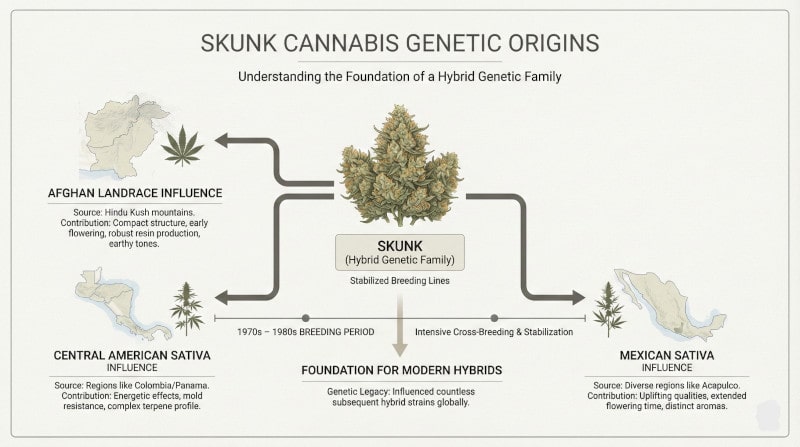
Skunk comes from a time when breeders were chasing something very practical: stable plants that finished reliably and hit consistently.
A lot of sources describe early Skunk work as combining Afghan (for body, structure, resin, and sturdiness) with Central/South American sativa lines (for lift, aroma range, and vigor). The names you often see in old accounts are Afghani plus Colombian and Mexican influences.
The exact details can vary depending on who tells the story. That is normal with older cannabis history. What matters is the breeding goal: make a strong, dependable hybrid that is easy to run and easy to recognize.
That effort is what made Skunk #1 so famous. Not because it was rare. Because it was repeatable.
Skunk #1: why it became the reference point
Skunk #1 is important because it acted like a “center of gravity” for later breeding.
People associate Skunk #1 with:
-
reliable hybrid effects (clear head + calm body, not usually chaotic)
-
manageable flowering compared to long, pure sativas
-
good yields without needing perfect conditions
-
a smell that people learned to call “Skunk”
Once a strain becomes predictable, breeders use it as a tool. That is how Skunk influence spread so widely through Europe and beyond.
Why Skunk smells so strong
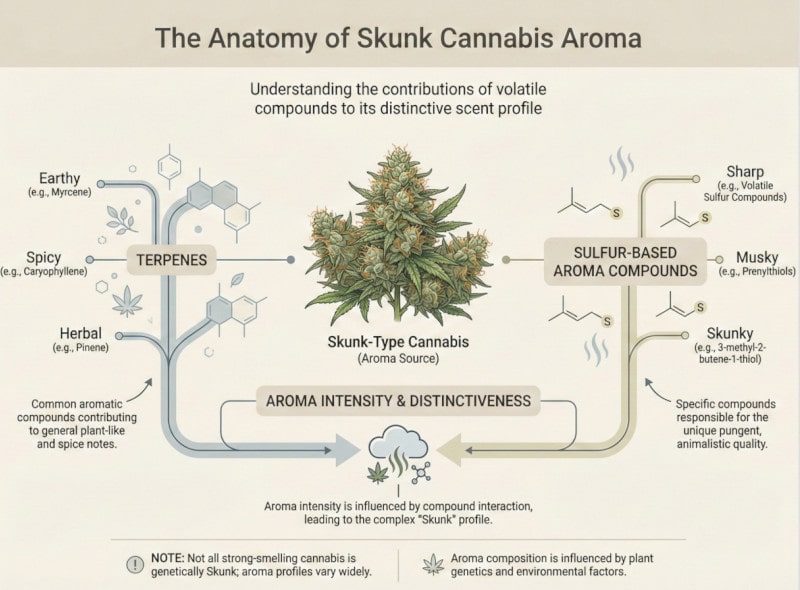
The smell is the main reason Skunk became a cultural thing.
Classic Skunk aroma is often described as:
-
sharp
-
musky
-
“animal”
-
sometimes sweet underneath
-
sometimes like rubber, fuel, or damp earth depending on phenotype
People usually blame terpenes alone, but that is not the whole story.
Terpenes matter, but they are not the entire explanation
Terpenes can shape the smell (earthy, spicy, citrus, herbal), but the “skunky bite” many people recognize seems to involve tiny amounts of sulfur-based aroma compounds.
That is why:
-
two plants can share similar terpenes, yet only one has that true “skunk” punch
-
some strains smell loud in a sweet way, but do not smell “skunky”
-
some strains smell “skunky” even when the terpene profile looks ordinary on paper
You do not need to over-science this. Just remember: Skunk smell is not just “terpenes = Skunk.” It is more layered than that.
Skunk effects: what people commonly feel
A lot of pages write “Skunk is strong” and stop there. That is not very useful.
Classic Skunk-leaning effects are usually described as:
-
a noticeable mental lift (not always racy)
-
a steady mood shift (less sharp spike, more “even”)
-
body relaxation that does not automatically glue you down
-
a social, talkative window for some people
But modern Skunk-style strains can lean in different directions depending on what they were crossed with.
Practical way to think about it
Instead of “Skunk = indica” or “Skunk = sativa,” think of Skunk as:
-
balanced hybrid baseline
-
with phenotype variation that can push it brighter or heavier
If you want a clean description for your brain:
Skunk tends to feel “usable.” That is the point. Not extreme. Not delicate. Just dependable.
Is Skunk indica or sativa?
Skunk is best understood as a hybrid family. Calling it pure indica or pure sativa usually causes arguments that go nowhere.
What you can say safely:
-
many classic Skunk lines lean hybrid with flexible effects
-
phenotypes can shift the experience
-
modern “Skunk” names often have mixed ancestry
So the honest answer is: Skunk is not one fixed thing. It is a family, and a smell category, and sometimes a specific line name.
Skunk phenotypes: why one “Skunk” can feel different from another
This is where a lot of competitor articles are thin.
Two plants labeled “Skunk” can differ in:
-
sweet vs sharp aroma
-
compact vs stretchy structure
-
more upbeat vs more calming effect
-
earlier vs later finishing time
-
dense buds vs more airy buds
That is normal in older hybrid families and in lines that have been worked across many breeders for decades.
So if you are trying to pick “a Skunk,” you are really picking a Skunk expression.
Growing Skunk: why growers historically loved it
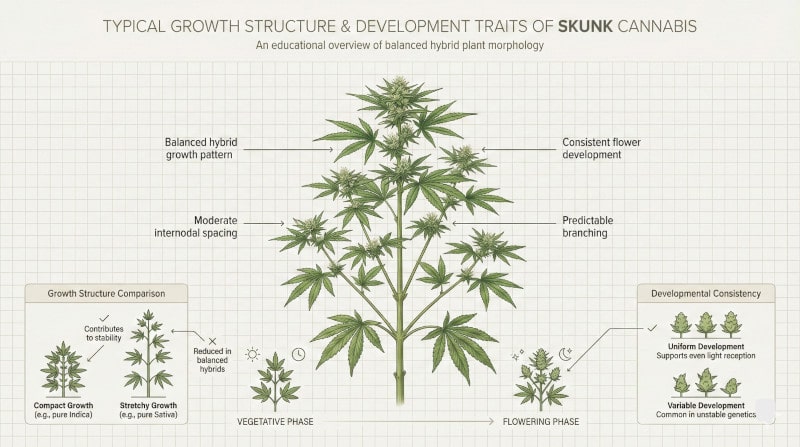
Skunk built its reputation in grow rooms.
Growers liked Skunk because it tended to be:
-
forgiving
-
consistent
-
productive
-
not overly sensitive
-
easier to predict than many long-flowering sativas
Skunk was often recommended as a “workhorse” plant. If you were learning, it gave you a fair chance to finish with decent results.
If you are comparing different seed formats, our guide to feminized, growing-autoflowering-cannabis, and regular cannabis seeds breaks down the practical differences.
The real downside: odor control
If you grow Skunk indoors, smell is not a small detail. Late flower can be intense.
If a page claims Skunk is discreet, it is not being honest.
Classic Skunk vs modern “Skunk-style” strains
This is one of the biggest ranking gaps on most Skunk pages, so we are going to spell it out.
Classic Skunk
-
closer to the older Skunk breeding lines
-
usually more “balanced hybrid” in feel
-
smell is often musky, sharp, unmistakable
Modern “Skunk-style”
-
may have Skunk influence, or may not
-
often named for the smell or the vibe
-
can range from energetic to heavy depending on cross
This is why “Skunk” can be a messy label today. The name became shorthand.
If you want your article to be trusted, you have to admit that out loud. People can tell when a page is pretending the label is perfectly precise.
How to tell if something is “real Skunk” (practical checklist)
You cannot verify genetics by smell alone, but you can spot Skunk-like traits.
Look for a combination of:
-
a sharp, musky odor with that “animal” edge
-
a hybrid effect that feels steady rather than dramatic
-
plant behavior that is generally predictable
-
references to Skunk #1 or older Skunk lines in the breeder background (when available)
If the product page or description is vague, you are often dealing with “Skunk-style,” not necessarily classic Skunk.
That is not automatically bad. It is just a different thing.
Why Skunk still matters in 2025
Skunk matters for two reasons:
-
History and influence
Skunk helped shape modern breeding. A lot of “everyday hybrid cannabis” traces back through Skunk influence somewhere in the family tree. -
A specific kind of experience
Some people still prefer the Skunk-style balance. Not because it is trendy, but because it feels straightforward and functional.
Skunk is not always the loudest in modern marketing. But it is still one of the most searched cannabis families for a reason.
FAQs
Q: What is Skunk cannabis?
A: Skunk cannabis refers to a classic hybrid genetic family and its well-known pungent smell profile. It can also refer specifically to Skunk #1, a famous reference line.
Q: Why does Skunk weed smell like a skunk?
A: Skunk aroma is shaped by terpenes, but the sharp “skunky” edge is also linked to trace sulfur-like aroma compounds that make the smell more aggressive and hard to miss.
Q: Is Skunk a strain or a category?
A: Skunk is both. Skunk #1 is a specific strain reference, while “Skunk” is also used as a broader category for Skunk-influenced genetics and skunk-like aromas.
Q: Is Skunk indica or sativa?
A: Skunk is generally considered a hybrid family. Different phenotypes and modern crosses can lean more uplifting or more calming.
Q: Is Skunk good for beginners?
A: Historically, Skunk lines were popular with beginners because they were reliable to grow and tended to produce balanced effects. Individual tolerance still matters.
Q: Skunk genetics still available today
A: While many modern strains only borrow the Skunk name or aroma, some breeders still maintain lines that stay close to classic Skunk genetics. These are often referenced not because they are trendy, but because they show what “Skunk” originally meant in practice.
For example, Skunk #1 is still widely regarded as a reference point for Skunk genetics. It is commonly mentioned in historical discussions because it represents a stabilized hybrid that helped define the Skunk family.
Another example is NL5 x Skunk, which illustrates how Skunk genetics were later combined with other foundational lines to create balanced, reliable hybrids while retaining the recognizable Skunk influence.
You will also find modern interpretations such as Skunk Redux #1, which reflect how Skunk genetics have been adapted over time while still keeping the general structure and aroma profile associated with the Skunk name. These examples are useful as reference points, not as definitions. They show how Skunk exists today as a genetic family rather than a single, fixed strain.