THC Is Not Everything: Terpenes Explained
THC Is Not Everything: Terpenes explained quickly and easily
Updated: February 2026 | What are cannabis terpenes and why THC does not explain flavor | Cannapot
Author: Cannapot Grow Team | Reading time: approximately fifteen minutes
Key Takeaways
✓ Terpenes are the main drivers behind cannabis aroma and flavor — THC alone does not explain why products smell or taste different.
✓ Two strains with similar THC percentages can still feel noticeably different because the full chemical profile varies beyond THC alone.
✓ Cannabis aroma is influenced not only by major terpenes but also by tiny secondary compounds that can strongly shape signature smells.
✓ A more reliable shopping strategy is to focus on terpene direction, aroma profile, freshness, and COA data instead of chasing THC percentages only.
A lot of people shop cannabis like it is a single-number game. Higher THC must mean “better,” right? In real life, it is not that clean. THC matters, but it does not explain flavor, aroma, or why two products with similar THC can feel surprisingly different to the same person.
If you want fewer surprises, terpenes are a better place to start learning. Terpenes are the aroma compounds in cannabis. They are why one strain smells like citrus and pine while another smells like grape candy, fuel, or pepper.
They also help you describe what you actually like, which is more useful than chasing a percent.
This guide breaks down terpenes in a practical way: what they are, what they are no, and how to shop with terpenes in mind.
Quick Takeaways
-
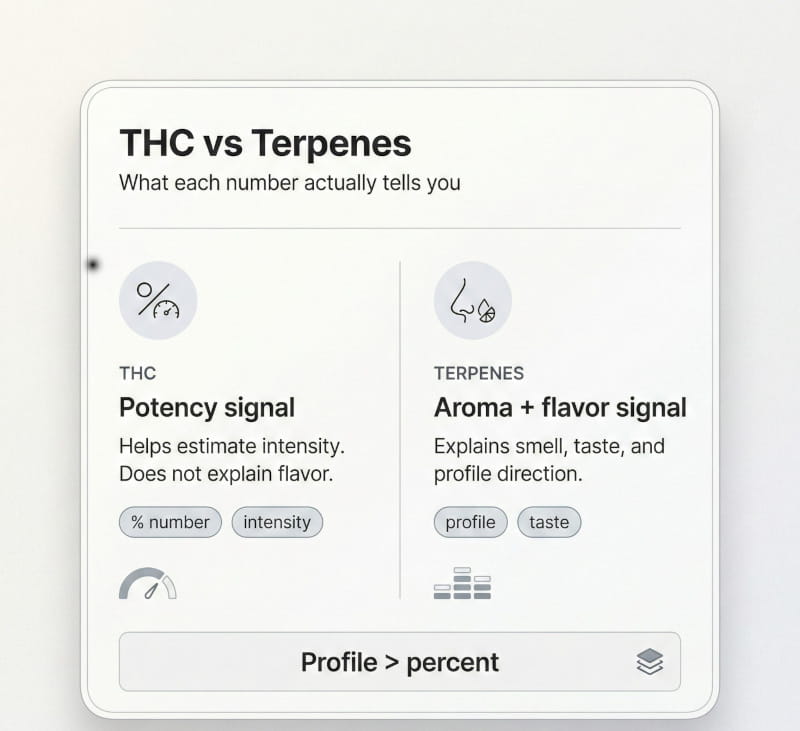
Terpenes drive smell and flavor. THC does not.
-
Two “high THC” strains can feel different because the full chemical profile is different (terpenes, minor cannabinoids, and other compounds).
-
Aroma is not only terpenes. Some “signature smells” are influenced by tiny compounds beyond the main terpene list.
-
Do not treat terpenes like guarantees. They are clues, not promises.
-
Best habit: choose a terpene direction you like, then confirm it with the COA and the product handling (freshness and storage).
Table of Contents
-
Terpenes 101: What They Are
-
Monoterpenes vs Sesquiterpenes (Why Aroma Changes)
-
Why THC Is Not Everything
-
Aroma Is Bigger Than “Terpenes”
-
The “Entourage Effect” (What We Know vs What We Do Not)
-
Common Terpenes and What They Usually Smell Like
-
How to Read a COA for Terpenes
-
How to Shop With Terpenes (Simple Checklist)
-
Related Cannapot Pages (Internal Links)
-
FAQ
Terpenes 101: What They Are
Terpenes are aromatic compounds made by many plants. Not just cannabis. You will find them in things like citrus peels, pine needles, lavender, black pepper, and hops. In cannabis, terpenes are a major part of what people call a strain’s “personality,” because they shape what you smell and taste.
When you see a terpene list on a COA, you are basically looking at an aroma fingerprint.
It does not tell you everything about the experience, but it tells you more than THC alone.
If you enjoy learning the “language” of aroma, the Cannapot Canna Wiki is a good place to explore related strain and genetics guides in the same style.
Monoterpenes vs Sesquiterpenes (Why Aroma Changes)
Not all terpenes behave the same. A simple way to understand it:
-
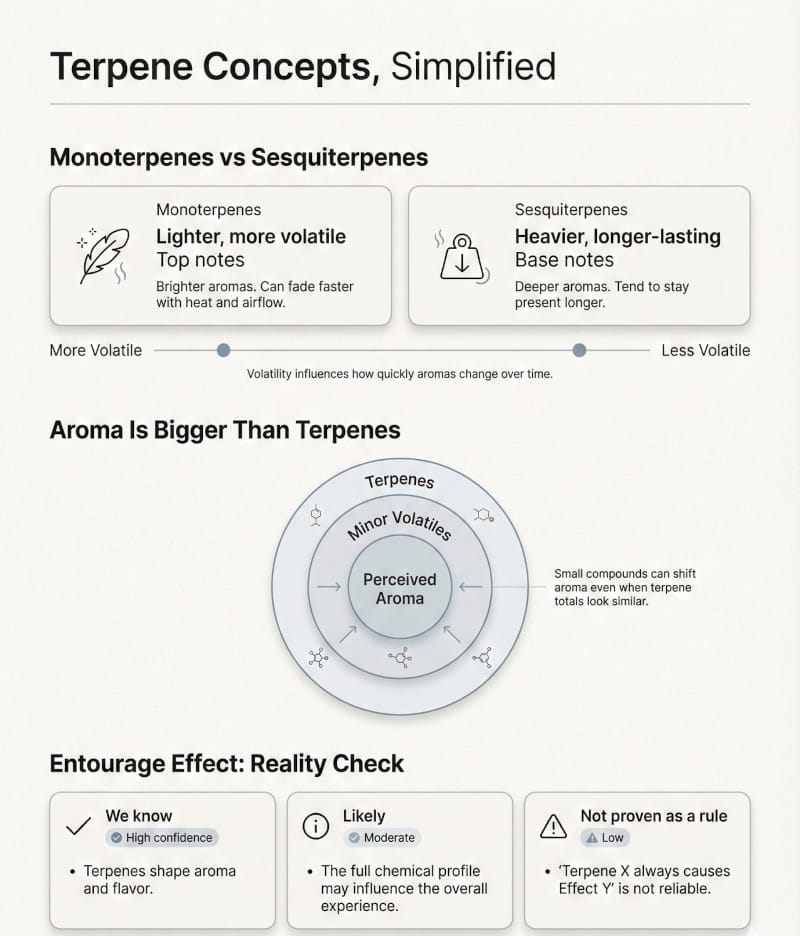
Monoterpenes are lighter and more volatile. They often smell bright (citrus, pine, sharp herbal notes). They can fade faster with heat and airflow.
-
Sesquiterpenes are heavier and less volatile. They often smell deeper (spice, wood, earth). They tend to stick around longer.
This is why “freshness” and handling matter. A product that is exposed to heat, air, or poor storage can lose top-note aroma first.
So when people say, “This did not smell like it was supposed to,” it is often a storage and volatility story, not a THC story.
Why THC Is Not Everything
THC is a major driver of intoxication. That part is real. But THC is not the whole chemical profile, and it is not a good shortcut for flavor or overall experience.
Here are the most common reasons THC alone fails as a shopping tool:
-
THC does not describe flavor. Terpenes do most of that work.
-
THC does not show cannabinoid balance. Minor cannabinoids and ratios matter for how a product feels to many people.
-
Two people can react differently because of tolerance, dose size, and timing.
-
Label categories like “sativa vs indica” are not reliable predictors by themselves. Chemical profile is often more useful than the label.
If you want the calm explanation, read: What Is Sativa Cannabis? Meaning, Effects, and Myths.
A better habit is to treat THC as one data point, then use terpenes (and the COA) to choose what you actually like.
Aroma Is Bigger Than “Terpenes”
This is a detail that separates surface-level terpene articles from real-world accuracy:
some aromas are strongly influenced by tiny compounds that are not the “main terpenes” on the list.
That is why two products can show similar terpene totals, yet smell different.
It is also why trendy aroma labels can be messy: “sweet,” “tropical,” “savory,” “chemical,” “gas,” and so on can come from complex mixtures, not one terpene.
If you have ever wondered why “Skunk” is such a confusing word, this is part of it.
The term gets used broadly, but the smell story is more specific. See: Skunk Cannabis: What It Really Means and Why It S4mells.
The “Entourage Effect” (What We Know vs What We Do Not)
Quick reality check:
-
We know: terpenes clearly shape aroma and flavor.
-
Likely: the full chemical profile can influence the overall experience in ways THC alone does not capture.
-
Not proven as a rule: “Terpene X always causes Effect Y.” People say this online, but it is not a safe way to think about it.
It is fine to be curious about synergy between compounds. Just keep your expectations realistic. Use terpenes as a taste-and-aroma guide first.
Anything beyond that should be treated as “possible” rather than “guaranteed.”
Common Terpenes and What They Usually Smell Like
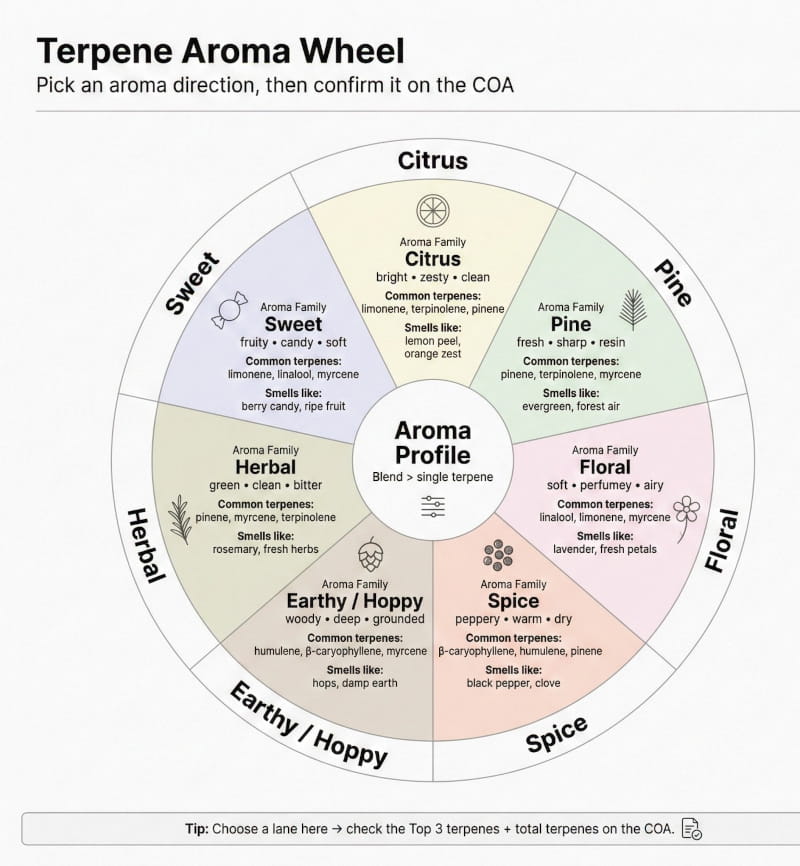
Below is a practical reference table you can use while browsing COAs. These are aroma cues, not promises.
| Terpene | Typical Cues | You Might Like It If You Like... | Notes |
|---|---|---|---|
| Limonene | Citrus peel, bright, clean | Lemon, orange, citrus cleaners (in a good way) | Often shows up in “fresh” profiles |
| Myrcene | Earthy, herbal, musky | Mango skin, cloves, damp herb notes | Common in many classic genetics |
| Pinene | Pine needles, fresh forest, sharp green | Pine, rosemary, evergreen | Often reads “crisp” on the nose |
| Linalool | Floral, soft, perfumey | Lavender, clean floral soap | Can feel “rounded” in aroma blends |
| β-Caryophyllene | Pepper, spice, warm wood | Black pepper, cloves, cinnamon bark | Interesting because it interacts with cannabinoid biology in lab studies |
| Humulene | Woody, hoppy, earthy | Hops, dry herbs, wood | Often appears with caryophyllene |
| Terpinolene | Sweet herbal, fresh, a bit complex | Herbal tea, sweet pine, light citrus | Stands out when it is a top terpene |
Reminder: these are aroma directions. Real-world experience depends on dose, your tolerance, the rest of the chemical profile, and how the product was grown and handled.
How to Read a COA for Terpenes
A COA (Certificate of Analysis) is your reality check. It tells you what is actually in the product.
When you are reading the terpene section, focus on four things:
1. Total Terpenes
Think of total terpenes like “overall aroma intensity.” It is not perfect, but it is a useful signal.
If total terpenes are extremely low, the product may smell flat even if THC is high.
2. Top 3 Terpenes
The top 3 terpenes usually set the main direction. For example:
-
Limonene + Pinene + Caryophyllene often reads bright, fresh, and spicy.
-
Myrcene + Caryophyllene + Humulene often reads earthy, musky, and warm.
-
Linalool + Limonene + Myrcene can read floral-citrus with a softer base.
3. Balance, Not Just One “Star Terpene”
One terpene rarely explains everything. The blend matters. A small amount of one compound can change the nose more than you expect.
4. Freshness and Handling
Terpenes are volatile. Heat and air exposure can dull aroma. Even a great COA cannot protect a product that was stored poorly.
If aroma matters to you, buy from sources that handle inventory carefully.
How to Shop With Terpenes (Simple Checklist)
If you want a simple process that works:
-
Pick an aroma lane first. Citrus, pine, dessert, fuel, floral, spice, herbal.
-
Then check the COA. Confirm the terpene direction matches the description.
-
Check balance, not just THC. THC alone is not a flavor guide.
-
Use a search tool that lets you filter by profile. This is where shopping becomes easier.
-
Buy for repeatability. If you find a terpene direction you love, stick to breeders and lines known for that lane.
On Cannapot, the easiest way to shop beyond THC is to use the Strain Finder, then explore the seed categories that match your goals:
If you are specifically exploring terpene products and related items, you can also browse:
Terpenes & CBD.
Related Cannapot Reads
FAQs
Q: Do terpenes matter more than THC?
A: They matter for different reasons. THC is a key driver of potency. Terpenes are a key driver of aroma and flavor, and they can help explain why two products feel different even when THC is similar.
Q: Can I predict effects from terpenes?
A: You can sometimes notice patterns, but you should not treat terpenes like a guarantee. Your response depends on dose, tolerance, the full chemical profile, and personal biology.
Q: Why does the same strain smell different sometimes?
A: Genetics, growing conditions, drying/curing, and storage all change aroma outcomes. Also, some key aroma compounds are present in tiny amounts and are not always obvious from a short terpene list.
Q: What is the best way to shop if I do not want to chase THC?
A: Pick an aroma lane you like, confirm it with the COA, and use filters that let you search by profile