Stages of cannabis cultivation: from sowing to harvest
Cannabis Growth Stages: From Seed to Harvest
Updated: September 2026 | Development stages from germination to maturity
Author: Cannapot Grow Team | Reading time: approximately seventeen minutes
The Most Important Things At A Glance
✓ Autoflower vs. Photoperiod: Differences in the Life Cycle
✓ Stage 1 – Germination: The Seed Wakes Up
✓ Stage 2 – Seedling Stage: First Leaves and First Mistakes
✓ Stage 3 – Vegetative Stage: Roots, Branches, Leaves and Structure
✓ Stage 4 – Pre-Flowering: The Plant Shows Its Direction
✓ Stage 5 – Early Flowering: Stretch, Pistils and Bud Sites
✓ Stage 6 – Mid Flowering: Bud Swelling, Resin and Aroma
✓ Stage 7 – Late Flowering and Ripening: Reading Harvest Readiness
✓ Stage 8 – Harvest: Cutting at the Right Time
✓ Stage 9 – Drying: The Stage Most Beginners Rush
✓ Stage 10 – Curing: The Final Step for Quality and Aroma
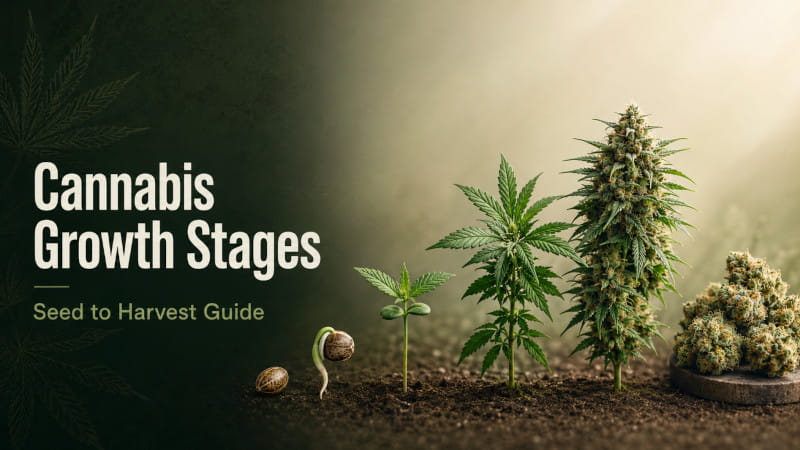
Cannabis does not grow in one straight jump from seed to harvest. It moves through clear stages, and each stage has its own rhythm. Some parts feel slow, like the first seedling days. Other parts move fast, especially during vegetative growth or the early flowering stretch. When you know what stage the plant is in, it becomes much easier to understand what looks normal, what looks wrong, and what may happen next.
This guide explains the growth and development stages of cannabis, from germination and the seedling stage through vegetative growth, pre-flowering, flowering, ripening, harvest, drying, and curing. The focus is on what changes in the plant during each stage and how to recognize its current developmental state. It also covers important differences between autoflower and photoperiod plants as well as common warning signs.
If you want to know when practical tasks such as transplanting, training, feeding, or harvest checks usually come up during a grow, use our Cannabis Grow Calendar for Indoor & Outdoor. This article deliberately focuses on the plant’s development itself.
Quick Answer: What Are the Main Cannabis Growth Stages?
The main cannabis growth stages are germination, seedling growth, vegetative growth, pre-flowering, early flowering, mid flowering, late flowering, ripening, harvest, drying, and curing. Autoflower and photoperiod plants pass through the same broad developmental stages, but they differ in what triggers flowering and how long individual stages can last. For concrete timing and task planning, the Cannabis Grow Calendar is the better reference.
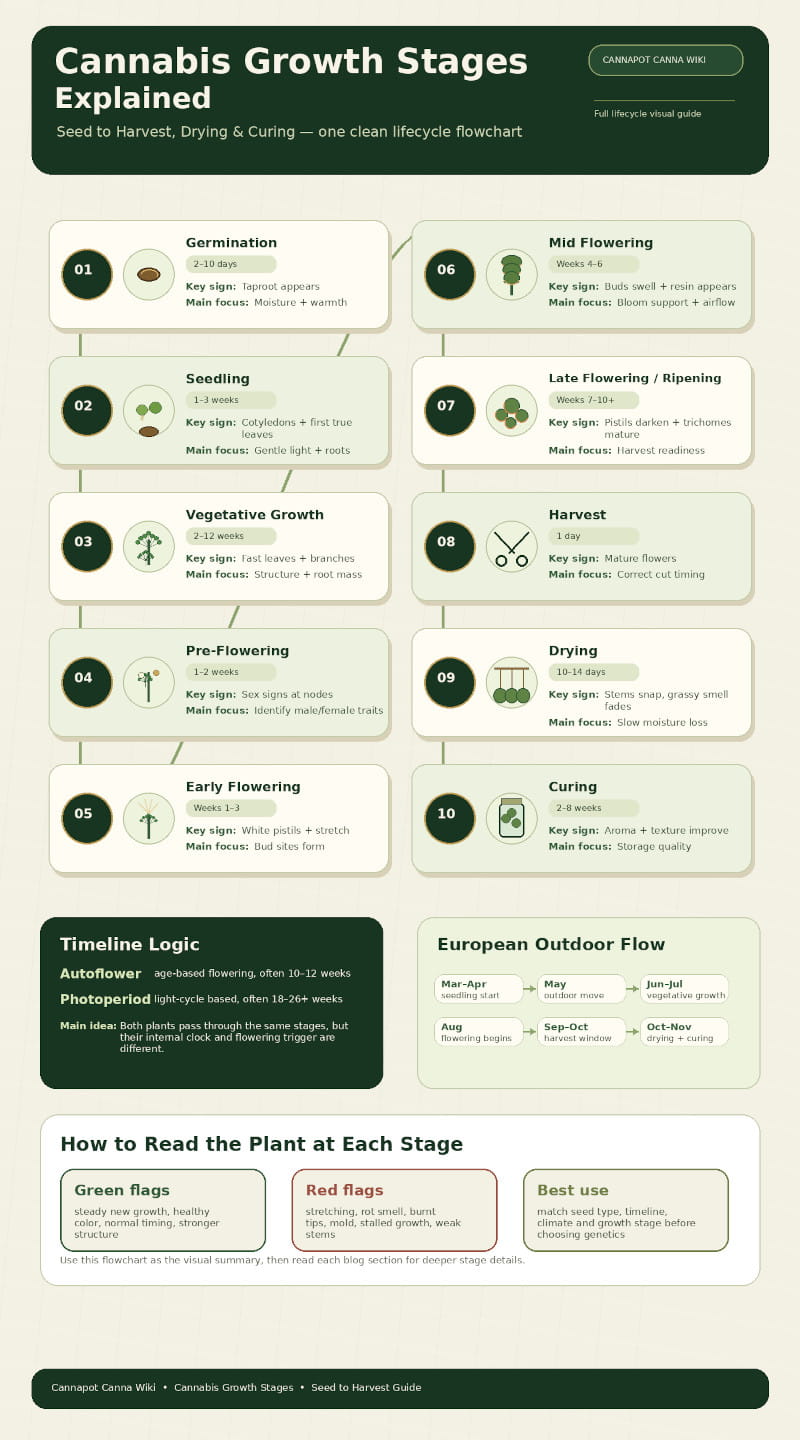
- Germination: the seed opens and the taproot appears.
- Seedling stage: cotyledons and first true leaves begin growing.
- Vegetative stage: roots, stems, branches, and leaves develop quickly.
- Pre-flowering: early male or female signs start appearing at the nodes.
- Early flowering: the stretch begins and white pistils show.
- Mid flowering: buds swell, resin increases, and aroma becomes stronger.
- Late flowering: pistils darken and trichomes mature.
- Harvest: flowers are cut when the maturity window is right.
- Drying: moisture slowly leaves the harvested flowers.
- Curing: aroma, texture, and smoothness continue to develop.
Growth stages are developmental states, not fixed calendar slots
The same stage can last for different amounts of time depending on genetics, light, root space, climate, and growing conditions. For this reason, the sections below focus on visible development, plant structure, and stage-specific signs rather than assigning every stage a rigid number of days or weeks.
What Is VPD in Cannabis Growth?
VPD means vapor pressure deficit. It sounds technical, but the idea is simple. VPD helps show how easily a plant can move moisture through its leaves. When VPD is too low, the plant can stay too wet and slow. When it is too high, the plant can lose moisture too quickly and show stress.
Seedlings usually prefer lower VPD because they are small and still building roots. Vegetative plants can handle stronger moisture movement because they have more leaves and root mass. Flowering plants often need a drier balance because thick flowers can hold moisture, and that can raise mold risk.
|
Growth Stage |
Common VPD Range |
Why It Matters |
|
Seedling |
0.4–0.8 kPa |
Supports small plants while roots are still weak. |
|
Vegetative |
0.8–1.2 kPa |
Helps active leaf and stem growth. |
|
Pre-flower |
0.8–1.1 kPa |
Helps manage the shift from veg to flower. |
|
Early flower |
1.0–1.3 kPa |
Balances stretch, airflow, and humidity control. |
|
Mid flower |
1.2–1.5 kPa |
Helps lower moisture risk as buds get denser. |
|
Late flower |
1.3–1.6 kPa |
Supports a drier ripening environment. |
VPD should not be followed blindly. Temperature, humidity, airflow, plant size, roots, and strain structure all matter too. It is best understood as one environmental indicator that can help explain how conditions interact with the plant at different stages.
Autoflower vs Photoperiod: Differences in the Life Cycle
Autoflower and photoperiod plants go through the same basic developmental stages, but they differ mainly in the trigger for flowering. Photoperiod plants respond to the daily light and dark period, while autoflowers begin flowering primarily according to age. This usually makes the vegetative development of autoflowers more compact and less flexible to extend.
|
Growth Point |
Autoflower Plants |
Photoperiod Plants |
|
Flowering trigger |
Age-based |
Light-cycle based |
|
Development pattern |
Usually more compact because flowering begins with age |
More variable because vegetative development depends more strongly on the light cycle |
|
Vegetative control |
Short and limited |
Vegetative development can be influenced more strongly indoors through the light cycle |
|
Outdoor behavior |
Can finish inside shorter seasons |
Follows natural daylight changes |
|
Typical characteristic |
Less time to recover from early stress |
Stronger dependence on the selected light cycle |
|
Characteristic |
Age-based transition from vegetative growth to flowering |
Light-dependent transition from vegetative growth to flowering |
For a deeper look at the special characteristics of automatic genetics, read Cannapot’s guide to autoflowering cannabis. If you want to translate these differences into a practical timeline for your own grow, use the Cannabis Grow Calendar.
Stage 1 — Germination: The Seed Wakes Up
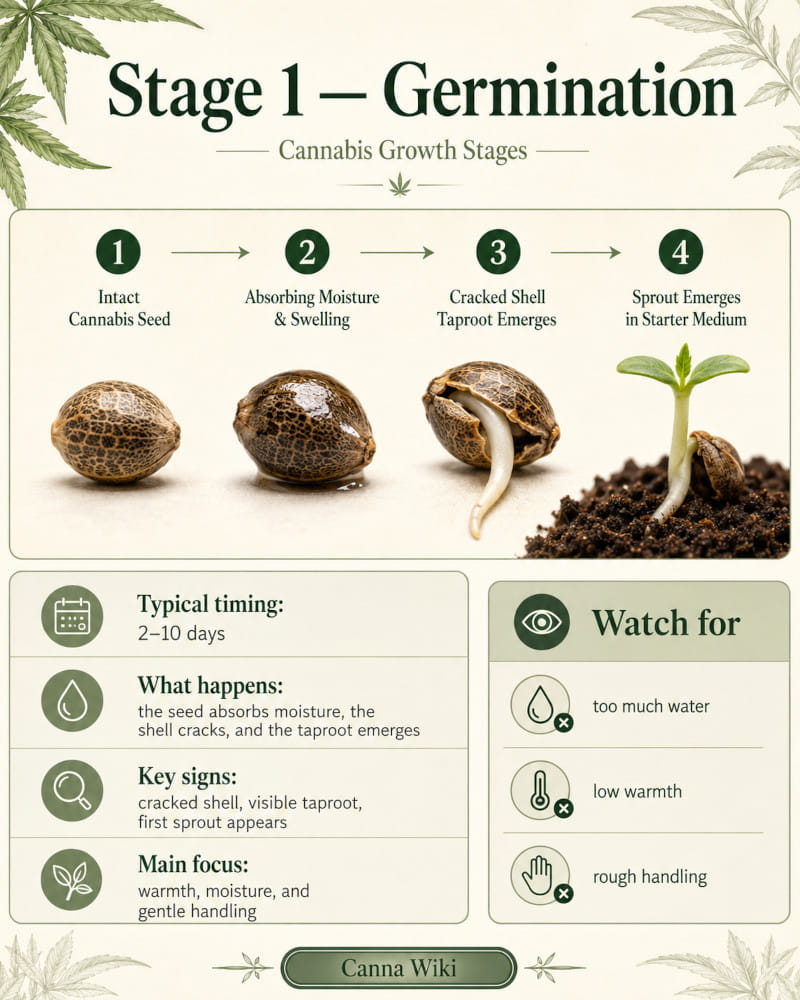
Germination is where everything starts. The seed absorbs moisture, the shell softens, and a small white taproot breaks through. That taproot is the plant’s first root. It grows downward first, while the shoot later pushes upward.
Most cannabis seeds germinate in 2 to 10 days. Fresh, well-stored seeds normally open faster than old or badly stored seeds. Moisture, warmth, and darkness help, but the seed should not be drowned. Too much water can ruin a seed just as easily as too little.
Common Cannabis Germination Methods
|
Method |
How It Works |
Best For |
Main Risk |
|
Paper towel method |
Seeds sit between moist paper towels until the taproot appears. |
Seeing exactly when the seed cracks. |
The towel dries out or the taproot gets damaged. |
|
Water glass method |
Seeds are soaked briefly before moving into a medium. |
Older or harder seeds that need moisture contact. |
Leaving seeds in water too long can drown them. |
|
Direct sow method |
Seeds go straight into the starter or final medium. |
Reducing taproot handling. |
Harder to see what is happening below the surface. |
Green Flags and Red Flags During Germination
|
Green Flags |
Red Flags |
|
Seed shell cracks naturally |
Seed stays closed after many days |
|
Clean white taproot appears |
Taproot turns brown, soft, or mushy |
|
No bad smell |
Rotten or sour smell appears |
|
Taproot grows downward |
Seed is handled too often |
What Your Seed Is Telling You
- Fast cracking: the seed is probably fresh and has taken in moisture well.
- No movement after several days: the seed may be old, too cold, too dry, or too wet.
- Mushy shell: the seed may have too much moisture and not enough oxygen.
- Brown taproot: the young root may be damaged or rotting.
For a full method-by-method explanation, read Cannapot’s guide to germinating cannabis seeds. If seeds are being kept for later, the guide on storing cannabis seeds correctly is also useful.
Stage 2 — Seedling Stage: First Leaves and First Mistakes
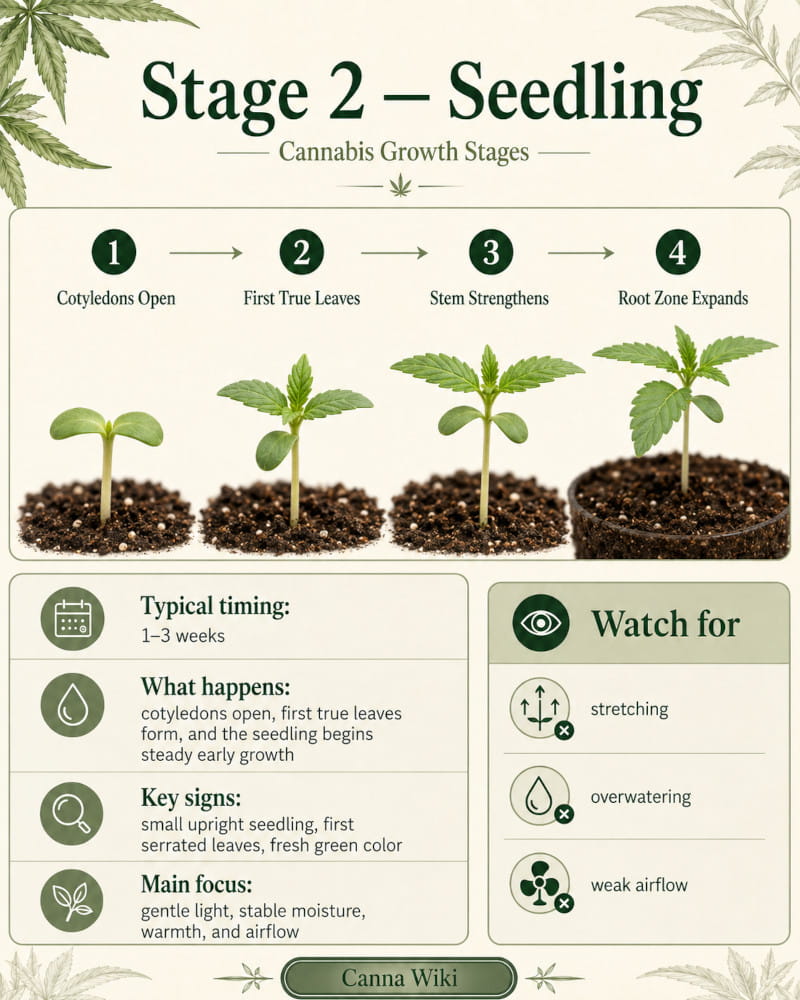
The seedling stage starts once the young plant breaks the surface. The first round leaves are called cotyledons. After them, the first serrated cannabis leaves appear. Above the soil, growth may look slow. Under the soil, though, the plant is busy making roots.
What a Healthy Cannabis Seedling Looks Like
A healthy seedling usually has bright green cotyledons, a short upright stem, and small serrated leaves forming from the center. It should not look pale, floppy, extremely tall, or wet around the stem base.
Ideal Seedling Conditions
- Light: gentle, but close enough to prevent stretching
- Temperature: around 20–25°C
- Relative humidity: around 65–80%
- VPD: around 0.4–0.8 kPa
- Watering: light and controlled, not repeated heavy soaking
Seedling Green Flag / Red Flag Box
|
Green Flags |
Red Flags |
|
Bright green cotyledons |
Pale or yellow new growth |
|
First true leaves forming |
Long, weak, leggy stem |
|
Stem stands upright |
Wet or pinched stem base |
|
Slow but steady progress |
No new growth after several days |
What Your Seedling Is Telling You
- Long, thin stem: the light may be too weak or too far away.
- Drooping leaves: roots may be too wet, cold, or stressed.
- Yellow cotyledons too early: the seedling may be struggling.
- No new leaves: growth may be stalled below the surface.
- Wet stem base: damping off may be starting.
If this is your first grow, Cannapot’s beginner cannabis grow setup guide explains the early choices that affect seedlings, including light, space, airflow, containers, and basic planning.
Stage 3 — Vegetative Stage: Roots, Branches, Leaves and Structure
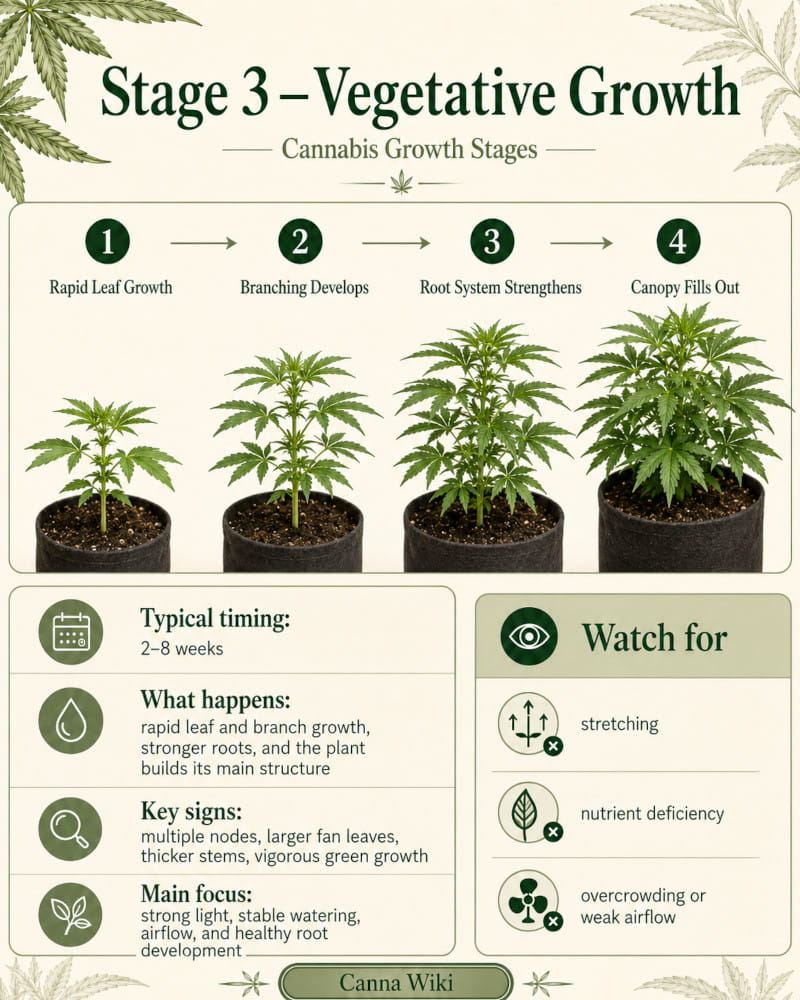
The vegetative stage is when the plant finally starts moving with real speed. Leaves get bigger. Branches stretch out. Roots spread. The main job here is not flower production yet. It is structure. The plant is building the frame that will later hold flowers.
Photoperiod plants can stay in vegetative growth for weeks or even longer indoors, because the light cycle can be controlled. Outdoor photoperiod plants usually stay in veg during the longer days of spring and early summer. Autoflowers move through this stage much faster because they flower by age, not by a light-cycle change.
Vegetative Stage Conditions
- Light cycle indoors: commonly 18/6
- Temperature: around 21–28°C
- Relative humidity: around 50–70%
- VPD: around 0.8–1.2 kPa
- Nutrient focus: more nitrogen than in flowering
For a closer look at one common plant-shaping method, read Cannapot’s article on topping cannabis plants.
Vegetative Green Flag / Red Flag Box
|
Green Flags |
Red Flags |
|
New leaves appear quickly |
Growth suddenly slows or stops |
|
Strong stem and branches |
Weak, floppy structure |
|
Healthy green color |
Dark clawing leaves or burnt tips |
|
Roots fill the container steadily |
Root-bound or waterlogged plant |
What Your Vegetative Plant Is Telling You
- Fast new growth: the plant is actively building structure.
- Burnt tips: nutrients may be too strong.
- Dark clawing leaves: too much nitrogen or watering stress may be involved.
- Weak stems: light, airflow, or root strength may be lacking.
- Very pale growth: feeding, pH, or root issues may be slowing nutrient uptake.
Stage 4 — Pre-Flowering: The Plant Shows Its Direction
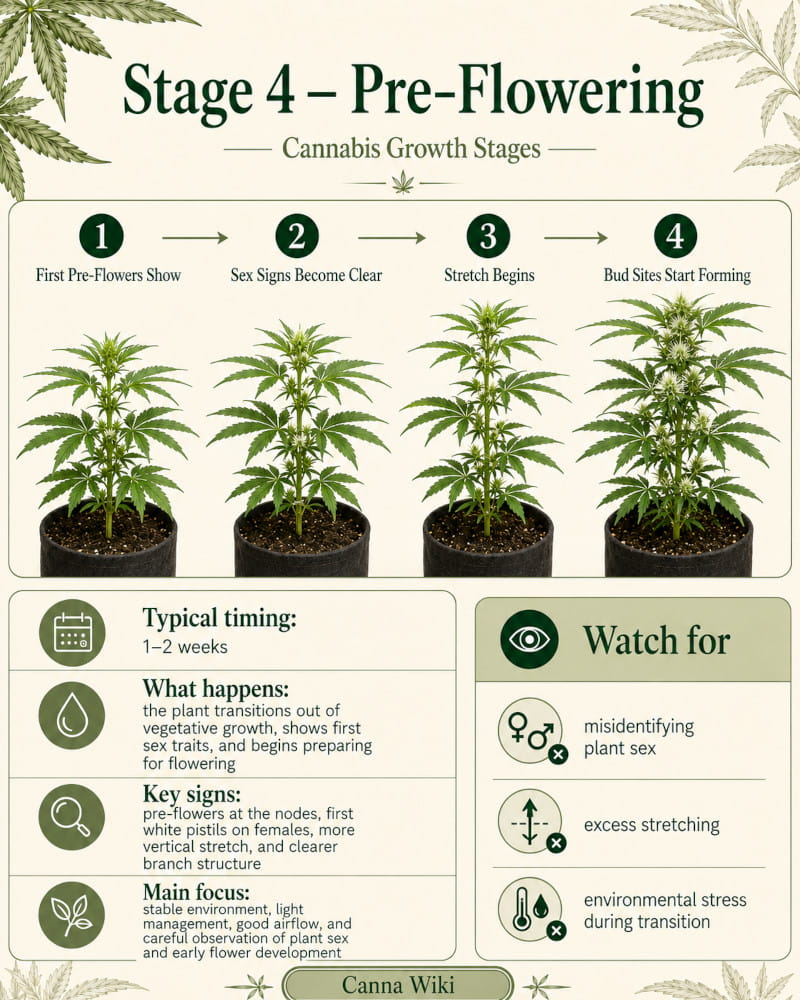
Pre-flowering is the bridge between vegetative growth and flowering. A lot of articles rush past it, but it matters. This is when early sex signs appear and the plant starts preparing for flower production.
Male vs Female Pre-Flowers
- Female pre-flowers: small calyxes with fine white pistils.
- Male pre-flowers: small round pollen sacs without white pistils.
- Hermaphrodite signs: mixed male and female traits on the same plant.
Pre-Flower Green Flag / Red Flag Box
|
Green Flags |
Red Flags |
|
Clear female pistils on feminized plants |
Male sacs on unwanted plants |
|
Controlled stretch |
Weak branches before flowering |
|
Healthy new growth |
Sudden stress or leaf curling |
|
No mixed-sex signs |
Banana-like hermaphrodite growth |
What Your Plant Is Telling You in Pre-Flower
- White pistils: female flowering signs are starting.
- Round sacs: male traits may be present.
- Fast vertical growth: the flowering stretch may be starting.
- Sudden stress: light, heat, watering, or root pressure may be affecting the plant.
If you want to understand female seed expectations better, read Cannapot’s guide to feminized cannabis seeds. For seed types where both male and female plants may appear, browse regular weed seeds.
Stage 5 — Early Flowering: Stretch, Pistils and Bud Sites
Early flowering is when the plant clearly changes direction. It is no longer only building branches and leaves. It starts setting bud sites. In photoperiod plants, this happens after the light cycle changes indoors or after days shorten outdoors. In autoflowers, it happens automatically with age.
Early Flower Conditions
- Light cycle indoors: commonly 12/12 for photoperiod plants
- Temperature: around 20–26°C
- Relative humidity: around 45–60%
- VPD: around 1.0–1.3 kPa
- Nutrient direction: less nitrogen, more phosphorus and potassium
Early Flower Green Flag / Red Flag Box
|
Green Flags |
Red Flags |
|
White pistils appear at many nodes |
No pistils after expected timing |
|
Bud sites begin forming |
Male sacs or hermaphrodite signs appear |
|
Stretch is strong but controlled |
Plant stretches too close to the light |
|
Leaves stay healthy during transition |
Severe clawing, yellowing, or burnt tips |
Common Early Flower Mistakes
- Not planning for stretch.
- Keeping humidity too high.
- Using heavy nitrogen for too long.
- Doing stressful training too late.
- Forgetting to check for male or hermaphrodite signs.
Because flowering is one of the most searched and misunderstood stages, Cannapot has a separate guide to the cannabis flowering stage week by week.
Stage 6 — Mid Flowering: Bud Swelling, Resin and Aroma
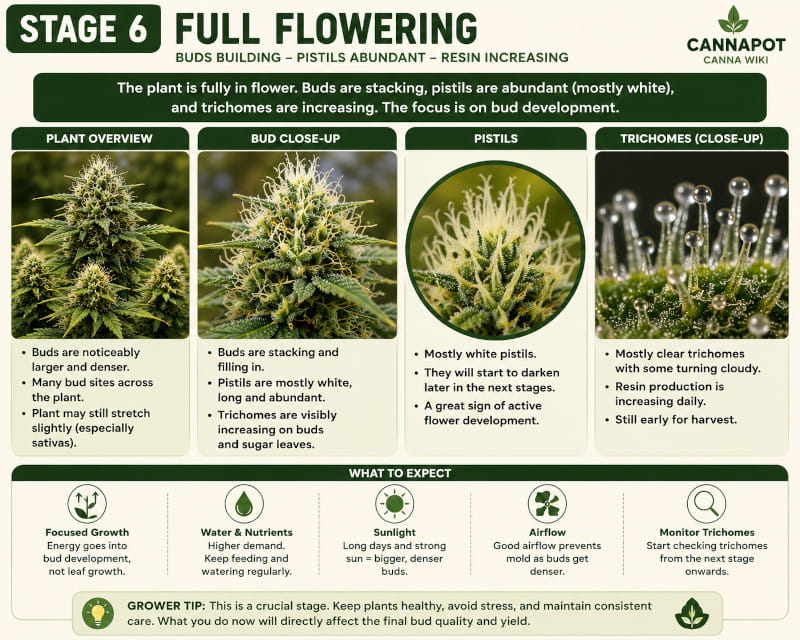
Mid flowering is when the plant’s energy is clearly going into the flowers. Buds become denser, trichomes show more clearly, and aroma often becomes much stronger. It is also the stage where moisture problems can hide inside thick flowers, so airflow and humidity matter more than many beginners expect.
Mid Flower Conditions
- Temperature: around 18–24°C
- Relative humidity: around 40–50%
- VPD: around 1.2–1.5 kPa
- Nutrient focus: stronger bloom support, usually more phosphorus and potassium
- Airflow: steady movement, but not harsh direct wind on flowers
Mid Flower Green Flag / Red Flag Box
|
Green Flags |
Red Flags |
|
Buds swell steadily |
Buds stop developing too early |
|
Resin production increases |
Mold smell or grey/brown inner flower areas |
|
Aroma becomes stronger |
Burnt tips spreading across many leaves |
|
Leaves remain mostly healthy |
Dark clawing leaves or severe curling |
Why Mid Flower Is a High-Risk Stage
Mid flower is where hidden issues often show up. From far away, a plant can look fine. Inside dense flowers, though, moisture can sit too long. Overfeeding can also show as burnt tips or dark clawing leaves. If the room stays damp and airflow is poor, mold risk climbs quickly.
Stage 7 — Late Flowering and Ripening: Reading Harvest Readiness
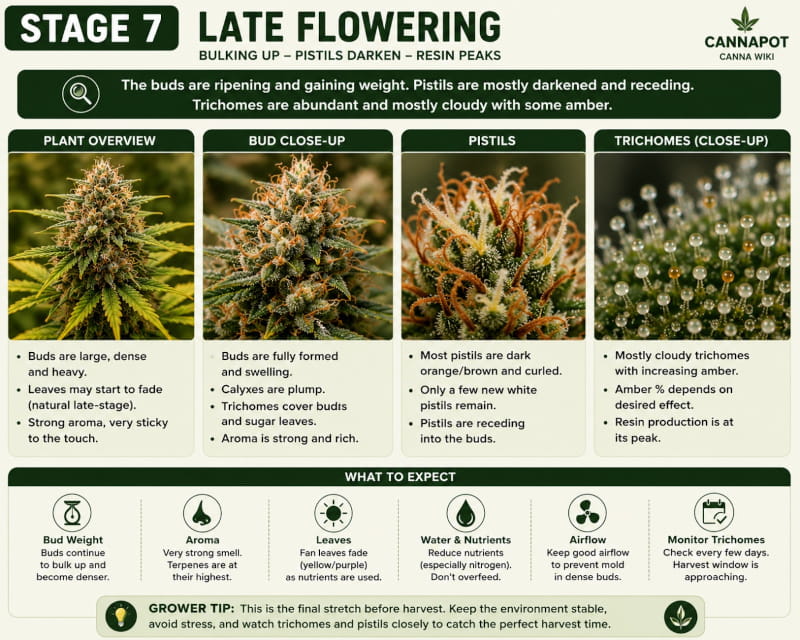
Late flowering is the ripening stage. The plant is no longer focused on growing taller or building lots of new leaves. Flowers mature, pistils darken, trichomes change, and aroma becomes deeper. This is also the point where many beginners cut too early because the buds already look finished from a distance.
Trichome Color Guide
|
Trichome Look |
What It Usually Means |
|
Mostly clear |
Usually too early for harvest |
|
Mostly cloudy |
Maturity window is approaching |
|
Cloudy with some amber |
Common harvest window for many growers |
|
Mostly amber |
Later maturity profile |
How to Read Harvest Readiness Without a Microscope
|
Visible Sign |
What It Usually Suggests |
|
50–70% pistils darkened |
Harvest window may be approaching, but the plant may still need time. |
|
70–90% pistils darkened |
A common visible sign that harvest is getting close. |
|
Many fresh white pistils still appearing |
Usually too early unless the strain naturally keeps pushing new pistils. |
|
Buds are still airy and soft |
The plant may not be fully mature yet. |
|
Buds feel swollen and sticky |
Ripening is more advanced. |
|
Aroma becomes deeper and less grassy |
Flowers are moving closer to maturity. |
Late Flower Green Flag / Red Flag Box
|
Green Flags |
Red Flags |
|
Pistils darken and curl inward |
Mostly fresh white pistils still pushing late |
|
Trichomes turn cloudy |
Mostly clear trichomes near planned harvest |
|
Buds feel swollen and mature |
Buds remain airy or underdeveloped |
|
Natural leaf fade appears |
Mold, rot, or bad smell inside flowers |
Late Flower Mistakes
- Harvesting only because the calendar says the plant is ready.
- Ignoring trichome color.
- Letting humidity stay too high around dense flowers.
- Confusing natural late-stage fade with a serious problem.
- Waiting too long after the plant has passed its best maturity window.
Stage 8 — Harvest: Cutting at the Right Time
Harvest is not just the moment the plant is cut. It is the decision point. A plant can look big and still not be mature. Another plant may be ready even if the calendar says it should have more time. Genetics, environment, and flowering length all play a part.
Harvest Green Flag / Red Flag Box
|
Green Flags |
Red Flags |
|
Mostly cloudy trichomes with some amber |
Mostly clear trichomes |
|
Pistils mostly darkened and curled |
Many fresh white pistils still appearing |
|
Buds feel firm and swollen |
Buds still feel airy or immature |
|
Aroma is strong and developed |
Grass-like smell or weak flower development |
Wet Trim vs Dry Trim
|
Method |
Best For |
Main Difference |
|
Wet trim |
Humid spaces or faster cleanup |
Leaves are removed right after cutting. |
|
Dry trim |
Slower drying and better moisture control |
Leaves are removed after drying. |
Common Harvest Mistakes
- Cutting too early.
- Handling flowers roughly.
- Using dirty scissors or tools.
- Leaving harvested flowers in bright light.
- Starting drying without planning room conditions.
Stage 9 — Drying: The Stage Most Beginners Rush
Drying often gets treated like a small after-step, but it can change the final result completely. A plant can be grown well and harvested at the right time, then lose aroma and texture because it dried too fast. Flowers are not ready for storage right after cutting. They need a slow moisture drop first.
Ideal Drying Conditions
- Time: usually around 10–14 days
- Room: dark, clean, and controlled
- Temperature: around 18–21°C
- Relative humidity: around 45–55%
- Airflow: gentle air movement, not direct fan blast
Drying Green Flag / Red Flag Box
|
Green Flags |
Red Flags |
|
Slow drying over 10–14 days |
Flowers dry crispy in only a few days |
|
Small stems snap or crack |
Stems stay wet and bendy for too long |
|
Aroma becomes less grassy over time |
Hay smell, ammonia smell, or mustiness |
|
Flowers feel dry outside but not dusty |
Overdry, brittle, or moldy flowers |
Drying Mistakes
- Drying too fast with too much heat.
- Pointing a fan directly at flowers.
- Letting humidity stay too high.
- Stacking flowers too tightly.
- Drying in bright light.
Stage 10 — Curing: Where Aroma, Texture and Smoothness Improve
Curing starts after drying. The point is to let the remaining moisture settle slowly inside the flowers. Good curing can improve aroma, texture, and smoothness. Bad curing can trap too much moisture and create mold risk.
Basic Curing Timeline
|
Cure Time |
What Usually Happens |
|
First week |
Moisture begins balancing inside the flowers. |
|
2–4 weeks |
Aroma becomes more rounded and less grassy. |
|
4–8 weeks |
Texture and smoothness often improve more clearly. |
|
8+ weeks |
Longer cure for selected flowers when stored carefully. |
Curing Green Flag / Red Flag Box
|
Green Flags |
Red Flags |
|
Aroma becomes smoother and deeper |
Ammonia, sour, or mold smell appears |
|
Flowers feel slightly springy, not wet |
Flowers feel damp inside the jar |
|
Jar humidity stays around 58–62% |
Condensation or wet glass appears |
|
Texture improves over several weeks |
Flowers become brittle or dusty |
Common Curing Mistakes
- Putting flowers into jars while they are still too wet.
- Never opening jars during the early cure.
- Overfilling jars so flowers cannot breathe.
- Ignoring bad smells.
- Storing jars somewhere hot or bright.
Nutrient demand changes with the plant’s development
Nutrient demand also changes across the life cycle. Young plants are more sensitive to excessive nutrient strength, while vegetative growth and flowering bring different demands. What matters most is the combination of medium, water quality, root health, genetics, and the plant’s actual developmental state.
This article therefore places nutrition only in the context of plant development. For detailed information about nutrients, dosage, and different growing media, see our guide to fertilizing cannabis. If you want to know when nutrient management should typically be reassessed during your own grow, use the Cannabis Grow Calendar.
Outdoor: How Season and Day Length Affect Growth Stages
Outdoor cannabis still passes through the same basic developmental stages, but the way those stages unfold is influenced more strongly by day length, temperature, region, weather, and genetics. Photoperiod plants usually remain in vegetative growth during the longer days of spring and summer and respond to decreasing day length by moving toward flowering. Autoflowers depend much less on this seasonal signal because their flowering transition is mainly age-driven.
For that reason, the beginning and end of a stage cannot be assigned to one fixed month across all of Europe. Southern Europe, Central Europe, northern regions, and higher elevations differ significantly in temperature, frost risk, day length, and usable growing season. The important point for this article is that the biology of the stages remains the same, while their timing can shift considerably by location.
For practical seasonal planning — including when germination, outdoor start, flowering, and possible harvest windows typically occur — use our Cannabis Grow Calendar for Indoor & Outdoor. For detailed outdoor cultivation information, see our guide to growing cannabis outdoors. We also have a separate guide on when to germinate cannabis seeds outdoors in Europe.
Cannabis Growth Stages by Seed Type
All cannabis seed types move through the same broad stages, but they do not behave the same way. Seed type affects sex expression, flowering trigger, and the way individual developmental stages unfold.
Feminized Seeds
Feminized seeds are usually chosen by growers who want female plants. They normally follow the photoperiod cycle unless they are specifically feminized autoflowers. Pre-flowering still matters because the plant needs to show healthy female development before flowering becomes heavy.
Autoflower Seeds
Autoflower seeds move through the same basic stages, but the transition from vegetative growth to flowering happens earlier and is age-driven. They begin flowering based on age instead of a 12/12 light cycle. This means early stress can matter more, because the plant has less time to recover before flowering starts.
Regular Seeds
Regular seeds can produce male or female plants. That makes the pre-flowering stage more important. Growers using regular seeds need to watch node development carefully because male plants can release pollen if left too long.
CBD Seeds
CBD-rich cannabis seeds still follow the same growth stages. The difference is mainly the cannabinoid profile, not the basic plant lifecycle. Harvest timing still matters because cannabinoid and terpene maturity are linked to the ripening stage.
If you are not sure which type fits your space, growing style, and experience level, Cannapot’s guide on how to choose the right cannabis seeds can help. You can also compare CBD cannabis seeds or use the Cannapot Strain Finder to filter genetics by seed type, breeder, flowering time, and other buying factors.
Common Cannabis Growth Stage Problems and What They Usually Mean
Many cannabis problems make more sense when they are matched to the stage. A yellow leaf on a tiny seedling is not the same as a yellow leaf on a late-flowering plant. The table below gives a simple first-read view.
|
Problem |
Most Common Stage |
What It Usually Means |
|
Seedling stretching |
Seedling |
Weak light, light too far away, or unstable early growth |
|
Yellow cotyledons very early |
Seedling |
Stress, poor start, overwatering, or seedling weakness |
|
Burnt leaf tips |
Vegetative / flowering |
Often overfeeding or nutrient strength too high |
|
Dark clawing leaves |
Vegetative / flowering |
Possible excess nitrogen or watering stress |
|
No pre-flowers |
Late vegetative |
Plant may not be mature, or light cycle/timing may not be right |
|
Buds not swelling |
Mid flower |
Weak light, stress, genetics, poor nutrition, or timing issue |
|
Mold smell |
Flowering / drying |
Humidity too high, poor airflow, or dense flowers staying wet |
|
Hay smell |
Drying |
Drying too fast or curing too early/poorly |
Cannabis Growth Stages FAQ
What are the main cannabis growth stages?
The main cannabis growth stages are germination, seedling growth, vegetative growth, pre-flowering, flowering, ripening, harvest, drying, and curing. Some growers group early, mid, and late flowering together, but separating them makes the whole cycle easier to understand because the plant behaves differently in each part of bloom.
How long does cannabis take from seed to harvest?
Total duration is not a fixed property of one growth stage. It depends on genetics, flowering trigger, the length of vegetative development, and growing conditions. Autoflowers usually develop more compactly, while photoperiod plants can remain in vegetative growth for very different lengths of time. For a concrete timeline based on your own grow details, use the Cannabis Grow Calendar.
Do autoflowers have the same growth stages?
Yes, autoflowers still go through the same basic stages. They germinate, grow as seedlings, build leaves and roots, flower, ripen, and then move into harvest, drying, and curing. The big difference is speed. Autoflowers do not wait for a 12/12 light cycle, so the plant moves into bloom on its own clock.
What is the longest cannabis growth stage?
For many photoperiod plants, the vegetative stage can be the longest because it can be extended. Indoors, the grower controls how long veg lasts. Outdoors, the plant often stays in vegetative growth through the longer days of spring and early summer before natural flowering begins.
What is the difference between vegetative and flowering stage?
The vegetative stage is mostly about building the plant’s frame: roots, stems, branches, and leaves. Flowering is different. At that point, the plant starts focusing on bud sites, pistils, resin, aroma, and flower maturity. A plant can look very strong in veg but still need the right flowering conditions to finish well.
How do I know when cannabis starts flowering?
Flowering usually starts when white pistils appear at the nodes and small bud sites begin forming. With indoor photoperiod plants, this normally follows a light-cycle change. Outdoors, it happens as the days get shorter. Autoflowers are different because they begin flowering by age, even if the light schedule has not changed.
What does pre-flowering look like?
Pre-flowering shows up as tiny sex signs where the branches meet the main stem. Female plants show small calyxes with thin white pistils. Male plants form small round sacs. This stage is easy to miss at first, so checking the nodes closely matters, especially when working with regular seeds.
How long does the flowering stage last?
Flowering duration is strongly influenced by genetics and can vary widely between strains. Breeder information is therefore only a starting point; flower development and maturity signs are more useful for judging the plant’s actual stage. We explain the individual parts of flowering in detail in our guide to the cannabis flowering stage.
When do cannabis buds grow the most?
Buds usually start gaining the most visible size during mid flowering. Early flowering sets the sites and handles the stretch. Mid flower is when the flowers begin to swell, resin becomes more noticeable, and the smell often gets much stronger. Late flower is more about ripening than big new growth.
How do I know when cannabis is ready to harvest?
The best clue is trichome maturity. Many growers look for mostly cloudy trichomes with some amber, depending on the result they want. Pistil color can help too, but it should not be the only signal. Darkened pistils, swollen buds, stronger aroma, and a natural leaf fade can all support the final decision.
Can you harvest cannabis without checking trichomes?
You can use visible signs like pistil color, bud swelling, aroma, and the slowing of fresh white hairs, but it is less accurate. Trichomes give a clearer look at maturity. Without checking them, harvest timing becomes more of an educated guess.
Is drying part of the cannabis growth process?
Drying is not growth in the biological sense, but it is part of the full seed-to-harvest journey. Freshly cut flowers still hold a lot of moisture. If they dry too fast, aroma and texture can suffer. If they dry too slowly or stay too wet, mold becomes a real risk.
How long should cannabis cure after drying?
A short cure can begin improving the flower within a couple of weeks, but many growers prefer 4 weeks or more when the flowers are worth keeping. Some batches continue improving over 6 to 8 weeks if stored carefully. The main thing is to avoid trapping too much moisture in the jar.
Do indoor and outdoor cannabis plants follow the same stages?
Yes, the stages are the same, but the timing is not. Indoor plants respond to the grower’s light schedule, temperature, and room setup. Outdoor plants follow the season, daylight changes, rain, cold nights, and local climate. That is why the same strain can behave differently indoors and outdoors.
Which seeds are best for a shorter cannabis growth cycle?
Autoflower seeds are usually the simplest choice for a shorter cycle because they start flowering automatically and often finish faster than photoperiod strains. Fast-flowering photoperiod seeds can also help, but they still depend on the light cycle and the length of the vegetative stage.
Final Thoughts: Understand the Stage Before Choosing the Seed
Cannabis is easier to understand when you stop looking at it as one long process and start reading it stage by stage. A seed has one job. A seedling has another. A vegetative plant is building its frame. A flowering plant is putting energy into buds. Then, after harvest, drying and curing decide whether the final result keeps its aroma, texture, and quality.
This is also why seed choice matters so much. Autoflowers have a more strongly age-driven developmental pattern. Feminized photoperiod seeds respond to the light cycle and therefore allow more influence over vegetative development. With regular seeds, pre-flowering is especially important because both male and female plants can appear. Outdoors, day length, temperature, and weather influence when the individual developmental stages become visible.
So before choosing a strain, look beyond the name. Check the seed type, flowering trigger, breeder background, outdoor suitability, and how the plant is expected to move through its growth stages. This makes it easier to judge which genetics fit your growing style, space, and climate.
The growth stages explain what is happening to the plant. For the practical question of what usually needs to be done when during a grow, use the Cannabis Grow Calendar for Indoor & Outdoor.
To keep researching, visit the Cannapot Canna Wiki, browse cannabis seeds, explore recommended cannabis seeds, check new cannabis seeds, or use the Cannapot Strain Finder to compare genetics by seed type, breeder, flowering time, and growing preference.