CBD Side Effects: Risks & Safety
CBD Side Effects: What Are the Risks?
Updated: August 2026 | CBD side effects, risks, tolerability, liver, dosage, long-term use and current safety assessments
Author: Cannapot Grow Team | Reading time: approximately twenty-five minutes
The Most Important Points at a Glance
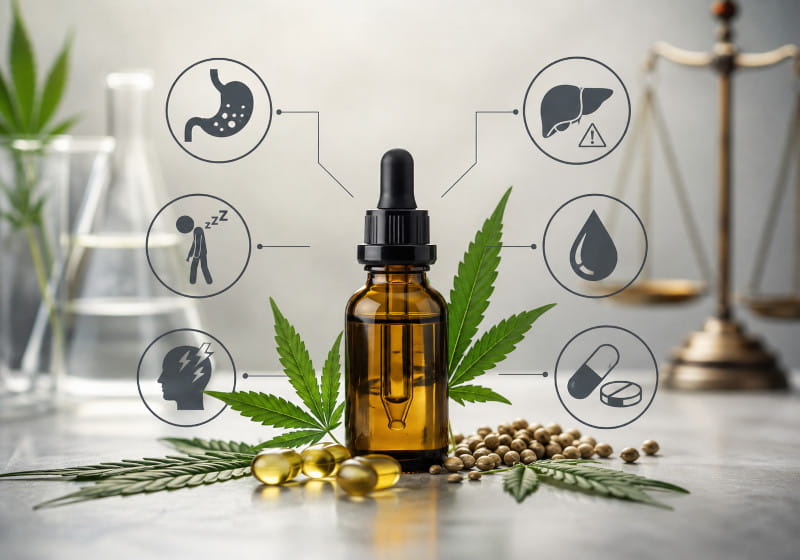
✓ CBD is not free from side effects. Depending on the dose, preparation, duration of use and the individual, diarrhea, fatigue or drowsiness, decreased appetite and other adverse effects may occur.
✓ Safety data from the approved CBD medicine Epidyolex also show possible increases in liver enzymes. These data mainly come from medical dosages and must not be generalized to low-dose over-the-counter products.
✓ A 2026 meta-analysis of randomized studies in healthy adults found a significantly increased risk of diarrhea compared with placebo. For several other symptoms examined, there was no statistically significant difference.
✓ In a randomized study in healthy adults, the FDA observed ALT levels above three times the upper limit of normal in 5.6% of the evaluated CBD participants; this did not occur in the placebo group. However, the doses studied were 250 to 550 mg of CBD per day.
✓ In 2026, the EFSA established a provisional safety limit of 0.0275 mg per kilogram of body weight per day for certain highly purified CBD food supplements. This corresponds to approximately 2 mg per day for a person weighing 70 kg and is explicitly not a dosage recommendation.
✓ Important data gaps remain regarding long-term safety. Particular caution is warranted in the assessment of pregnancy, breastfeeding, people under 25 years of age, liver problems and simultaneous use of medication.
What Side Effects Can CBD Cause?
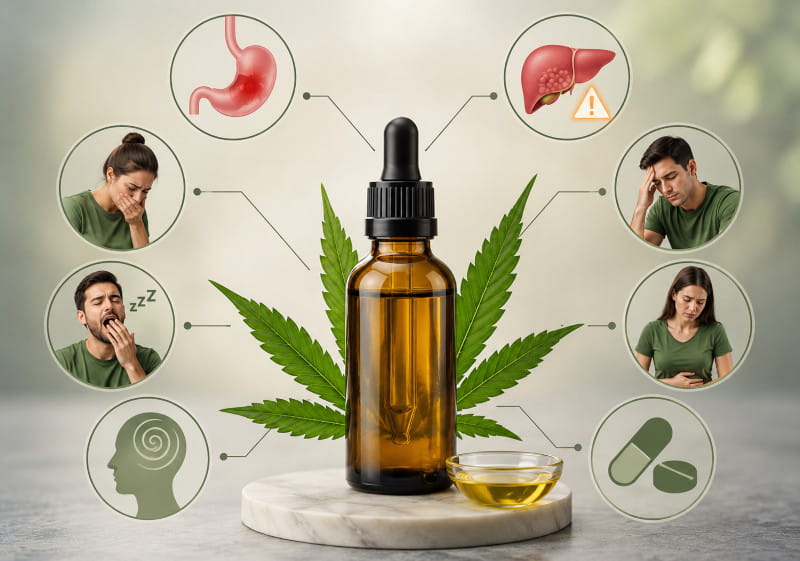
CBD can cause adverse effects; clinical studies particularly describe gastrointestinal complaints, fatigue or drowsiness, decreased appetite and, at certain dosages or in certain treatment situations, elevated liver values.
How likely a side effect is cannot be answered with a single figure. Studies differ considerably in CBD amount, duration of use, participants, medical conditions and concomitant medication. Data from high-dose drug therapy therefore cannot automatically be compared with a commercially available CBD oil.
For interpretation, it is also important to distinguish between an observed adverse effect and an effect clearly caused by CBD. Controlled placebo studies are particularly valuable because symptoms such as headaches, fatigue or nausea can also occur independently of CBD. We explain in more detail which biological mechanisms are discussed for cannabidiol and how possible effects can be scientifically classified in our overview of CBD Effects.
|
Possible Side Effect |
Scientific Assessment |
Important Context |
| Diarrhea | Repeatedly described in clinical studies; also increased versus placebo in a 2026 meta-analysis of healthy adults. | Dose, formulation and carrier substances can influence tolerability. |
| Fatigue / Drowsiness | Known from medical CBD studies. | Concomitant medication and other sedating substances may play an important role. |
| Decreased Appetite | Described with Epidyolex and in systematic analyses of clinical studies. | Transferability to low CBD amounts is limited. |
| Nausea / Vomiting | Gastrointestinal complaints are reported in safety data; vomiting is among the very common side effects of the CBD medicine Epidyolex. | Not every stomach complaint after a CBD product must be caused by CBD itself. |
| Elevated Liver Enzymes | Clearly documented at higher medical dosages; also observed in an FDA study with healthy adults. | Risk and transferability depend strongly on dose and accompanying factors. |
How Common Are CBD Side Effects?
There is no universally applicable frequency for CBD side effects because the available studies examine very different dosages, preparations and groups of people.
This becomes particularly clear when comparing healthy adults with patients who receive CBD as a medicine at high dosages and sometimes together with several antiepileptic drugs. In such treatment situations, both CBD exposure and drug interactions can be substantially greater than with occasional low-dose use.
A systematic review with meta-analysis published in 2026 evaluated four randomized controlled trials involving a total of 269 healthy adults. The risk of diarrhea was significantly increased compared with placebo. For headaches, fatigue, abdominal pain and dizziness, this analysis found no statistically significant differences. At the same time, the authors emphasize that larger studies with longer observation periods are required.
Can CBD Cause Diarrhea and Other Gastrointestinal Complaints?
Diarrhea is among the best-documented adverse effects of orally administered CBD and has been observed both in medical studies and in healthy adults.
The 2026 meta-analysis calculated an increased relative risk of diarrhea in healthy adults compared with placebo. However, the confidence interval was broad because only a small number of randomized studies were available. The exact probability for an individual user cannot be derived from this.
Other components may also be relevant in a CBD oil. Carrier oils, flavorings, additional plant compounds or the total amount of oil consumed can influence gastrointestinal tolerability. If symptoms occur only with a particular product, this therefore does not automatically prove an intolerance to pure cannabidiol.
Does CBD Make You Tired or Drowsy?
Fatigue and drowsiness can occur with CBD, although their frequency depends strongly on the context studied and possible concomitant medications.
Somnolence is among the very commonly reported side effects of Epidyolex. Earlier meta-analyses of randomized CBD studies also found an increased occurrence of somnolence and sedation, with a substantial proportion of these signals coming from epilepsy studies involving concomitant medication. This is crucial for interpretation.
Anyone who becomes tired, drowsy or light-headed after CBD should avoid activities in which reduced alertness could be dangerous. Fatigue as a side effect should also not be equated with a proven therapeutic benefit for sleep disorders. We explain in detail what controlled studies actually show on this topic under CBD for Sleep Problems.
Can CBD Affect Appetite?
Decreased appetite is known from clinical CBD data, particularly from studies involving medically used cannabidiol.
With Epidyolex, decreased appetite is among the very common side effects. Systematic analyses of oral CBD studies also list appetite loss among the more frequently observed adverse events. However, these data do not allow a reliable conclusion about how relevant this effect is at significantly lower CBD amounts.
A persistent, marked change in appetite or unintended weight loss should not simply be dismissed as a harmless accompanying effect, especially if additional symptoms occur.
Can CBD Cause Dizziness or Headaches?
Dizziness and headaches can occur during CBD use, but according to the current evidence they are not as clearly established as CBD-specific side effects as, for example, diarrhea.
Common everyday symptoms are particularly difficult to attribute scientifically. Headaches or dizziness can occur in a CBD group, but also in a placebo group. In the 2026 meta-analysis of healthy adults, headaches and dizziness did not differ statistically significantly between CBD and placebo.
If such a symptom repeatedly occurs in close temporal relation to use, it should nevertheless be taken seriously. Medical assessment is advisable particularly in cases of severe dizziness, circulatory problems or additional neurological symptoms.
Can CBD Affect the Liver?
CBD can increase liver enzymes, particularly at higher dosages; this is why the liver is one of the most important areas of current safety research on cannabidiol.
From the medical use of Epidyolex, it is known that elevated liver enzyme values can occur. Such changes are measured using blood values such as alanine aminotransferase (ALT) and aspartate aminotransferase (AST). An elevated laboratory value does not automatically mean permanent liver damage, but it can be a warning sign of stress on or damage to liver cells.
A randomized, double-blind, placebo-controlled FDA study involving healthy adults is particularly relevant. Participants received an oral CBD solution of 2.5 mg per kilogram of body weight twice daily for 28 days, corresponding to approximately 250 to 550 mg of CBD per day. Among the CBD participants included in the liver analysis, eight people, or 5.6%, developed ALT levels above three times the upper limit of normal. No such increase occurred in any participant in the placebo group.
These results are important but must not be generalized incorrectly. The CBD amounts studied were significantly higher than many typical consumer amounts. The study therefore does not prove that low amounts of a CBD oil cause corresponding liver value changes in 5.6% of users.
Are CBD Side Effects Dose-Dependent?
For several safety risks, research suggests that the CBD dose plays an important role, but there is no simple threshold below which side effects can generally be ruled out.
With medical cannabidiol, increases in liver enzymes have been described as dose-dependent. At the same time, body weight, absorption, dosage form, intake with food, individual metabolism and concomitant medications influence actual CBD exposure. Two people can therefore react differently to the same milligram amount.
Percentage figures on CBD oils must also not be confused with a dose. They describe the concentration of the product. The amount of the product used determines how much CBD is actually taken. Basic information on calculation and scientific interpretation can be found in our guide to CBD Dosage.
What Does the EFSA Safety Limit of 2 mg of CBD per Day Mean?
The figure of approximately 2 mg of CBD per day for a 70 kg adult cited by the EFSA in 2026 is a precautionary provisional safety limit derived for certain CBD food supplements and not a recommended intake dose.
The authority set the value at 0.0275 mg per kilogram of body weight per day. It includes an additional uncertainty factor because important safety data are still missing. The EFSA announced that it would review the provisional limit once the required toxicological or human data become available.
The value also does not apply across the board to every CBD product. According to the EFSA assessment, it applies exclusively to food supplement formulations with at least 98% CBD purity, without nanoparticles, with a manufacturing process assessed as safe and with genotoxicity ruled out. A full-spectrum oil or a differently formulated product therefore cannot automatically be equated with this assessment.
Can You Overdose on CBD?
Very high amounts of CBD can intensify adverse effects, but “CBD overdose” should not be equated with a single universally applicable toxic threshold dose.
Safety research shows that high oral CBD doses can be associated with gastrointestinal complaints, drowsiness and changes in liver values, among other effects. However, the amount at which problems arise depends on the preparation, body weight, health status and possible accompanying substances.
Anyone who has accidentally taken significantly more CBD than intended and develops severe drowsiness, persistent vomiting, pronounced weakness or other unusual or severe symptoms should seek professional medical advice. Acute severe symptoms require urgent medical assessment.
What Long-Term Side Effects of CBD Are Known?
The long-term safety of regular CBD use has not yet been sufficiently clarified, meaning that possible long-term risks cannot currently be fully described or ruled out.
Many controlled human studies last only weeks or a few months. Such studies can record short-term side effects but are only of limited suitability for detecting rare effects or effects that occur only after long exposure. Data from long-term medical treatment also concern different dosages and patient groups than over-the-counter CBD products.
In 2026, the EFSA continued to confirm data gaps regarding possible effects on the liver, endocrine system, nervous system and reproductive system. The statement that long-term CBD use is generally risk-free would therefore not be scientifically justified.
Who Should Be Particularly Cautious With CBD?
Particular caution is advisable during pregnancy and breastfeeding, in people under 25 years of age, when taking medication, with existing liver problems and generally in cases of increased health risk.
For pregnant and breastfeeding women as well as people under 25 years of age, the EFSA was unable to establish safety in its 2026 Novel Food assessment. The same applies there to people taking medication. “Safety not established” does not automatically mean that CBD has been proven to cause harm in every one of these situations. It means that the available data are insufficient for a robust safety determination.
Additional caution is sensible in cases of known liver disease because changes in liver values are among the scientifically relevant CBD risks. People who rely on full alertness should also take into account that drowsiness or fatigue may occur.
Can Medications Affect the Side Effects of CBD?
Yes, medicines can alter the safety profile of CBD, and CBD can in turn influence the effects or side effects of certain medicines.
This relationship is important for risk assessment, but it is deliberately not expanded into a list of medications here. Interactions depend, among other things, on the metabolic enzymes involved, dosage and the therapeutic range of the respective medicine and therefore constitute a separate medical topic.
Anyone who regularly uses medicines should therefore have CBD use professionally assessed. This is particularly important when several medications or preparations are taken at the same time or when changes in active ingredient levels may be clinically relevant.
Are Side Effects of a CBD Oil Always Caused by Cannabidiol?
No, complaints after using a CBD oil may be related not only to cannabidiol but also to the carrier oil, other plant compounds, THC, contaminants, incorrect labeling or individual intolerances.
Clinical studies often use precisely defined preparations with controlled purity. Commercially available products, by contrast, can differ in extraction methods, CBD concentration, cannabinoid profile and additional ingredients. The tolerability of an individual product therefore cannot be predicted solely from studies using pharmaceutically defined CBD.
The distinction between pure CBD and products containing additional cannabinoids is particularly important. If a product contains more THC than expected, for example, effects may occur that are not part of the typical profile of pure cannabidiol. Basic information about cannabidiol and its classification can be found in our CBD Guide.
CBD-rich cannabis strains should be distinguished from this, as CBD forms part of a more complex cannabinoid and plant-compound profile in these strains. Depending on the genetics, the composition and ratio of cannabinoids can differ considerably. You can learn more about these differences in our overview of CBD Strains and CBD Genetics. You can also find a selection of corresponding plant genetics under CBD Seeds.
Is CBD Dangerous or Generally Well Tolerated?
CBD cannot generally be classified as either dangerous or risk-free: short-term studies show an overall limited number of serious adverse events in many adults, while clearly documented side effects and relevant knowledge gaps remain.
Risk assessment depends strongly on the context of use. A healthy adult using a small amount of a defined preparation is not comparable with a patient receiving several hundred milligrams of CBD daily together with other medicines. Conversely, good short-term tolerability must not automatically be taken as evidence of established long-term safety.
A serious assessment therefore takes into account dose, duration, product quality, age, pre-existing conditions and concomitant medication. These factors explain why strongly simplified statements such as “CBD has no side effects” are not scientifically tenable.
When Should You Seek Medical Advice for CBD Side Effects?
Severe, persistent or unusual symptoms, as well as possible signs of a liver reaction or severe allergic reaction, should be medically assessed.
Symptoms that do not subside after discontinuation, repeatedly occur after every use or significantly impair everyday life are also reasons for professional assessment. With regular medication use, it is particularly important to consider not only the CBD product but also possible interactions.
In the event of severe acute symptoms such as pronounced shortness of breath, impaired consciousness or other signs of a medical emergency, one should not wait for spontaneous improvement.
How Can the Risk of CBD Be Realistically Assessed?
The most appropriate assessment lies between downplaying and dramatizing: CBD has a real side-effect profile, while the extent and significance of many risks depend strongly on dose, duration, the individual and the product.
For healthy adults studied over the short term, the evidence is more favorable than some blanket warnings might suggest, but clearly less complete than the statement “CBD is safe” implies. Diarrhea is comparatively consistently documented. Drowsiness, appetite changes and increases in liver values are particularly known from medical studies, with dosage and concomitant medication being crucial for transferability.
The greatest uncertainty continues to concern long-term regular use and certain groups of people. New safety assessments should therefore become more important in the future than rigid statements based on individual older studies.
Which Sources Are Particularly Helpful for CBD Side Effects?
For a robust assessment of CBD side effects, current regulatory assessments, randomized controlled trials and systematic reviews are more informative than individual anecdotal reports.
The following sources allow a more in-depth review of the safety data described. When interpreting them, dose, participant group, concomitant medication and the CBD formulation studied should always be taken into account.
- EFSA 2026: Provisional Safety Limit for Cannabidiol as a Novel Food
- FDA: Randomized Study on CBD, Liver Enzymes and Safety in Healthy Adults
- European Medicines Agency: Epidyolex – Risks and Side Effects
- Systematic Review and Meta-Analysis 2026: Safety of CBD Versus Placebo in Healthy Adults
- Systematic Review: Side Effects of Oral Cannabidiol in Randomized Trials
- Meta-Analysis of Randomized Clinical Trials on Adverse Effects of Cannabidiol
- Wikipedia: Cannabidiol
FAQs
Q: Does CBD Have Side Effects?
A: Yes. Scientifically described adverse effects include diarrhea, fatigue or drowsiness and decreased appetite; at higher medical dosages, elevated liver values are also relevant.
Q: What Is the Most Common Side Effect of CBD?
A: A single most common side effect for all uses cannot be determined. However, diarrhea is among the consistently documented symptoms and was also significantly increased compared with placebo in a 2026 meta-analysis of healthy adults.
Q: Does CBD Make You Tired?
A: CBD can cause fatigue or drowsiness. The extent of this effect depends, among other things, on dose, individual response and concomitant medication.
Q: Can CBD Cause Diarrhea?
A: Yes. Diarrhea is repeatedly described in clinical CBD studies and is also supported by placebo-controlled data in healthy adults.
Q: Can CBD Cause Headaches?
A: Headaches can occur during use, but a clearly increased risk compared with placebo was not demonstrated in the current meta-analysis of healthy adults.
Q: Can CBD Damage the Liver?
A: Higher CBD dosages can significantly increase liver enzymes. Whether and to what extent this occurs at low consumer amounts is much less well understood.
Q: Is Taking CBD Every Day Harmful?
A: This cannot be answered across the board. Relevant data gaps remain regarding long-term regular use, which is why a general statement about permanent safety is not possible.
Q: Can CBD Be Taken Long Term?
A: A generally safe duration for independent CBD use has not been scientifically established. With long-term use, dose, health status and possible medications are particularly relevant.
Q: Can You Take Too Much CBD?
A: High amounts of CBD can intensify adverse effects. However, there is no universal threshold dose at which an overdose occurs in every person.
Q: Is 2 mg of CBD per Day the Recommended Dose?
A: No. The approximately 2 mg for a person weighing 70 kg from the EFSA assessment is a provisional safety limit for certain highly purified CBD food supplements and not an intake or efficacy recommendation.
Q: Who Should Be Particularly Cautious With CBD?
A: This includes in particular pregnant and breastfeeding women, people under 25 years of age, people taking medication and people with liver problems or other relevant pre-existing conditions.
Q: Can CBD Interact With Medications?
A: Yes. CBD can be involved in drug interactions. The specific assessment depends on the respective medication, the dose and other individual factors.
Q: Are All Side Effects of a CBD Oil Caused by CBD?
A: No. Carrier oils, other ingredients, THC, product quality and individual intolerances can also influence symptoms.
Q: Is CBD Dangerous?
A: CBD is not generally classified as dangerous, but it is also not risk-free. Individual risk assessment depends substantially on dose, duration, product, health status and concomitant medication.