Cannabis Plant Anatomy: Structure Explained
Cannabis Structure and Plant Parts Explained Clearly
Updated: August 2026 | Anatomy of the cannabis plant: roots, stem, nodes, leaves, flowers, trichomes and other plant parts explained clearly.
Author: Cannapot Grow Team | Reading time: approximately twenty-five minutes
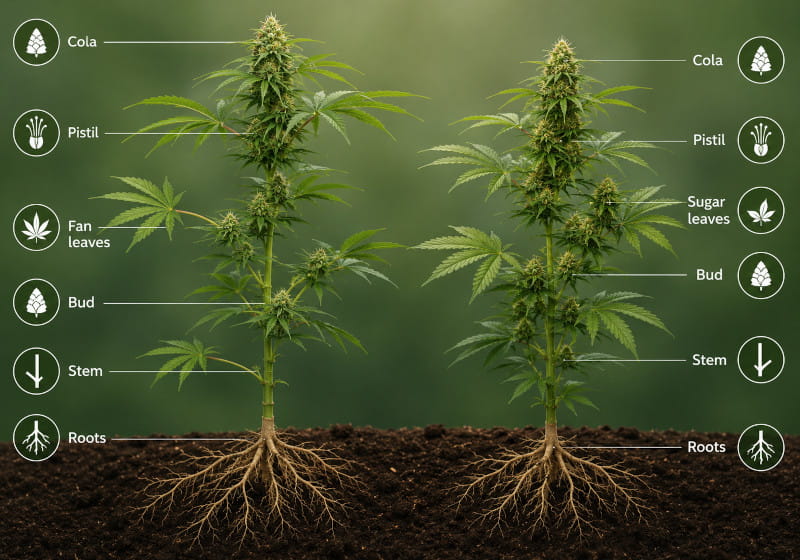
The Most Important Points at a Glance
✓ Cannabis consists of an underground root system and, above ground, a stem, side shoots, nodes, internodes, leaves and later flowers.
✓ Nodes are the points on the shoot where leaves, side shoots and later flower structures develop. The sections between two nodes are called internodes.
✓ Typical cannabis leaves are palmate and consist of several serrated leaflets. The shape, size and number of leaflets can change during development.
✓ Male and female cannabis flowers differ clearly. Female flowers have ovaries and stigmas, among other structures, while male flowers develop pollen-producing stamens.
✓ The resinous covering of a female flower often referred to as the “calyx” in cannabis terminology is botanically usually a bract. Terms such as calyx, bract, pistil and stigma are therefore often confused.
✓ Glandular trichomes are especially dense on female flowers and the adjacent bracts. Many cannabinoids and terpenes are produced and stored in these specialized structures.
✓ Genetics and environment jointly determine the plant’s appearance. Leaf width, internode spacing, branching and growth form can therefore vary considerably.
How is a cannabis plant structured?
The structure of cannabis can basically be divided into the underground root system and the above-ground part with the stem, side shoots, leaves and later the flowers.
Below ground, the main and lateral roots anchor the plant in the substrate and absorb water and mineral nutrients. Above the substrate, the main stem forms the central shoot axis. Leaves, buds and side shoots, among other structures, develop at its nodes, the junction points of the shoot. The sections between two nodes are called internodes.
As development progresses, the appearance of the plant also changes. After the cotyledons, simple true leaves first develop, followed later by the characteristic palmately compound cannabis leaves. As sexual maturity increases, preflowers may become visible before male or female flowers eventually develop.
| Plant part | Where is it located? | Important function |
|---|---|---|
| Roots | in the substrate | Anchorage and absorption of water and mineral nutrients |
| Main stem | central shoot axis | Stability and transport of water, nutrients and assimilates |
| Nodes | junction points along the shoot | attachment points for leaves, buds, side shoots and later flower structures |
| Internodes | between two nodes | their length influences the distance between the nodes and therefore the growth form |
| Leaves | at the nodes | Photosynthesis, gas exchange and transpiration |
| Flowers | on the reproductive shoot areas | Reproduction and, after successful pollination, formation of seeds |
| Trichomes | on various plant surfaces, especially densely around female flowers | Protection; glandular trichomes produce and store cannabinoids and terpenes, among other compounds |
Not all of these structures develop at the same time. We explain in detail how cannabis develops from germination through the vegetative and flowering stages to maturity in the growth stages of cannabis. In this guide, however, we focus on the anatomical structure and function of the individual plant parts.
How is the root system of cannabis structured?
The root system anchors cannabis in the substrate and develops from an initially dominant primary root with increasingly branched lateral and fine roots.
After germination, the radicle first emerges from the seed. It develops into the primary root axis, from which numerous lateral roots later branch off. This increasing branching enlarges the surface area through which water and dissolved minerals can be absorbed.
Young fine roots and root hairs in particular play an important role in absorption. At the same time, the entire root system provides mechanical anchorage. How deeply and widely the roots spread depends on genetics, soil structure, moisture and available root space, among other factors. Fixed statements about a specific root depth are therefore only of limited applicability.
Good to know: The visible size of a plant does not directly indicate how its roots are distributed. The root system adapts strongly to soil structure, water availability and available space.
What functions do the stem, main shoot and side shoots have?
The main stem forms the central shoot axis and connects the root system with the leaves, side shoots and later the inflorescences.
Vascular tissues run through the inside of the stem and transport water, minerals and organic compounds between the different plant organs. The xylem primarily carries water and dissolved minerals from the root zone to the above-ground parts of the plant. The phloem transports assimilates such as sugars in particular to areas where they are needed or stored.
As the plant ages, the stem becomes stronger and can become more woody. Side shoots develop from axillary buds at the nodes. Together with the main shoot, their number, length and orientation shape much of the plant’s later growth form.
What are nodes in cannabis?
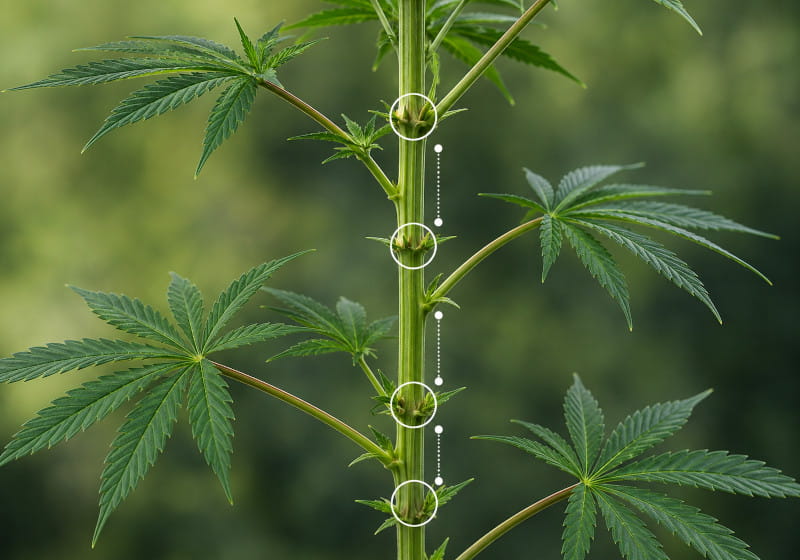
Nodes are the junction points along the shoot where leaves, axillary buds and side shoots, among other structures, attach.
The nodes are important attachment points for further branching of the plant. During vegetative growth, leaf bases and axillary buds are located there, from which new side shoots can emerge. As sexual maturity increases, preflowers or reproductive structures may also become visible in the leaf axils.
In young plants, leaves at early nodes are often arranged in opposite pairs. As development progresses, the leaf arrangement can change and become increasingly alternate. This transition is part of the natural morphological development of cannabis.
What are internodes in cannabis?
An internode is the section of the shoot between two consecutive nodes.
Short internodes cause nodes and side shoots to be closer together, while longer internodes contribute to a more elongated growth form. However, internode spacing is not an unchangeable trait of a genotype. Light, temperature and other environmental conditions also influence how strongly the individual shoot sections elongate.
Node and internode can therefore be distinguished easily: The node is the junction or attachment point, while the internode is the section of shoot between two of these nodes.
What types of leaves does cannabis have?
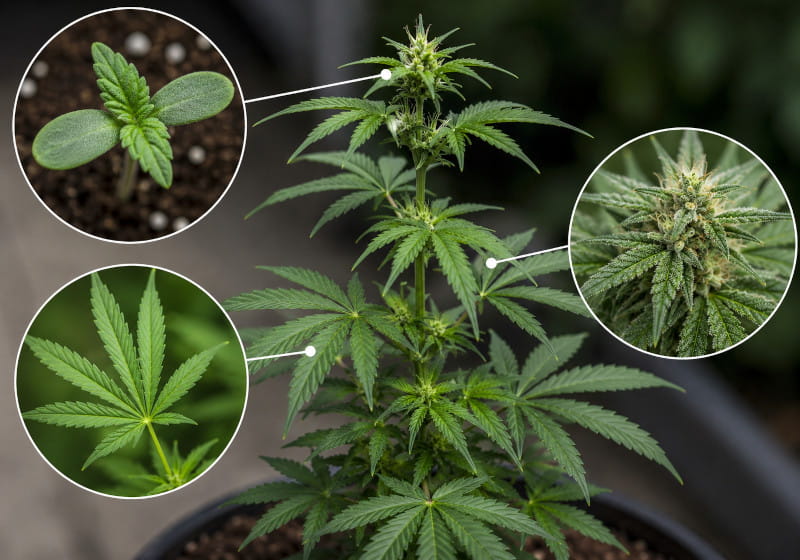
Cannabis develops different leaf forms over the course of its development – from the first cotyledons to the characteristic fan leaves and the smaller sugar leaves near the flowers.
Botanically, the familiar cannabis leaf does not consist of many individual “leaves”, but of several leaflets that together form a compound leaf. A palmate arrangement is typical, in which the individual leaflets radiate from a common area at the end of the petiole.
The number, length and width of the individual leaflets can change during development and differ between different genetics. Even on the same plant, leaf shape can vary considerably depending on position and developmental stage.
What are cotyledons?
Cotyledons are the first leaf-like organs to become visible above the substrate after germination.
They differ clearly from the typical cannabis leaves that develop later and do not yet have their characteristic serrated, multi-part form. Shortly afterwards, the young shoot produces the first true leaves, whose shape changes progressively during further development.
What are fan leaves in cannabis?
Fan leaves are the large, characteristic foliage leaves and are among the plant’s most important photosynthetically active organs.
They typically consist of several elongated, serrated leaflets. Their large surface area captures light, while stomata enable gas exchange and transpiration. The leaf veins supply the leaf with water and minerals and connect it to the vascular tissue of the shoot, through which assimilates produced during photosynthesis are also transported onward.
What are sugar leaves?
Sugar leaves are smaller leaves around female inflorescences that are often noticeably covered with glandular trichomes.
The name refers to the glittering appearance of the trichomes, which seem to be coated with crystals. Botanically, they are still leaves. They differ from large fan leaves mainly in their position, smaller size and often higher trichome density.
| Leaf type | Typical position | Characteristics |
|---|---|---|
| Cotyledon | on the young seedling | simple, not yet characteristically serrated and palmate |
| Fan leaf | on vegetative and reproductive shoots | large, palmately compound, important for photosynthesis |
| Sugar leaf | around female inflorescences | smaller and often densely covered with glandular trichomes |
Where do preflowers and sex characteristics develop?
The first visible reproductive structures typically develop at the nodes or in the leaf axils, where leaves and side shoots attach to the main or lateral shoot.
In these areas, male or female preflowers can develop as sexual maturity increases. Anatomical differences are already visible at this early stage: female structures develop carpels and stigmas, while male flower primordia form stamens and later pollen-producing anthers.
This article primarily covers the anatomical location and structure of these organs. If you want to determine the sex of a plant based on visible characteristics, you can find the practical distinction in our guide to identifying male and female cannabis plants.
How do male and female cannabis flowers differ?
Male and female cannabis flowers have different reproductive organs: male flowers produce pollen, while female flowers contain the ovules and structures that receive pollen.
| Characteristic | Female flower | Male flower |
|---|---|---|
| Main function | Reception of pollen and formation of a seed after successful fertilization | Production and release of pollen |
| Reproductive organs | Ovary with ovule as well as style and stigma structures | Stamens with anthers |
| Prominent visible structure | two elongated stigma branches protrude from the enclosing bract | hanging or stalked flowers with pollen-producing anthers |
| Glandular trichomes | especially dense on bracts and leaves close to the flowers | much less pronounced than on female inflorescences |
Cannabis is often dioecious, meaning male and female flowers develop on separate plants. However, plants can also occur that develop male and female reproductive structures simultaneously or successively. We discuss the practical classification of such cases separately in the article about the hermaphroditic cannabis plant.
How is a female cannabis flower structured?
An individual female cannabis flower contains an ovary with an ovule and forms two prominent stigma branches. It is enclosed by a resin-rich perigonal bract.
In a mature female inflorescence, many of these individual flowers are packed closely together. This creates the compact appearance commonly referred to as a “bud” or cannabis flower. Botanically, such a bud is therefore not one large individual flower, but a complex inflorescence made up of numerous individual flowers and the surrounding structures.
During flower development, numerous glandular trichomes form especially on the bracts close to the flowers. The two stigma branches protrude from the enclosing bract. Their surface bears fine papillae that play an important role in capturing and binding pollen.
What are bracts and what does calyx mean in cannabis?
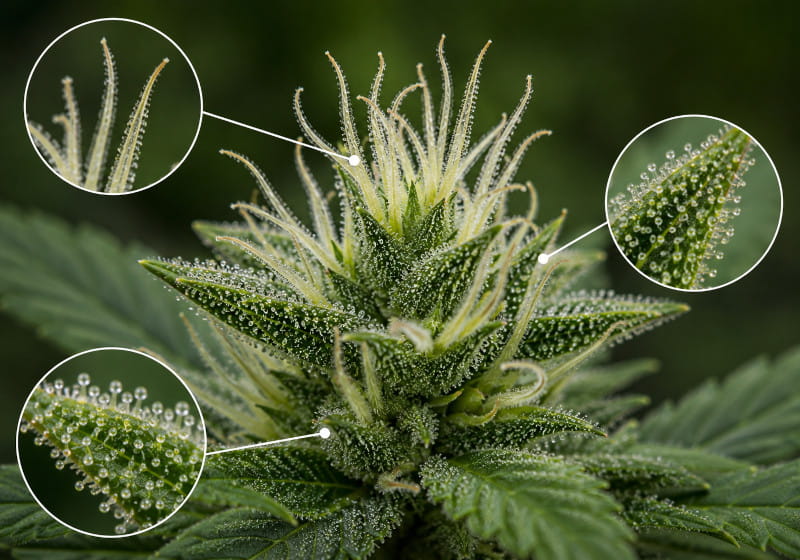
The small green structure, often heavily covered with trichomes, that tightly encloses an individual female flower is frequently referred to as the “calyx” in cannabis terminology. Botanically, however, it is usually a perigonal bract.
A bract is a specialized or modified leaf closely associated with a flower. In female cannabis, this flower-adjacent bract almost completely encloses the ovary and is often densely covered with glandular trichomes.
The botanical term Calyx actually refers to the calyx of a flower, meaning the collective sepals. In cannabis, the perianth is highly reduced. The visible resinous covering called the “calyx” in grower terminology therefore does not simply correspond to a classic floral calyx. Since the term is used very frequently in cannabis texts, it is still useful to know both terms.
Botanically more precise: When growers refer to the “calyx” of a female cannabis flower, they often mean the trichome-covered bract that encloses the actual individual flower.
What are the pistil, style and stigmas?
The visible structures of a female cannabis flower often described as “white hairs” are botanically the stigmas – not the entire pistil.
The pistil comprises the female reproductive structures of the flower. These include the ovary, style region and stigma. In cannabis, the two elongated stigma branches are especially visible and initially usually appear whitish to yellowish.
Numerous fine papillae are present on the surface of the stigmas. They increase the surface area and help capture and retain pollen grains. As they age, the stigmas can change color, curl and eventually dry out.
What are trichomes in cannabis?
Trichomes are fine outgrowths of the plant surface. Cannabis has both non-glandular and glandular trichomes.
Glandular trichomes are particularly important for the production of numerous cannabinoids and terpenes. They occur at high density especially on the bracts of female inflorescences. Depending on their structure, stalked capitate, sessile capitate and very small bulbous glandular trichomes are distinguished, among other types.
These glandular trichomes contain specialized secretory cells. Numerous secondary plant compounds are produced and stored in the gland head. The large number of these trichomes also creates the typical resinous and glittering appearance of female cannabis flowers.
How is a male cannabis flower structured?
Male cannabis flowers have stamens with anthers in which pollen grains are produced.
Unlike the usually dense female inflorescences, male inflorescences appear looser and more highly branched. Individual male flowers have five greenish to yellowish perianth segments and five stamens. As they mature, the flowers open and the anthers release their pollen.
If a pollen grain lands on the receptive stigma of a female flower, a pollen tube can grow from it. The male gametes travel through this tube to the ovule. After successful fertilization, a new seed can eventually develop from the ovule.
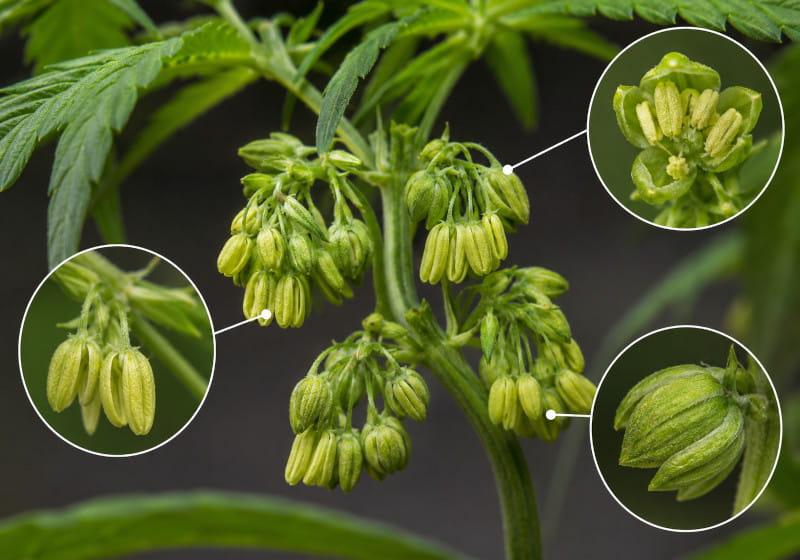
What are pollen sacs in cannabis?
The term “pollen sac” is commonly used in cannabis terminology for the initially rounded male flowers or their pollen-producing structures.
Botanically speaking, pollen is produced in the anthers of the stamens. Before opening, male flowers often look like small closed spheres from the outside. As development progresses, they open so that the individual flower organs and eventually the pollen-releasing anthers become visible.
Where are cannabinoids and terpenes produced?
A large proportion of the cannabinoids and terpenes characteristic of cannabis are produced in specialized glandular trichomes, which occur especially densely on female flowers and the bracts surrounding them.
The gland head contains specialized secretory cells that produce various secondary plant compounds. These substances accumulate beneath the outer cuticle of the trichome. This creates the characteristic spherical head that is clearly visible under high magnification in many mature glandular trichomes.
Cannabinoids and terpenes form an extensive topic of their own, which we cover in more detail in our Cannabis Knowledge section. For the anatomy of the plant, what matters most is where its most important production and storage structures are located: on certain plant surfaces and especially concentrated around female inflorescences.
How does the structure change during development?
The structure of cannabis does not remain the same throughout its life cycle: leaf shape, leaf arrangement, branching and reproductive organs change as development progresses.
After germination, the cotyledons appear first, followed by the first true leaves. At subsequent nodes, larger and more divided leaves as well as new side shoots develop. During the transition from the juvenile to the adult vegetative plant, the leaf arrangement can change, among other things.
As sexual maturity increases, the first preflowers may appear in the leaf axils. Once reproductive development begins, the plant architecture changes further: leaves may become smaller in the upper areas while male or female flowers and increasingly developed inflorescences form.
We cover the complete chronological sequence separately in the cannabis growth cycle. You can also find how female inflorescences in particular develop in our overview of the cannabis flowering stage week by week.
Does genetics influence the structure of cannabis?
Genetic differences influence numerous morphological traits such as plant height, branching, internode spacing, leaf width and flower structure.
However, the visible form is not determined exclusively by genetics. Light, temperature, water and nutrient supply, root space and other environmental conditions also influence the phenotype. Even genetically identical plants can therefore look visibly different under different conditions.
We explain in detail how genotype, phenotype and different generations are related in our guide to Cannabis genetics: F1, F2, BX, S1 and IBL.
Do Indica and Sativa differ in structure?
Cannabis genetics can differ considerably in leaf width, plant height, branching and internode length; however, the simple equation “broad leaf = Indica, narrow leaf = Sativa” is too simplistic for modern genetics.
Historically, certain cannabis groups were described differently based on their origin and morphological characteristics. Many modern strains, however, are complex hybrids. Individual visible traits therefore do not allow reliable determination of their entire genetic ancestry.
Nevertheless, typical morphological tendencies can be observed in different genetic types. The following overview shows some commonly described growth traits and well-known strains as examples. The actual plant form may differ depending on genetics, phenotype and growing conditions.
| Genetic type | Typical growth traits | Examples |
|---|---|---|
| Indica-dominant | often more compact growth, broader leaflets and comparatively short internodes | Purple Urkle, Granddaddy Purple |
| Sativa-dominant | often more elongated growth, narrower leaflets and longer internodes | Granny Candy, Princess Haze |
| Hybrid | combines different traits depending on ancestry; growth form can range from compact to strongly elongated | Toad Venom, Blueberry Pancakes |
| Autoflowering | same basic anatomical structure; growth form depends on the genetics crossed in, while the main difference lies in the regulation of flowering onset | Gorilla Cookies Auto, Do-Si-Dos-Auto |
The examples also show why external appearance alone does not allow reliable classification. Especially in modern hybrids and autoflowering strains, traits from different genetic lines can occur in combination.
We discuss the historical and present-day meaning of these terms in detail in our articles on Indica Cannabis and Sativa Cannabis.
Is an autoflower anatomically different?
Autoflowering cannabis basically has the same important plant organs as photoperiod cannabis: roots, shoot axis, nodes, leaves, and male or female flowers.
The key difference therefore does not lie in a completely different anatomical structure, but mainly in the regulation of development and flowering onset. Autoflowering genetics begin reproductive development more strongly as a function of age and are much less dependent on a shortening of the daily light period for flowering to begin.
We cover the practical characteristics in our dedicated guide to growing autoflowering cannabis.
Anatomy of the Cannabis Plant at a Glance
From the root system to the trichomes, every plant part performs its own function while also being functionally connected to other organs.
| Plant part | Position | Function | Special feature |
|---|---|---|---|
| Main and lateral roots | underground | Anchorage and absorption of water and minerals | strong branching increases the absorption surface area |
| Stem | central shoot axis | Stability and transport of substances | becomes stronger with age and may become partly woody |
| Node | junction on the shoot | attachment point for leaves, buds and side shoots | important location for preflowers and sex characteristics |
| Internode | between two nodes | shoot elongation | length is influenced by genetics and environment |
| Fan leaf | on vegetative and reproductive shoots | Photosynthesis, gas exchange and transpiration | typically palmately compound |
| Sugar leaf | around female inflorescences | Photosynthesis | often particularly densely covered with glandular trichomes |
| Perigonal bract | encloses the individual female flower | protection of the flower | often referred to as the “calyx” in cannabis terminology and bears many glandular trichomes |
| Stigma | protrudes from the female flower | reception and binding of pollen | usually two elongated stigma branches per individual flower |
| Anther | male flower | Production and release of pollen | part of the stamen |
| Glandular trichome | on various plant surfaces, especially densely on female flowers | production and storage of secondary plant compounds | different types such as stalked, sessile or bulbous |
Frequently Asked Questions About Cannabis Plant Anatomy
What parts does a cannabis plant consist of?
The most important plant parts include roots, the main stem, side shoots, nodes, internodes and leaves, as well as male or female flowers during the reproductive stage. In addition, trichomes are found on various plant surfaces and perform different functions depending on their type.
What are nodes in cannabis?
Nodes are the junctions on the shoot where leaves, axillary buds and side shoots, among other structures, attach. As maturity increases, preflowers or sex characteristics can also develop there.
What are internodes in cannabis?
Internodes are the sections of the shoot between two consecutive nodes. Their length influences how compact or elongated the plant architecture appears.
What is the difference between fan leaves and sugar leaves?
Fan leaves are large foliage leaves and important photosynthetic organs, while sugar leaves are smaller and are located within or directly on female inflorescences. Sugar leaves often carry considerably more glandular trichomes.
What are the white hairs on cannabis flowers?
The visible white or yellowish “hairs” of an individual female flower are stigma branches, or stigmas. They are part of the female reproductive organ and have papillose surfaces to which pollen can adhere.
What is a bract in cannabis?
A bract is a specialized leaf associated with a flower. In female cannabis, a perigonal bract heavily covered with glandular trichomes encloses the ovary of the individual flower.
What does calyx mean in cannabis?
In grower terminology, the resinous covering of an individual female flower is often called the calyx, although botanically a perigonal bract is usually meant. The actual botanical term calyx refers to the floral calyx, or the collective sepals.
Where are most trichomes located?
A particularly high density of glandular trichomes is found on the bracts and flower-adjacent leaves of female cannabis inflorescences. However, trichomes also occur on other plant surfaces.
Where are cannabinoids and terpenes produced?
Large amounts of these secondary plant compounds are produced and stored in glandular trichomes. These specialized structures are especially dense around female flowers and their bracts.
Is an autoflower anatomically different?
No, the basic anatomical structure is comparable. Autoflowering plants also have roots, a stem, nodes, leaves and flowers. The main difference concerns the regulation of development and flowering onset.
Why is it helpful to understand the structure of cannabis?
Anyone who understands the anatomy of the cannabis plant can interpret botanical terms, visible developmental stages and differences between individual plant parts much more accurately.
Nodes are not the same as internodes, sugar leaves differ from large fan leaves, and the visible “hairs” of a female flower are stigmas rather than the entire pistil. The term “calyx”, which is widespread in cannabis terminology, is also often used for a structure more accurately described botanically as a perigonal bract.
At the same time, plant anatomy shows how closely the individual organs are connected: the root system supplies the shoot, the stem connects the different organs, leaves provide products of photosynthesis, and the flowers enable sexual reproduction. We explain in more detail how these structures change during development in the growth stages of cannabis and in the cannabis growth cycle.
Scientific and Professional Sources
- Morphological Characterization of Cannabis sativa L. Throughout Its Complete Life Cycle
- Architecture and Florogenesis in Female Cannabis sativa Plants
- Cannabis sativa: origin and history, glandular trichome development, and cannabinoid biosynthesis
- Assessment of pharmacognostic specification of Cannabis sativa leaves
- Cannabis sativa: The Plant of the Thousand and One Molecules – anatomical details of the stem
- Hermaphroditism in Marijuana Inflorescences – Floral Morphology and Seed Formation