VPD for Cannabis: Calculator & Optimal Values
VPD for Cannabis: Calculator, Values & Explanation
Updated: August 2026 | What does VPD mean for cannabis? Find out how temperature, humidity and leaf temperature are connected, which VPD values can be used as a guide, and calculate your VPD directly with our calculator.
Author: Cannapot Grow Team | Reading time: approximately six minutes
VPD Calculator for Cannabis
Enter air temperature, humidity and leaf temperature to calculate leaf VPD automatically.
The Most Important Points at a Glance
✓ VPD stands for Vapor Pressure Deficit and describes the difference between the potential and the actual water vapor pressure.
✓ Temperature and relative humidity need to be considered together. The same humidity can result in a significantly different VPD at different temperatures.
✓ For a more accurate calculation for cannabis, the temperature of the leaf surface is relevant in addition to the air temperature.
✓ Very low or very high VPD values can affect transpiration. However, VPD is only one part of the overall plant climate.
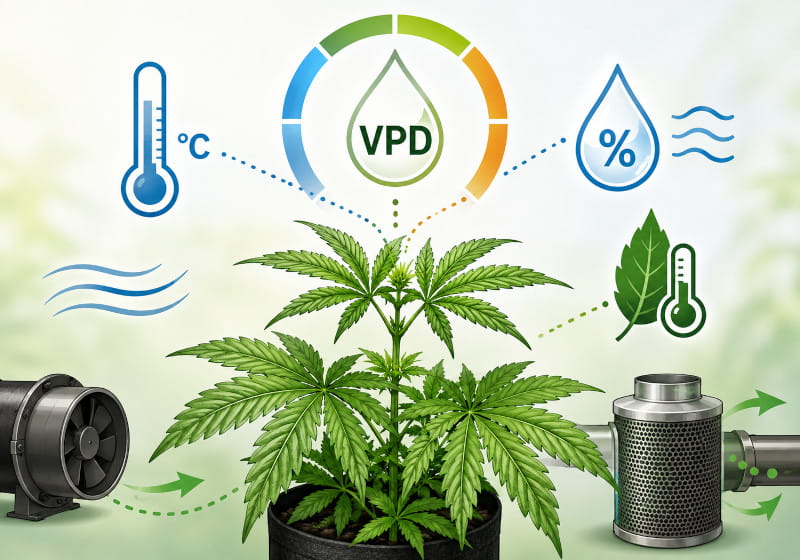
Anyone who looks only at relative humidity when growing cannabis indoors overlooks an important relationship: how much water the air can hold depends largely on its temperature. VPD for cannabis therefore combines temperature and humidity into a more meaningful value for assessing the plant climate.
Especially in a grow box temperature and humidity can change quickly due to lighting, exhaust ventilation, watering and plant transpiration. A VPD calculator helps assess both measurements together instead of looking at humidity in isolation.
What Is VPD for Cannabis?
VPD stands for Vapor Pressure Deficit and, in simple terms, describes the difference between the water vapor pressure of a saturated surface and the actual water vapor pressure of the surrounding air.
The value is usually expressed in kilopascals (kPa). The higher the temperature, the greater the amount of water vapor the air can potentially hold. For this reason, a relative humidity of 60 % at 20 °C, for example, can create a different evaporation potential than the same 60 % at 28 °C.
This difference matters for plants because a vapor pressure gradient exists between the moist leaf surface or leaf interior and the surrounding air. This gradient is one of the driving forces of transpiration.
Why Is VPD Important When Growing Cannabis?
VPD affects the atmospheric evaporative demand under which a cannabis plant releases water through its leaves.
Through their stomata, plants exchange carbon dioxide and water vapor with their surroundings. As VPD rises, the physical driving force for transpiration initially increases as well. In very dry air, however, plants may partially close their stomata to limit excessive water loss.
A very low VPD, by contrast, means that there is only a small vapor pressure difference between the leaf and the surrounding air. This can limit transpiration. At the same time, a very low VPD often occurs together with high relative humidity, which should be taken into account especially in dense plant canopies.
VPD is therefore a useful climate parameter, but it is not the only measure of healthy growth. Light intensity, air movement, root-zone temperature, water supply, substrate, nutrient supply and genetics also affect the plant.
Why Is Leaf Temperature Important for VPD?
For the most realistic leaf VPD possible, the temperature of the leaf surface should be taken into account because it can differ from the measured room temperature.
Leaves can be cooler than the surrounding air due to transpiration. Lighting and radiant heat, on the other hand, can additionally warm the leaf surface. A blanket assumption of, for example, a one- or two-degree temperature difference therefore does not work under all conditions.
Leaf temperature can be checked with a suitable infrared thermometer. It is useful to take several measurements on different leaves at canopy height. The average usually provides a better basis than a single measurement.
Which VPD Values Can Be Used as a Guide for Cannabis?
Different VPD ranges are used as practical guidelines for cannabis depending on the stage of development, but there is no universal scientifically established ideal value for every strain and every growing situation.
| Plant stage | VPD guideline | Assessment |
|---|---|---|
| Seedlings / cuttings | approx. 0.4–0.8 kPa | Lower evaporative demand |
| Vegetative stage | approx. 0.8–1.2 kPa | Moderate range for established plants |
| Flowering stage | approx. 1.2–1.5 kPa | Higher evaporative demand with usually lower humidity |
These ranges are not fixed biological limits. Different genetics, light intensities, irrigation strategies and measurement methods can lead to different conditions. It is therefore especially important to assess VPD values together with the actual condition of the plants.
How Is VPD Calculated?
Air temperature and relative humidity are required for the calculation; for a more accurate leaf VPD, leaf temperature is also included.
First, the saturation vapor pressure is determined from the respective temperature. The actual water vapor pressure of the room air can then be calculated from air temperature and relative humidity. For leaf VPD, this value is subtracted from the saturation vapor pressure at the leaf surface.
You do not need to calculate the formula yourself. With our VPD Calculator for Cannabis at the top of this page, you can calculate and assess your measured values directly.
What Happens When VPD Is Too Low or Too High?
Both persistently very low and very high VPD can negatively affect the interaction between the plant, its water balance and the surrounding environment.
At very low VPD, the air is often warm and very humid or cool and humid. The vapor pressure difference between the leaf and the surrounding air is small, which also reduces the driving force for transpiration. Especially in dense plant canopies, care should be taken to prevent persistently damp and poorly ventilated areas from developing, as such conditions can promote mold on cannabis.
At very high VPD, by contrast, the surrounding air has a high evaporative demand. If water uptake through the roots cannot keep pace with water loss, plants may regulate their stomata more strongly and limit transpiration.
Rather than trying to force a single VPD value as precisely as possible, a stable climate within a sensible range is usually more helpful. Sudden changes in temperature or humidity can significantly alter VPD within a short period of time.
How Do You Measure VPD Correctly in a Grow Box?
Temperature and humidity should ideally be measured at canopy height, while leaf temperature is checked directly on several representative leaves.
A sensor placed directly under a powerful light, immediately in front of a humidifier or directly in a fan's airflow can display values that poorly represent the actual climate within the plant canopy. The plants themselves should also not be exposed to a continuously strong airflow, as this can promote wind burn in cannabis. In larger grow boxes, using several sensors may be useful.
Measurement accuracy should not be overestimated either. In practice, a calculated VPD of 1.16 kPa is not automatically better than 1.20 kPa. What matters are reliable measuring devices, a sensible measurement location and a climate that is as stable as possible.
Anyone who considers temperature, relative humidity and leaf temperature together can use VPD meaningfully to assess the climate in a grow box. What matters less is a supposedly perfect single value than a stable plant climate suited to the respective development stage and the actual condition of the plants.
Frequently Asked Questions About VPD for Cannabis
What Is a Good VPD for Cannabis?
A single optimal VPD value does not apply to every cannabis plant and every growing situation. As a practical guide, approximately 0.4–0.8 kPa is often used for seedlings and cuttings, 0.8–1.2 kPa for the vegetative stage and 1.2–1.5 kPa for the flowering stage. These ranges should not be understood as fixed biological limits.
Can VPD Be Calculated Using Only Temperature and Humidity?
Yes, an air VPD can be calculated from these values. For a more accurate leaf VPD, leaf temperature is also taken into account because the leaf surface can be warmer or cooler than the surrounding air.
What Does a VPD That Is Too High Mean for Cannabis?
A high VPD means that the surrounding air has a high evaporative demand. If the plant's water supply cannot keep up, it may regulate its stomata more strongly and thereby limit water loss.
What Does a VPD That Is Too Low Mean for Cannabis?
A low VPD means a small vapor pressure difference between the leaf and the surrounding air. Transpiration may therefore be lower. Very low values often occur together with high relative humidity, which is why air movement and moisture within the plant canopy should also be considered.